


There’s one thing I’ve learned from trying robotic lawn mowers over the past few months: on paper they all seem similar, but in the real world everything changes. Because one thing is to have a robot working on an English-style lawn, perfectly level, with clean edges, few obstacles and simple geometry. Another thing, though, is putting it in a real garden, the lived-in kind, with higher areas, uneven ground, roots, slopes, pots, chairs, trees, narrow passages and perhaps a lawn that isn’t exactly the catalog one.
And it’s precisely in this context that I wanted to try the MOVA LiDAX Ultra 1000, a lawn mower robot that should not be confused with other models of the brand, nor with the MOVA ViAX 250 that I tried some time ago. Because with this LiDAX Ultra 1000 we are looking at a more ambitious product, designed for gardens up to 1000 square meters and especially designed to eliminate two of the biggest annoyances of traditional robotic lawn mowers: the boundary wire and the RTK antenna.
With the MOVA LiDAX Ultra 1000, in fact, there is no need to dig up the garden, lay cables along the entire perimeter, or find the perfect spot to install an RTK antenna. Its navigation system is based on 360° 3D LiDAR and AI Vision, a combination that allows it to read the environment, build a map of the garden, and orient itself by using the real references around it: walls, trees, fences, flower beds, edges, passages and obstacles.
Said like that, it seems like a very technical thing, but the concept is quite simple. Tethered robots know where they must not go because there is a physical cable delimiting the area. RTK robots, instead, use satellite positioning, but they require favorable conditions and a well-positioned base/antenna. The LiDAX Ultra 1000 tries to solve the problem in another way: it observes the garden, interprets it, and moves inside a virtual map. And this is precisely the feature that makes it interesting, especially for those who have a garden that isn’t perfect or don’t want to deal with an invasive installation.
Review MOVA LiDAX Ultra 1000: LiDAR and AI at the service of the lawn
Design, materiali e installazione
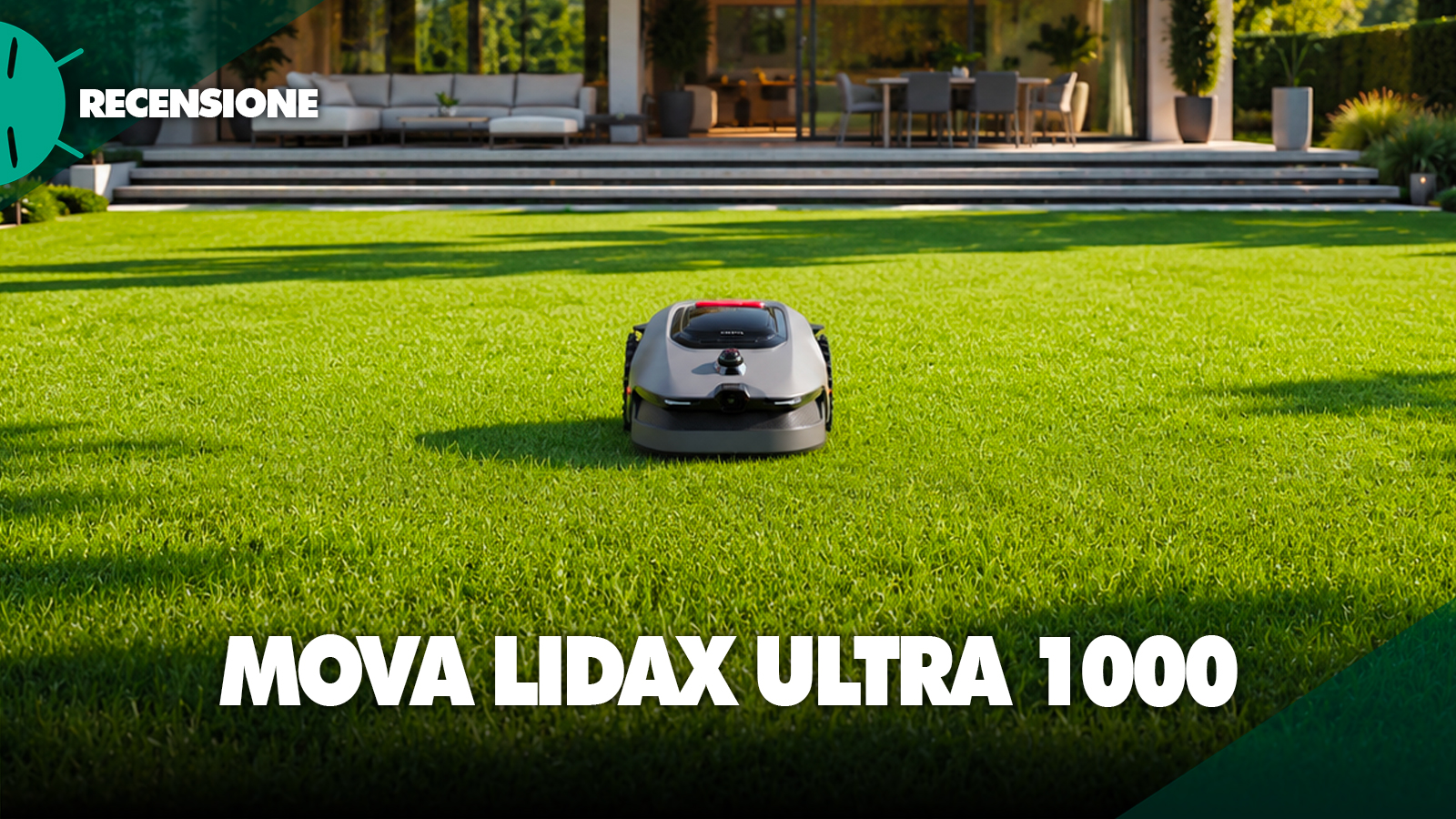
From an aesthetic point of view, the MOVA LiDAX Ultra 1000 doesn’t deviate much from the brand’s other robotic lawn mowers. It isn’t tiny, but it’s not overly large either, and the design is closer to that of a smart device than to that of a traditional garden tool. On the top part there is the LiDAR module, clearly visible, together with the emergency button and the main controls. At the front there is the vision system, which works together with the LiDAR to recognize obstacles and improve navigation.


The charging base is fairly easy to position, but here we must make a clarification right away: the fact that a boundary wire isn’t required doesn’t mean the robot can be placed anywhere. The station still must be installed in a stable, fairly flat and easy-to-reach location. In my case, with an irregular garden full of obstacles, I had to think a bit about the placement, because the robot must be able to exit, orient itself, and reach the work area without facing immediately a passage that’s too narrow or a zone that’s too chaotic, and above all it needs to be placed near a power outlet.

However, the installation remains immensely simpler than a corded robot. You position the base, connect the power supply, pair the robot with the MOVAhome app, and move on to the mapping phase. And it’s here that, in my opinion, you need to take things slowly, especially if your garden isn’t regular.
Automatic mapping works, and it is one of the most convenient features of this product, but in a complicated garden I still recommend carefully checking the result and, where necessary, intervening manually. If the lawn is well defined, with clear borders and few ambiguous elements, the robot is able to interpret it with good precision. If, however, there are irregular flower beds, stones, mixed soil/grass areas, low borders or passages that are not very clear, it is better to guide it in creating the map or correct the zones afterwards from the app. It is a step that takes a few extra minutes, but it makes the difference between a good experience and a frustrating one.
Come funziona LiDAR 3D e Visione IA
The most interesting part of the MOVA LiDAX Ultra 1000 is undoubtedly the navigation system. The 360° 3D LiDAR creates a kind of scan of the surrounding environment and allows the robot to understand where it is relative to the fixed elements of the garden. AI Vision, on the other hand, helps to better distinguish obstacles and interpret what the LiDAR alone might not recognize perfectly.

In everyday use, this combination translates into a behavior very different from old ‘bounce’ lawn mower robots, those that moved randomly, changing direction every time they encountered an obstacle. In this case, however, mowing is orderly, methodical, with U-shaped paths and parallel lines. The robot knows where it has already passed, knows where it needs to go, and if the battery runs low, it returns to base to recharge and then resumes from the point where it left off.
And it’s a logic that matters a lot, because it changes the way a lawn-mowing robot is interpreted. You shouldn’t imagine it as a traditional lawn mower that has to fix the whole garden in an hour. Its job is different: it cuts little, often, and in a steady way. The best result comes from consistency, not from aggressive cutting once every two weeks.

In my garden, which isn’t an English-style lawn and has an uneven surface, this setting has been essential. The LiDAX Ultra 1000 doesn’t shy away from a more real and less ‘showroom’ context, but it doesn’t work miracles. If the grass is too tall, if there are significant holes, fallen branches, or very low objects hidden in the lawn, it needs a helping hand. The first cut, especially after a period of significant growth, is best done with a traditional lawn mower or by setting a more conservative height. Then, once the lawn is stabilized, the robot can maintain it much more effectively.
Taglio, altezza regolabile e UltraTrim
The MOVA LiDAX Ultra 1000 uses a 20 cm cutting width with rotating blades and an electronically adjustable height from 3 to 10 cm via the app. This is one of the features I appreciated most, because in an uneven garden it doesn’t always make sense to mow low. In fact, it’s often better to keep the grass a little taller, both to protect the lawn on hot days and to prevent the robot from hitting the ground too often in the most irregular spots.
The app-based adjustment is incredibly convenient: you don’t have to lift the robot, you don’t have to turn knobs, and you don’t have to intervene manually on the cutting plate. You set the height, confirm it, and the robot adapts. In my case, on imperfect terrain, I would always start from a higher height, around 6 or 7 cm, and then only descend in the more even areas. And it’s precisely here that zone management becomes useful, because it allows you to adapt the robot’s behavior based on the different parts of the garden.
The quality of the cut is good, especially if the lawn is regularly maintained. It doesn’t pull the grass, it works cleanly and leaves a neat result. Obviously you should not expect it to turn a rustic lawn into a golf course, because that’s not its job. Its objective is to keep the grass under control, drastically reduce manual maintenance, and do so with a constant, ongoing intervention.
Very interesting as well is UltraTrim 1.0, i.e., the system designed to improve edge trimming. Edges have always been the weak point of robotic lawn mowers, because the cutting disc is generally positioned away from the margins of the machine’s body and therefore there remains always a strip of grass to finish off with the string trimmer. With UltraTrim, MOVA tries to reduce this problem by bringing the cut closer to the edge, down to a distance of less than 5 cm.

In practice, the difference is visible. On traversable edges—where the robot can slightly overlap a pavement or a flat area adjacent to the lawn—the result is very good. Along walls, tall curbs or vertical obstacles, there remains a small margin anyway, and it’s normal: no robot should rub against a wall just to cut two blades of grass. However, compared to many traditional robots, the amount of residual work with the string trimmer is reduced quite a bit.
Applicazione
The MOVAhome app is a central part of the experience. It’s from here that you manage basically everything: mapping, cutting height, zones, programs, edges, obstacles, paths, cutting modes, and maintenance. The interface is fairly clear, but the features are many, and in my opinion you need a little patience in the first days to understand well how to set it up.

It is possible to start a full mowing, select only certain zones, have the robot work along the edges, create no-go zones, set connecting corridors, and manage multiple maps. Multizone management is one of the most useful features, especially in a garden like mine, where there isn’t a single rectangular area but many small sections connected to each other. In my case, being able to divide the garden into different zones is essential, because there are areas that are simpler and others more complicated, with obstacles and less even terrain.
No-go zones are just as important. They are used to exclude flower beds, pots, freshly sown areas, small gravelly spaces, areas that are too uneven, or spots where the robot could get stuck. The advice is not to wait for the robot to make a mistake: it’s better to prevent problems and create a well-considered map right away. The more precise the map, the less manual intervention will be needed afterward.

Ostacoli, passaggi stretti e giardini difficili
MOVA reports recognition of over 300 types of obstacles thanks to the combination of LiDAR and AI Vision. In real-world use, the system works well with visible obstacles: chairs, vases, trees, people, animals, garden furniture, large toys, and clearly defined objects are detected and avoided. The robot slows down, changes its trajectory, and resumes work.

But you shouldn’t assume it’s infallible. Small, low-lying, thin, or partially hidden objects in the grass can still pose a problem. A thin tube, a twig, a small toy, or a very low object may not always be detected with the same precision. This is a common limitation of this category of products, even in the most advanced models. Before starting the cut, especially in a well-used garden, it’s always wise to take a quick look at the area.
Regarding tight passages, the LiDAX Ultra 1000 can handle corridors of about 60 cm, but here too you need to think practically. Crossing a tight passage is one thing; maneuvering inside a tight passage is another. If you have a corridor running between two flower beds or between a wall and a hedge, it is essential to map the route well and give the robot the space it needs to enter and exit without getting bogged down in constant corrections.

On uneven terrain, its performance is convincing, especially considering that we are not talking about the AWD version. The rear-wheel-drive system and off-road tires allow it to handle slopes of up to 45% and overcome small obstacles or elevation changes of up to about 4 cm. In my garden, where the ground is uneven, this feature is important. The robot is able to operate, but you have to be realistic: if the ground is very rough, wet, with deep potholes or dry elevation changes, it can slip or require some adjustments. For extremely challenging gardens, significant slopes, or very technical terrain, it makes more sense to look at an AWD model. For a residential garden that is complex but not extreme, however, the LiDAX Ultra 1000 handles it well.
Autonomia, rumore e manutenzione
The MOVA LiDAX Ultra 1000 is designed for gardens up to 1,000 square meters, but that doesn’t mean it cuts the entire area in a single session without ever stopping. Like all the most advanced robotic lawn mowers, it works, returns to base when necessary, recharges and resumes from the point where it left off. And it is a fundamental feature because it enables managing even larger surfaces without having to intervene manually.

It’s not the fastest robot in the world, but it’s methodical. And I prefer a robot that’s more precise and cautious to one that’s fast but sloppy. The point is to plan sessions well: if the garden is large, full of obstacles, and divided into multiple zones, you need to give it time. It’s not a product to be used once in a while, but a system of continuous maintenance.
The noise level is very low. You can hear the wheels turning and the grass being cut, but it’s far from the noise of a traditional lawn mower. This allows it to operate without disturbing too much, even in residential settings. Maintenance, however, is the classic kind: periodic cleaning of the underside, blade checks, replacement when they no longer cut well, cleaning of the sensors, and attention to the charging base. It is weather-resistant, but that doesn’t mean it should be treated as an indestructible object. Every now and then it should be checked, especially if it works in a garden with soil, leaves, humidity and plant debris.
Prezzo di vendita e considerazioni
The MOVA LiDAX Ultra 1000 arrives at a very interesting moment for the robotic mower market, because at 899 euros on Prime Day sale it becomes decidedly more competitive compared to many models without boundary wire. The price remains important, to be clear, but it should be evaluated in relation to what it offers: no cable installation, no RTK antenna, LiDAR 3D mapping and AI Vision, a neat U-shaped cut, zone management, height adjustable via the app, edges improved with UltraTrim and a very complete app.

However, there are limits. It’s not a weed eater, it’s not designed to recover an abandoned lawn and it’s not magical when it comes to small objects hidden in the grass. In a very irregular garden, like mine, you need to spend time mapping and creating restricted zones. Also, since it’s not the AWD version, on truly difficult or very steep terrains it may show some traction limits. And there’s another aspect to consider: the more complex the garden, the more time the robot takes. But I don’t see this as an absolute fault, because the purpose of a product like this is to work often and autonomously, not to replace a quick manual mowing done from time to time.

It’s not the robot that magically turns a difficult lawn into a golf course. But it’s one of those products that, if you get it right and configure it properly, can change your habits. And in the world of lawn mowing robots, this is probably the most important thing.
Se non visualizzi correttamente il box qui sotto, prova a disattivare AdBlock.
I link di acquisto presenti in questo articolo generano una piccola commissione per GizChina.it. Scopri tutti i dettagli qui.
FAQ MOVA LiDAX Ultra 1000
MOVA LiDAX Ultra 1000 ha bisogno del filo perimetrale?
No, MOVA LiDAX Ultra 1000 does not need the perimeter wire. The robot uses a navigation system based on 360° 3D LiDAR and AI Vision to map the garden, recognize boundaries, and move in an orderly manner without having to install cables in the ground. It is one of its main advantages, especially for those who want to avoid invasive installation work.
MOVA LiDAX Ultra 1000 funziona anche senza antenna RTK?
Yes, MOVA LiDAX Ultra 1000 works without an RTK antenna. Unlike other wire-free robotic lawn mowers, it does not rely primarily on satellite positioning, but on LiDAR and artificial intelligence. This makes it easier to install and more suitable even for gardens with trees, walls, shaded areas, or spots where the GPS signal might not always be perfect.
For how many square meters is MOVA LiDAX Ultra 1000 recommended?
MOVA LiDAX Ultra 1000 is designed for gardens up to 1,000 square meters. Naturally, performance depends greatly on the complexity of the lawn: a regular and flat garden will be easier to manage, while in the presence of obstacles, narrow passages, uneven ground and multiple separate zones, more attention to mapping and programming via the app will be required.
MOVA LiDAX Ultra 1000 riconosce gli ostacoli?
Yes, MOVA LiDAX Ultra 1000 recognizes many obstacles thanks to the combination of 3D LiDAR and AI Vision. It is able to identify elements such as trees, pots, chairs, people, animals, and objects present on the lawn, changing its path to avoid them. Like all robotic lawn mowers, however, it can have more difficulty with very small, low-lying, or hidden objects in tall grass.
MOVA LiDAX Ultra 1000 conviene a 899 euro?
At 899 euros during the Prime Day sale, MOVA LiDAX Ultra 1000 becomes very interesting for those looking for a boundary-wire-free lawn mowing robot, without an RTK antenna and with advanced navigation via LiDAR and AI. It is not the cheapest model by any means, but the price is justified by the ease of installation, smart lawn management, app-based mapping, and the ability to work even in gardens more complex than traditional robots.