


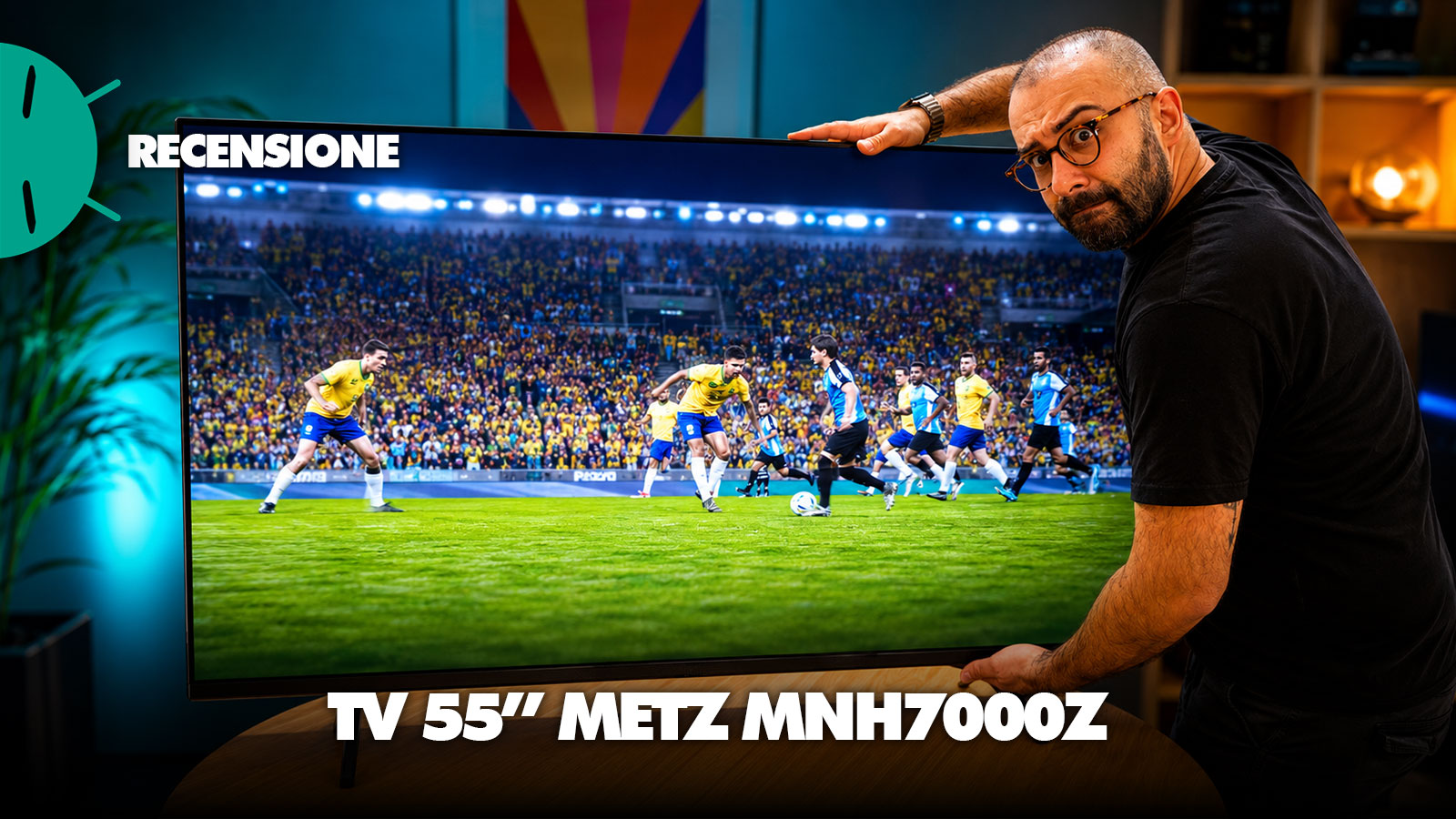
Over the past few years the Smart TV market has become increasingly difficult to describe, because now almost all manufacturers speak of 4K, HDR, artificial intelligence, smart platforms and slim bezels. The point, however, is that not all technologies really make a difference in daily use; the new METZ MNH7000Z 55-inch appears precisely with the aim of working on one of the most concrete aspects of the experience in front of a TV, namely image quality in real-life conditions, therefore not only in the dark, not only with perfect content, not only in a controlled room.
METZ, a brand that in recent years has sought to carve out an increasingly interesting space in the Smart TV segment, bets with this model on a fairly ambitious technical combination: a QD-MiniLED panel, the Google TV operating system and, above all, a display with Matte Screen Ultra technology, designed to reduce reflections and glare. And this is precisely the heart of the product, because the MNH7000Z does not want to be simply “just another Mini LED”, but a TV designed for those who watch content in the living room, in the bedroom, perhaps during the day, perhaps with a window facing you, without having to close curtains every time to see clearly.
The 55-inch model is therefore a proposal that tries to merge two worlds: on one side the image quality, with high contrast, local dimming, Dolby Vision, HDR10+ and smart management of video parameters; on the other side practicality, with Google TV, a very complete app ecosystem and smart features now indispensable for daily use. In short, on paper the METZ MNH7000Z seems a TV designed not only for those who seek the “nice panel”, but for those who want a modern, immediate product suitable for truly everyday use.
As always, however, the technical specifications tell only part of the story, because a TV can have many interesting acronyms, but then it must convince when switched on: in handling reflections, in the depth of blacks, in the naturalness of colors, in the fluidity of images and also in the simplicity of the interface. And it is precisely from here that we must start to determine whether this METZ MNH7000Z is merely a well-equipped Smart TV Mini LED, or a product capable of truly standing out in an increasingly crowded market.
METZ MNH7000Z Review
Design and Materials
Aesthetically, the METZ MNH7000Z 55-inch follows a fairly clear direction, aiming to keep a low profile and not draw too much attention with quirky or overly aggressive solutions; instead, it leans toward a clean, modern look that easily fits into a contemporary living room. It’s a sensible choice, because a TV of this size inevitably becomes an important element of the space, but it doesn’t have to “dominate” the room even when it’s off.

The bezel is reduced, the front is minimal and the overall design leaves room mainly for the panel, which is then the real protagonist of this model. The dark finish helps to maintain a certain elegance and to make the product feel more understated compared to many TVs that try to seem premium only with some more conspicuous aesthetic detail. Here the approach is different: simple lines, solid build and a cinematic presence that works especially when the television is on.
However, the most interesting element is not so much the design per se, where there is little room to differentiate, but the treatment of the display that adopts the Matte Screen Ultra technology, i.e. a matte screen designed to reduce reflections and glare and to improve viewing even in bright environments. It’s a feature far more important than it may seem, because in real life you don’t always watch TV in a perfectly dark, controlled room with lights off and the ideal seating position, as if you were in a mall: there is often a side window, a lamp on, an open-plan kitchen behind or simply someone sitting not exactly in the center of the sofa.


And it is precisely in these scenarios that the matte screen can make the difference: METZ also states a viewing angle close to 180 degrees, a feature designed to maintain good readability of the image even when not perfectly facing the panel. Naturally, it remains a 55-inch TV, so it requires the right space and a proper viewing distance, but the format is probably the most balanced choice for many living rooms: large enough to deliver satisfaction with movies, TV series and matches, but not so demanding as to feel excessive in medium-sized homes.
Technical specifications and audio/video quality
The most interesting part of the METZ MNH7000Z is undoubtedly the visual one, because this is where the TV manages to convey the leap over a more traditional model. In my case I installed it in the bedroom (coincidence, also METZ bought 6-7 years ago), and the difference is noticeable not so much for the classic “more luminous image” effect, but for a cleaner and more relaxed viewing experience. The merit lies mainly in the combination of the QD-MiniLED panel and the Matte Screen Ultra technology, which probably represents the most concrete element of this model: the matte screen reduces reflections and glare, so even with a window or a light in the room the image remains more readable and less disturbed. It is a feature that on paper may seem less dramatic, but in everyday use it really changes the relationship with the TV, because it does not force you to always create the perfect condition to see well.

The panel then works in two precise directions: light control and color reproduction. The Mini LED technology, with local dimming, allows better contrast management than a traditional LED backlight: dark scenes appear deeper, bright areas have more impact and the image, especially with HDR content, gains a greater sense of depth. It’s not just about high brightness; it’s about balance: the TV tries to preserve details in the dark areas without blowing out the illuminated parts, and this is noticeable especially in films, in darker-graded series and in high-quality sports events.
The QLED+ component enhances color richness; here Metz’s new TV relies on Quantum Dots designed to keep color brightness over time and on materials with greater environmental sensitivity, but in real-life experience what matters is the sense of color being fuller and more vivid, without necessarily venturing into an hyper-saturated postcard effect. With well-produced content, the image appears more pleasant, denser, more modern, but still believable. To bring coherence to all of this there is also the S AI Processor, which automatically optimizes brightness, contrast and sharpness: it isn’t a feature you notice as a menu item, but you perceive it when moving from a very bright scene to a darker one, or when imperfect content is displayed more pleasantly.

Good support for the most advanced video formats too, with Dolby Vision and HDR10+, which help the TV manage compatible HDR content better. In practice, bright scenes stay cleaner, dark scenes retain more information and the image avoids the grayish effect that often plagues less refined panels. For sports and fast scenes MEMC (Motion Estimation and Motion Compensation) comes into play to make movements smoother; during a match, for example, ball, field and camera movements are all elements that can challenge a TV, and here the aim is to keep a steadier, less choppy view. As always, interpolation should be adjusted to personal taste, because not everyone likes overly smooth motion, but it’s a coherent feature for a TV intended for football, action films and family entertainment.
To illustrate this aspect even better in a real scenario, imagine a night-time soccer match, with the stadium illuminated by floodlights and the dark sky in the background: here backlight control is noticeable because the headlights stay intense and well defined,
without annoying blooming or halos invading the black areas of the image. At the same time, the darker stands do not become a uniform mass, but keep readable details in the crowd and bleachers; and when the director tightens on the coach’s face on the sideline, expressions, tension and emotions come through clearly and crisply, making the scene more engaging and credible.

A detail I appreciated more than expected are the Eye Care technologies, with Low Blue Light and Flicker Free. They aren’t headline features, but in the bedroom they have a very concrete meaning: evening viewing is less tiring, especially when you watch TV for longer periods or before sleep. It’s one of those aspects that don’t sell a TV by themselves, but contribute to making it more enjoyable in real use and that you subconsciously appreciate only after having purchased and installed it. Also the Wi‑Fi dual band connectivity plays its part, because today much of the experience relies on streaming: you can have a good panel, but if Netflix, Prime Video, YouTube or Disney+ don’t run stably, the experience is still spoiled.
On the audio side, the METZ MNH7000Z integrates Dolby Atmos and Total Sonic, and here too the approach is fairly realistic: it does not replace a dedicated soundbar or a true home cinema system, but it offers a more spacious and organized listening experience than the typical slim TV with flat-sounding audio. Dialogues remain fairly clear, effects have a better presence and, for movies, TV series, sports and everyday use, the result is more than adequate. Those seeking deep bass and maximum immersion will still need to pair with an external system, but for everyday use the audio-video package of this model is certainly well balanced.
Operating System: Google TV
On the smart front, the METZ MNH7000Z relies on Google TV, and it’s a choice that today makes a lot of sense especially for those who want a TV that is immediate, complete and without too many complications. The interface is the familiar one of the Google ecosystem: tidy, rich with suggested content and mainly built around the platforms we actually use every day, from YouTube to Netflix, via Prime Video, Disney+ and all the major streaming apps.
The advantage of Google TV isn’t just having many apps available, but having a system that tries to bring order to the content. You no longer have to think in terms of each app separately, but by films, series, videos and recommendations gathered on a single screen. It’s a convenient approach especially for those who use multiple services at once, because it reduces that classic “ah, Netflix, then Prime Video, then Disney+, and I don’t know what to watch” effect.

In my personal view today, a platform like Google TV, which, incidentally, offers access to over 11,000 apps, more than 700,000 contents and integrates into the Google ecosystem with over 1 billion IoT devices compatible, is effectively the best solution for a TV of any price range, with no real rival; for me the flexibility it offers is exceptional and not comparable with the various competing OS.
Price and Considerations
Coming to conclusions, the METZ MNH7000Z 55-inch (also available in the 65-inch option) becomes particularly interesting, mainly in light of its selling price: 449 euros. And this is an important point, because it changes quite a bit the perspective with which this product should be judged. We are not looking at an “economical” TV in the classic sense, the kind that bets everything on the price and then makes evident compromises on the panel, the smart platform or the build quality; here METZ instead tries to bring to a very accessible tier some features that we usually associate with more ambitious models.
The strong point remains, without a doubt, the QD-MiniLED panel with Matte Screen Ultra technology. At this price, having a TV that is not only bright but also actively works on managing reflections is a non-trivial advantage, and this is precisely where the MNH7000Z manages to have a clearer identity than many competing models that may look similar on paper but suffer more in daily use. I also appreciated that METZ did not neglect the rest of the experience. There is Google TV, a complete, easy-to-use platform rich with applications; there is Dolby Vision and HDR10 for HDR content management; there is MEMC for smoother motion; there is Dolby Atmos and Total Sonic for a more ordered and spacious audio than the average slim TV. It isn’t the best television for “connoisseurs” or for those demanding a pure home cinema experience, and a soundbar is recommended if deeper bass and greater immersion are desired, but for everyday use between streaming, sports, movies and TV series the package is very convincing.
Of course do not expect miracles: it remains a 449 euro TV, so you should evaluate it for what it offers in its segment and not compare it to premium models that cost two or three times as much. But this is exactly the point: in its segment, the METZ MNH7000Z manages to stand out because it does not rely solely on the usual “4K + Smart TV” combination, but introduces more tangible elements, such as the matte screen, the Mini LED, good HDR handling as well as a reliable operating system.
I link di acquisto presenti in questo articolo generano una piccola commissione per GizChina.it. Scopri tutti i dettagli qui.
Se non visualizzi correttamente il box qui sotto, prova a disattivare AdBlock.
[su_Google]