


The recent conclusion of the legal proceedings that pitted Google pitted against Epic Games has generated a substantial transformation in the economic policies of the Play Store.
The tech giant has officially announced a clear reduction in the commissions charged to developers distributing their applications on the Android platform, while at the same time introducing greater freedom in choosing the monetary transaction systems.
Google Play Store: Here’s How the Commissions Are Changing


Starting on June 30, 2026, Google’s take on the first $1 million of annual revenue generated by each developer will drop from the previous 30% to 10%.
This same reduced percentage also applies to all automatically renewing subscriptions.
One of the main novelties of this framework lies in the clear separation between the service fee and the billing fee.
Those who choose to rely on Google’s native payment system will be charged an additional billing fee which, in the United States, the United Kingdom and the European Economic Area markets, is set at 5%.
Conversely, such surcharge will not be applied to transactions processed through alternative payment systems or links to external websites.
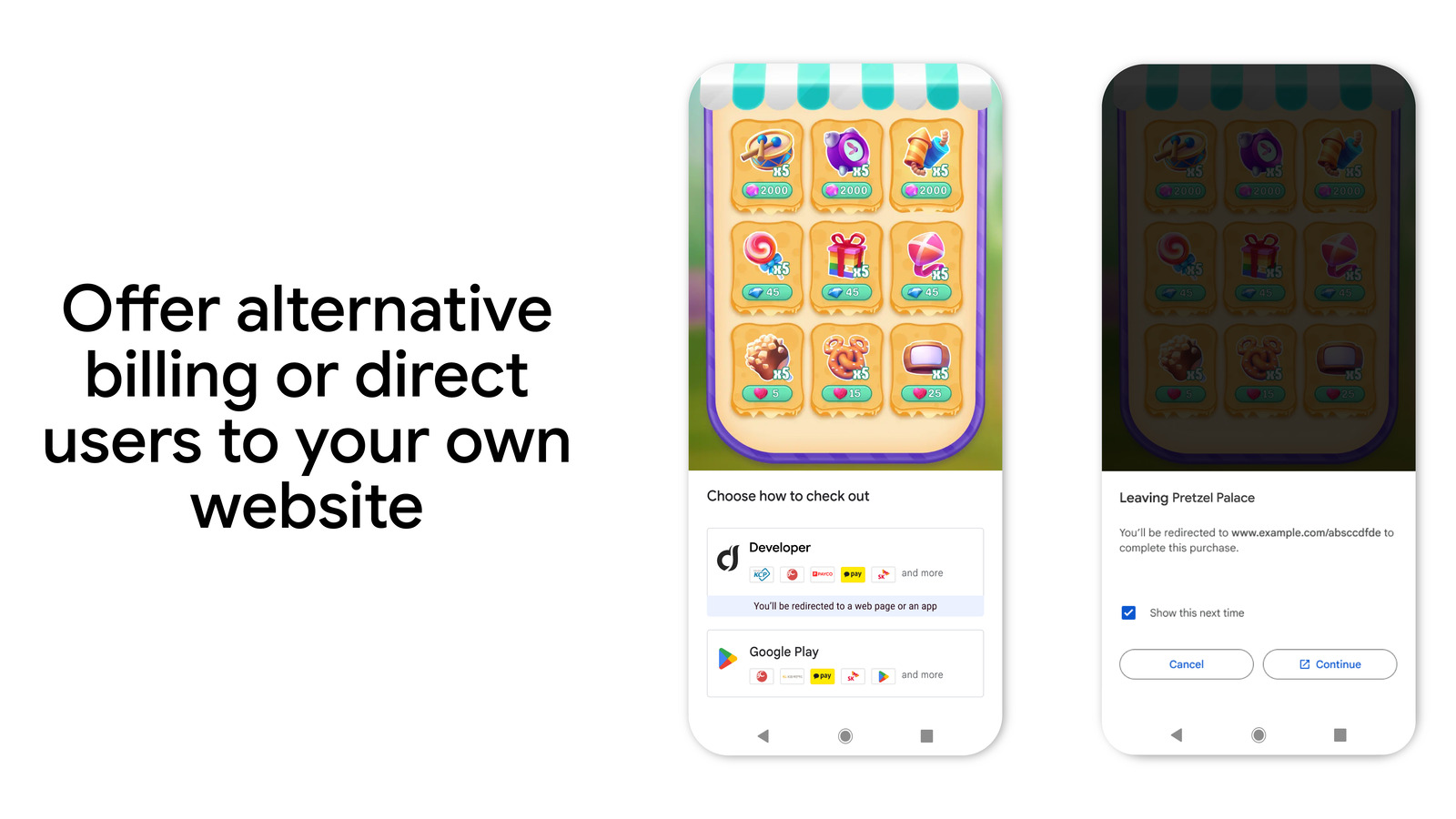
Opening up to third-party billing channels represents a turning point for the digital ecosystem. Google will allow developers to integrate external payment platforms or redirect users to their own websites to complete purchases, offering the ability to tailor the user-facing payment choice interface following user-experience-based design guidelines.
This flexibility is intended to address the needs of businesses that require autonomous management of digital commerce, while continuing to benefit from the Play Store’s distribution tools.
Incentive Programs and Global Rollout Milestones
Alongside the base tariff changes, the company will introduce new guidelines named Games Level Up and Apps Experience.
Applications and games that meet the requirements of these initiatives will be eligible for an even more favorable tariff schedule. These specific programs will be available starting September 30, 2026.
The transition to the new economic model will be gradual to ensure compliance with local regulations and the upgrading of technical infrastructure.
As specified in the table at the top, the first phase will commence on June 30, 2026 in the United States, the United Kingdom and the European Economic Area.
Subsequently, the tariff changes will be extended to Australia on September 30, 2026, the date on which the Games Level Up and Apps Experience programs will also debut in the initial markets. The implementation path will reach Japan and South Korea on December 31, 2026, to then conclude with extension to the rest of the world scheduled for the September 30, 2027.