


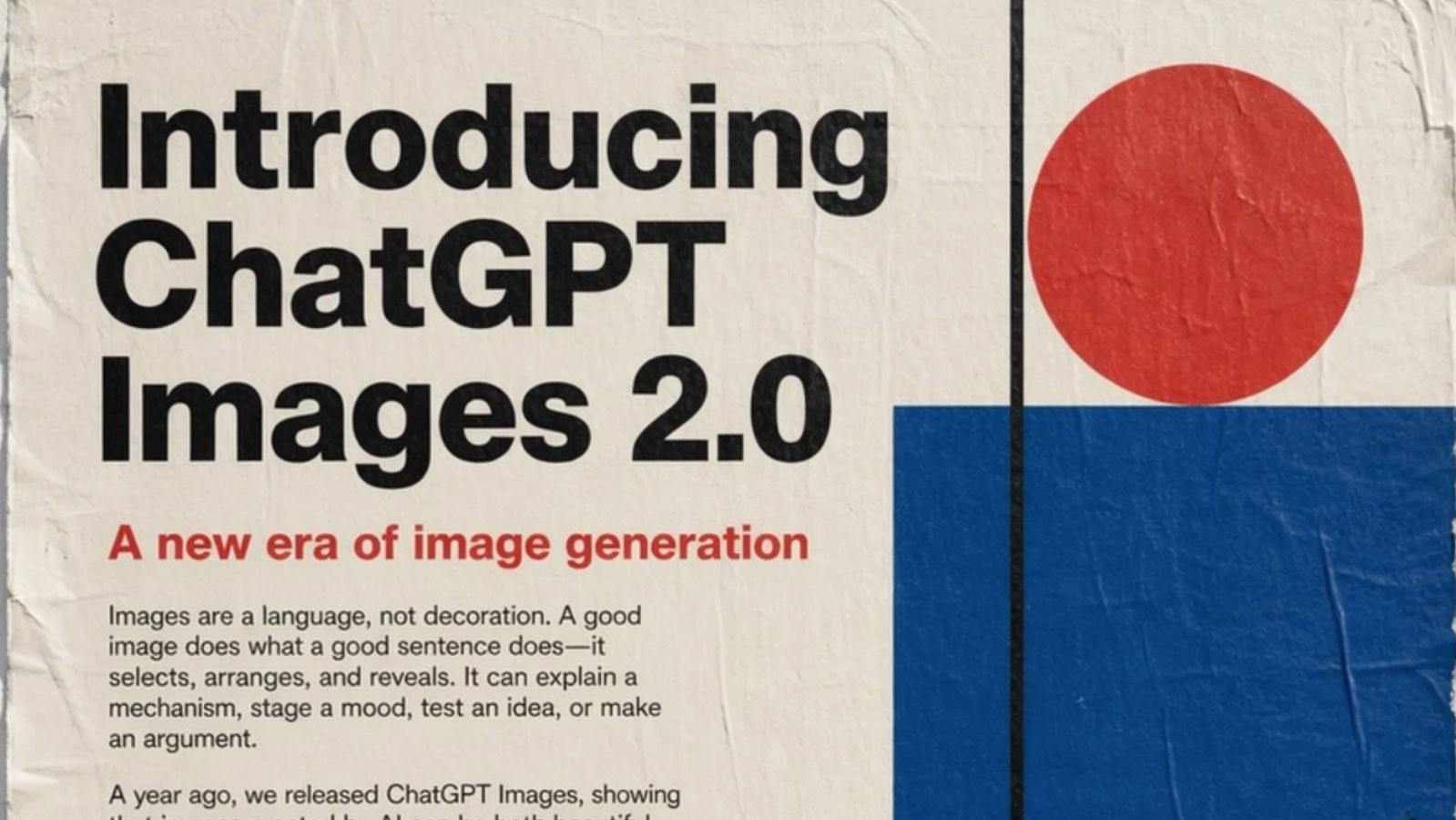
OpenAI has officially launched ChatGPT Images 2.0, an update that marks the transition of image generation from simple rendering to true strategic design. The new model not only produces aesthetically pleasing content, but also integrates reasoning capabilities that transform artificial intelligence from a mere prompt executor into a true creative assistant.
OpenAI presents ChatGPT Images 2.0: visual generation now has reasoning capabilities

The big novelty of ChatGPT Images 2.0 is its unprecedented ability to search and synthesize information from the web in real time to produce professional-grade visuals. When the Thinking mode, exclusive to Plus, Pro, Business and Enterprise plans, is used, the system can operate autonomously behind the scenes to thoroughly understand the task, reason about the output structure, and even generate up to eight distinct images simultaneously from a single input.
This feature helps maintain visual coherence, facilitating the creation of narrative sequences such as manga pages, storyboards, or coordinated social graphics series for different channels.

Practically, the model introduces operational flexibility aimed at replacing in many contexts dedicated editing applications. ChatGPT Images 2.0 can remove backgrounds, transform aspect ratios (supporting formats ranging from panoramic 3:1 to vertical 1:3) and handle complex texts with very high fidelity.
A significant improvement concerns handling text not in the Latin alphabet: the system now excels at rendering languages such as Japanese, Korean, Hindi and Bengali, integrating language as a natural part of poster, diagram and comic design.

Accuracy in following instructions is such that it allows rendering of granular elements often challenging for AI, such as icons, small texts, and user interface components, with resolutions reaching up to 2K via API.
The model’s intelligence also extends to understanding the real world, with knowledge updated to December 2025, ensuring infographics and educational content are relevant and accurate in the current context (more or less). It is possible to use stylistic nuances, such as the grain of 35mm film or the atmospheres of early 2000s digital cameras.

Despite the progress, OpenAI maintains a transparent approach to current limits: the system may still struggle with tasks requiring absolute physical understanding, such as origami instructions or solving a Rubik’s Cube, and with extremely dense repetitive details like grains of sand.
ChatGPT Images 2.0 is already available to all platform users and via the API under the name gpt-image-2. While advanced reasoning features remain tied to paid subscriptions, standard access allows anyone to experiment with a more intuitive model.