


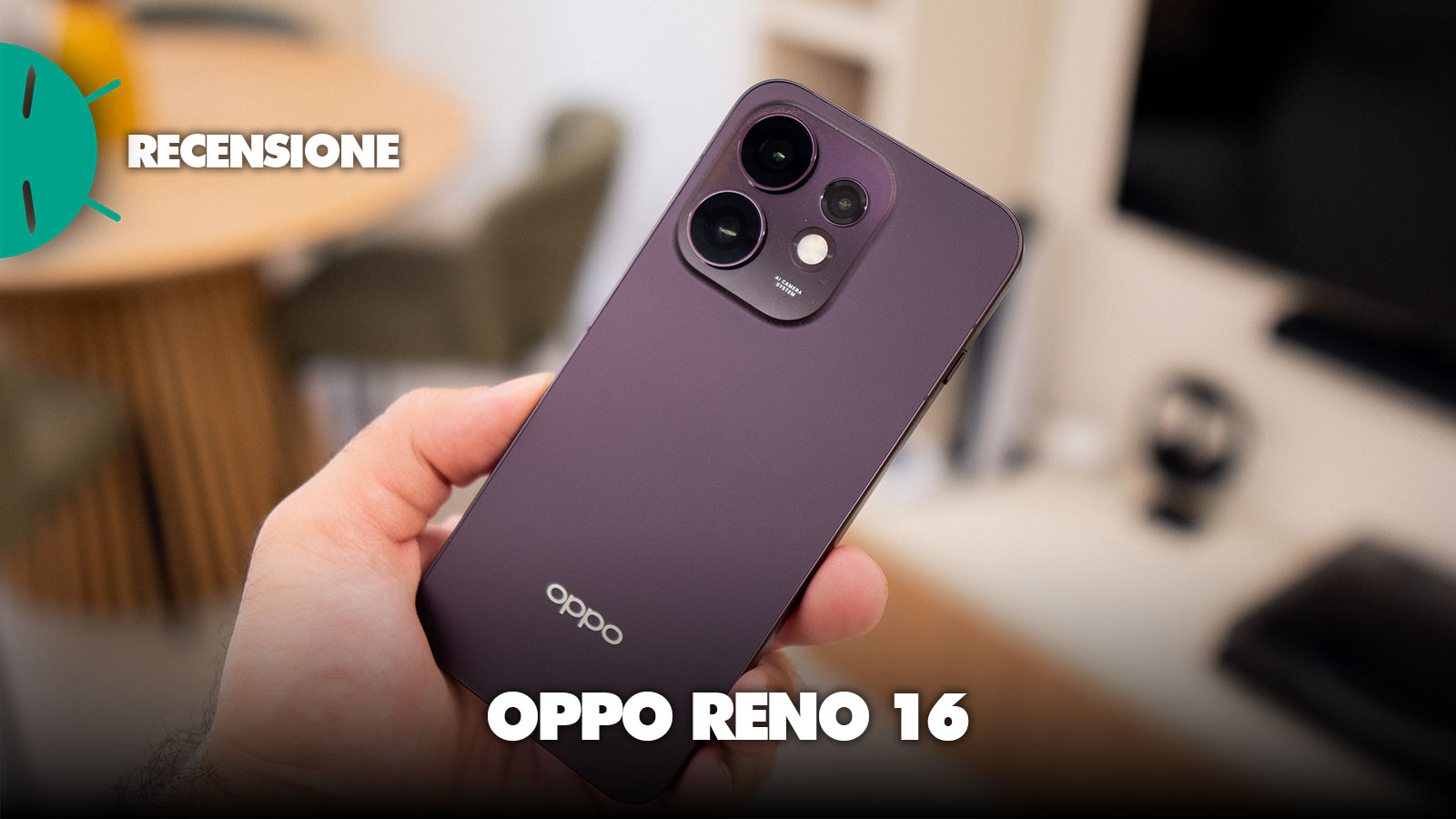
OPPO Reno16 arrives in a very particular position within the new Reno family, because this year the gap from the Pro version has shrunk quite a bit. We are not looking at the classic base model that sacrifices everything that makes the bigger brother interesting, but at a smartphone that inherits a large part of the Reno16 Pro experience, keeping the same compact form factor, the same aesthetic language, a premium build, and a camera package far more ambitious than one might expect.
The price difference with Reno16 Pro remains a central element in the evaluation, because we are talking about around 150 euros of gap, and therefore the question becomes fairly simple: what do you lose by choosing Reno16 instead of the Pro? And above all, who is this model more sensible for? The answer, in my view, is less obvious than it might seem, because Reno16 does not necessarily aim to be the most powerful in its category or the one with the most aggressive hardware on paper, but instead targets a very precise combination of design, portability, autonomy, display, versatile cameras, and AI features.
OPPO Reno16 is a smartphone that continues to speak to a young, social, creative audience, attentive to style and everyday photography, but does so with a slightly more rational approach than the Pro. Reno16 is, essentially, the model for those who want the aesthetic and lifestyle experience of the new OPPO series, the compact form factor, the 3.5x telephoto, the 50MP selfie camera, ColorOS 16 and the AI Snap Key, but can do without the 200MP main camera and a more powerful chipset to save a bit.
It is not a perfect device, and some trade-offs are noticeable, especially if you’re looking for the best price/performance ratio. Nevertheless, Reno16 has a clear identity: it is a compact, elegant, sturdy camera phone designed for everyday use—capturing trips, summer, people, nights out, social content, and small daily moments.
OPPO Reno16 Review
Design and Materials
From an aesthetic standpoint, OPPO Reno16 is virtually identical to the Reno16 Pro, and this is very positive news for the standard model. Dimensions, weight, lines and the feel in the hand are almost identical, so choosing Reno16 doesn’t give the impression of getting a product that’s less refined or premium. On the contrary, one of its main strengths is precisely this: it costs less, but maintains the same stage presence and perceived quality as the bigger brother.

The design remains the distinctive look of the Reno16 line, with flat edges, an aerospace-grade aluminum frame, and a very clean, modern aesthetic that feels almost iPhone-like in its tactile quality and attention to detail. The phone is compact, slim, well balanced, and above all very comfortable to use one-handed, which is not a given today. In a market where many devices exceed 6.7 or 6.8 inches, the 6.32-inch panel makes Reno16 decidedly more practical, especially for those who shoot, record videos, frequently use the front camera, or simply don’t want a giant device in their pocket.
Available colorways are one of the elements that help Reno16 stand out. In addition to the more classic variants, the Pop White and Dream Purple versions leverage the 3D Pop Planet effect already seen on the Reno16 lineup, with a back graphic that subtly changes with light and motion. It’s a distinctive aesthetic choice, perhaps not for everyone, but perfectly coherent with the Reno identity: young, recognizable, creative and less anonymous than many smartphones in the same tier.

Durability is also a major talking point: Reno16 offers IP66, IP68, IP69 and IP69K certifications, meaning advanced protection against dust, immersion, splashes and high-pressure water jets. That doesn’t mean we should mistreat it, but for a smartphone meant to travel, beach days, outings, or less controlled situations, it’s a valuable safeguard. The only minor caveat is the in-display fingerprint sensor, which works well, is fast and reliable, but is placed a bit too low. Nothing dramatic—we adapt, but the first days may require a slightly less natural thumb motion. Otherwise, Reno16 is built really well, and in this regard its proximity to the Pro works heavily in its favor.
Display
The display is one of the areas where Reno16 comes very close to the Reno16 Pro. Here too we find a 6.32-inch AMOLED panel with a 1.5K resolution, 10-bit color depth, HDR10+ support, and overall very high visual quality. The main difference is the refresh rate: Reno16 stops at 120Hz, while Reno16 Pro goes up to 144Hz in compatible gaming. In practice, I don’t consider this a heavy sacrifice, because the 144Hz on the Pro are usable in a very limited set of scenarios, while Reno16’s 120Hz deliver a fluid, responsive, modern UI all day long.
The panel performance is highly convincing; colors are vivid, sharpness is high, and brightness allows using the phone outdoors without issues when viewing a photo under the sun or recording moving video. It’s a display well-suited for both content consumption and creation, offering good legibility, excellent definition, and the fluidity we expect from a mid-to-premium device.

Also interesting is how the refresh rate adapts to content: lower when the display is static or when watching videos, higher in the UI, in compatible apps and in games. It isn’t an advanced LTPO panel like some high-end devices, but in daily use the management makes sense and helps balance smoothness with power consumption.
The compact form factor remains one of the strongest aspects: Reno16 is large enough for watching videos, editing photos, reading, gaming and browsing comfortably, yet not so big as to be unwieldy. It’s one of those phones that feel good in the hand, are pleasant to use on the move, and make shooting or recording on the fly feel more natural. In this regard, OPPO has made a smart choice: instead of chasing ever-larger diagonals, they built a premium experience inside a more manageable body.
Hardware and Performance
Under the hood, the Reno16 uses the Snapdragon 7 Gen 4, a 4 nm platform designed to deliver a solid, efficient experience suitable for the vast majority of daily tasks. Compared to the Reno16 Pro, which uses a more powerful MediaTek solution, the difference is most noticeable in heavier tasks, benchmarks and more graphics-intensive gaming, but in real-world use Reno16 remains a fluid and reliable smartphone.
The important thing to understand is this: Reno16 is not built to be the most powerful in its class, but to offer performance aligned with the user type it targets. Social, messaging, web browsing, photos, video, navigation, streaming, light editing apps and multitasking are handled without particular difficulty. App switching is fast as well, especially in the 12GB RAM versions (I unfortunately received the 8GB RAM unit for the test, which still works well), while UFS 3.1 storage ensures reasonable app launch and save times.
The AI Mind Space also integrates models like Gemini, Perplexity and DeepSeek, allowing you to get answers, compare perspectives, or handle more complex queries in a more immediate way. The positive aspect is that OPPO doesn’t force the user to use these features: they exist, are accessible, but don’t become invasive. Those who want to use them will find a dedicated physical button and a fairly intuitive system; those who are not interested in AI can continue to use Reno16 as a normal, fully functioning Android smartphone.
The button can also be remapped, which makes it even more interesting. In an era when many brands sprinkle AI features across devices just to boast them in the tech specs, here there is at least a concrete effort to turn them into quick, accessible tools tied to everyday gestures. Also very important is the promise of updates: the Reno16 series is designed to accompany the user for a long time, with several years of major updates and security patches. It’s a pity that there are so many preinstalled apps on first boot, which forces you to waste time uninstalling them.
Camera
The camera system is one of the most interesting aspects of OPPO Reno16, because even without the Pro’s 200MP main camera, it maintains a very complete configuration and is noticeably more balanced than in the past. On the back there are three 50MP sensors: a stabilized main camera, a 3.5x telephoto with OIS and a 50MP ultrawide with autofocus. On the front, there is a 50MP ultra-wide selfie camera, also with autofocus and capable of recording up to 4K at 60fps.
The main difference compared to the Reno16 Pro is obviously the main camera. The Pro has a 200MP sensor that offers more room for cropping, more detail and a more ambitious result, especially when working on recomposing the image. Reno16, instead, relies on a 50MP main camera that on paper is less spectacular but performs well in practice, especially in daylight. Shots have good detail, wide dynamic range, and a generally natural rendering with pleasant colors, though not always highly saturated.

However, the standout element that makes Reno16 very compelling is the 3.5x telephoto. It isn’t a lens added for show but a genuinely useful tool, especially for portraits. The longer focal length helps achieve a more natural perspective, better face compression, and a background that’s more attractive than a close-up shot taken with the main camera. In this sense, Reno16 brings to the standard model a photography experience that recalls some traits of the Find series, at least in the idea of offering a true telephoto lens that’s useful not just for zooming but also for telling people, details, and everyday scenes more effectively.
It’s here that Reno16 becomes a credible camera-phone lifestyle device: whether you’re traveling, in summer, at a dinner, in the city or on vacation, the 3.5x lets you isolate subjects, photograph architectural details, dishes, people, and moments without getting too close. There is a minimum focusing distance limitation, so it’s not ideal for very close-ups, but for portraits and everyday scenes it works really well.
The upgrade of the ultra-wide to 50MP is also very important, finally bringing a lens up to the rest of the setup. Compared to the old 8MP ultrawides, the jump is substantial: more detail, autofocus, better overall quality, and 4K video recording. It’s a lens useful not only for landscapes and architecture but also for more dynamic content, travel shots, group photos, and scenarios where more context is needed.
The selfie camera remains one of Reno16’s strengths; the wide field of view allows you to include more people or more background, autofocus helps keep faces sharp, and the ability to record in 4K at 60fps makes Reno16 very suitable for vlogs, stories, talking content and front-facing footage. Compared to the Pro there may be small differences in rendering, with slightly less saturated colors and, in some situations, a touch less bite, but the experience remains very solid.
On the creative front, Reno16 inherits the lineup’s more playful soul: Pop Cam, looks inspired by vintage cameras, Instant Film, Light Leak and especially tools like AI Remix Collage. This latter is one of the most coherent elements with the product’s positioning because it lets you combine photos and short videos into more dynamic compositions, adding stickers, text, outlines and subjects extracted from Motion Photo or video. It’s not just fine editing for editing’s sake: it’s a faster, more playful way to tell a vacation, a day, an evening, or a moment shared.
In terms of video, Reno16 can record up to 4K at 60fps with all cameras, and this is a big plus, especially considering the ultra-wide upgrade. Quality is good, with confident daytime results and usable nighttime results too, though stabilization when walking isn’t always perfect. When stationary or with controlled moves, the phone fares well. Once again, the Pro remains more ambitious overall, but Reno16 offers a very complete photo and video package for everyday content creators.
Autonomy
Reno16’s battery life is very good, with a key caveat: some international versions reach 6,700 mAh, while in Europe the capacity drops to 6,000 mAh. Despite this, in daily use the phone performs well, aided by the Snapdragon 7 Gen 4, which helps keep energy use balanced. Between social, messaging, camera, video, browsing and a bit of gaming, you can reach the end of the day with comfortable peace of mind, especially given the phone’s compact form factor.
The 80W SUPERVOOC fast charging remains one of the most tangible advantages of the OPPO experience: even if it’s not the absolute fastest in its class, it still lets you recover a lot of battery in a short time and reduces the need to plan charging. It’s a pity there’s no wireless charging, which is still missing on a device in this tier, but overall Reno16 remains a reliable and practical phone for the busiest days.
Price and Considerations
OPPO Reno16 enters a delicate price bracket, especially since the difference with Reno16 Pro is around 150 euros. This is precisely where you need to decide what you’re really after: the Pro remains superior in terms of the main camera, power and overall margins, but Reno16 preserves most of the series’ more recognizable experience, including premium design, compact form factor, excellent display, good autonomy, ColorOS 16, AI Snap Key and a still very versatile camera package.
In my view, Reno16 makes sense for those who want a stylish, compact and creative smartphone, but don’t necessarily need the 200MP main camera or the higher performance of the Pro. The 3.5x telephoto, the 50MP selfie camera, the upgraded ultrawide, and creative tools like AI Remix Collage make it a very compelling camera-phone lifestyle option for travel, summer, social, and daily photography.
It isn’t the most powerful phone in its tier and if you only look at benchmarks you may find more aggressive options. But OPPO Reno16 plays a different game: usability, build, portability and creativity. It is the most rational model in the lineup for those who want something very close to the Pro, but at a lower price and with a few compromises that are, overall, acceptable.
⭐️ Scopri le migliori offerte online grazie al nostro canale Telegram esclusivo.