


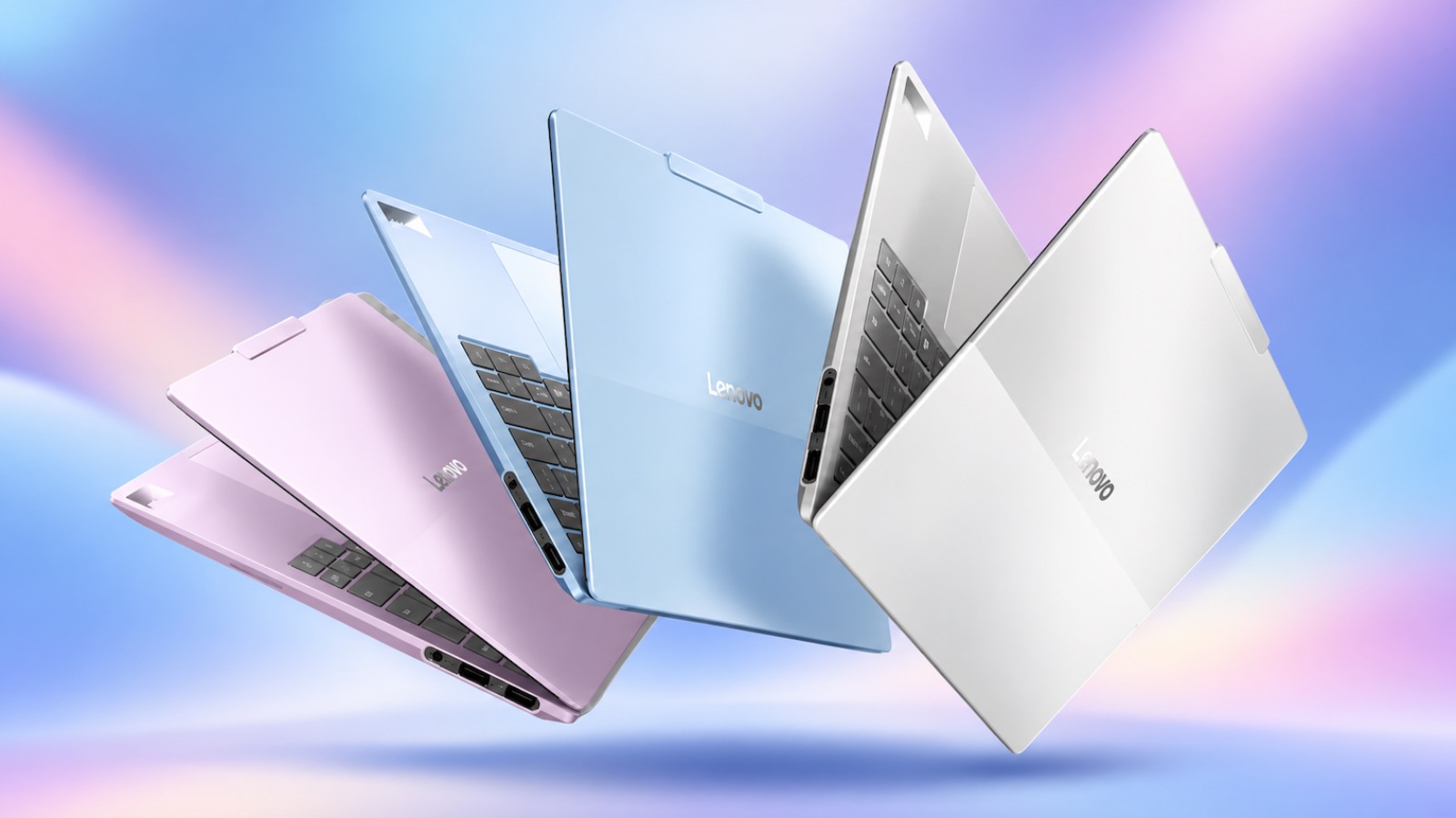
At IFA 2026 Lenovo has drawn attention to Project AeroBlade, a concept that rethinks from the ground up the traditional notebook to bring it to the smallest possible footprint: under 830 grams in weight and less than 10 mm thick for a 14″ display, compared with 1.3 kg and 14–17 mm typical of 14″ notebooks on the market today.
Alongside AeroBlade, Lenovo also showcased Project Swan, a second concept with a rollable display unveiled in the same context.
Project AeroBlade: the Lenovo concept that eliminates the traditional fan

The heart of the project is the replacement of the usual mechanical fan with AirJet, a solid-state cooling solution developed together with Frore Systems.
Instead of the traditional fan, the system is based on an architecture “Active Flow” with modules just 2.65 mm thick that generate a high-velocity pulsed airflow thanks to vibrating diaphragms, pushing the heat toward the back of the device. Each module consumes at most 1 watt while able to dissipate up to 5.25 watts, and can be positioned at multiple points of the chassis, offering greater freedom in motherboard design.
According to Lenovo, the new architecture enables high performance even under AI workloads, while reducing noise, dust buildup and mechanical complexity compared to a traditional fan-based cooling system.
Materials, display and connectivity
On the build side, Project AeroBlade uses a magnesium-aluminum alloy chassis paired with an OLED display with a high screen-to-body ratio.
The planned connectivity includes Thunderbolt 4 and Wi-Fi 7, while Lenovo has not yet provided details on the chipset and memory mounted on the concept. According to reports, the performance would still be comparable to the ThinkPad X1 Carbon series with Intel processors.
Project Swan: the second concept, with a display that expands from 14″ to 17″

The second concept shown by Lenovo is Project Swan, designed to combine the portability of a compact notebook with a workspace that can literally expand as needed thanks to a rollable display.
In the compact configuration, Project Swan presents itself as a 14″ notebook, with a thickness of 17.9 mm and a weight of 1.6 kg; when extended mode is activated, the screen extends to 17″ in a 16:9 format, offering a significantly larger workspace for multitasking, while keeping the footprint of a portable device when closed in its standard form.
Only two concepts: no commercialization date
Lenovo presented both Project AeroBlade and Project Swan as proofs of concept at Lenovo Innovation World at IFA 2026. They are not commercial product announcements: at the moment, neither has a price or launch date planned, and it remains to be seen which of the showcased solutions will eventually make it onto Lenovo notebooks actually on sale.
Other Lenovo news shown at IFA 2026

Besides the two concepts, IFA 2026 gathers a series of more concrete Lenovo products, all built around the company’s hybrid AI strategy, which combines on-device processing and cloud/edge resources.
On the desktop front arrive ThinkCentre X Ultra (designed for work with generative AI, with architecture ready for clustering multiple units and the same Active Flow/AirJet cooling as AeroBlade), as well as the more compact ThinkCentre M75s Gen 6 and M75q Gen 6.
Among the standard notebooks debut ThinkBook 14 Gen 9, with Copilot+ PC and Lenovo Qira integrated, and the premium ultrabook ThinkBook 14x Gen 2, also available with an OLED display.
On the monitor front, Lenovo expands the ThinkVision line with the curved P34WD-4v (the first Microsoft-certified monitor for video calls over Thunderbolt), the P27UL-40 model with the new inkjet-printed OLED technology, and the T32UD-4v and T34WD-4v models designed for office videoconferencing.
Two security solutions close the picture: ThinkShield TraceLock, which allows locating, locking or remotely erasing corporate devices even when they are powered off or disconnected, and the integration with SentinelOne’s Prompt Security platform to monitor and protect the use of generative AI in the enterprise.
For all the updates on the brand’s ecosystem, you can find our latest articles in the Lenovo section of GizChina.it.