


The Redmi Note series is the most appreciated when it comes to Xiaomi’s mid-range: for years it has been the backbone of Lei Jun’s company churning out devices for every budget, and this time the appointment has been renewed as well. In this in-depth article we compare Redmi Note 17 and 17 Pro vs Redmi Note 15 and 15 Pro: here are the differences between the new and the “old” series, with details on aesthetics, hardware and launch prices!
What are the differences between Redmi Note 17 and the Redmi Note 15 series, between standard and Pro models

Design and specifications in comparison
First of all it is important to make a point: as of writing, Xiaomi has launched the Redmi Note 17 in China and details about the models that will arrive in Global version are still missing. Therefore, this should be considered a preliminary comparison, awaiting to learn what changes will affect the international variants.
However, the design and a large part of the specifications should remain unchanged: we expect some changes on the camera side or perhaps for the display aesthetics (perhaps with the introduction of Dual Edge panels, as in the Note 15 series). Still, we do not foresee real upheavals, at least according to the strategy Xiaomi has followed so far.
Redmi Note 17 5G vs Redmi Note 15 5G

The design of the new generation completely shifts the playing field compared to the look of Redmi Note 15. Xiaomi has opted for a dual module positioned in the top-left corner: the first one, square with rounded corners, houses inside the second, capsule‑shaped.
Inside the latter sits the camera array, based on two sensors accompanied by the LED flash. The front section hosts a display with a central punch hole: the screen features flat bezels, in stark contrast with the predecessor.

The design of Redmi Note 15 5G is the opposite: the back is characterized by a Squircle module centered on the upper portion of the chassis; the display features Dual Edge bezels as we haven’t seen in a long time.
Many manufacturers have shifted toward flat panels (or at most Micro Quad Curved); in fact, Note 15 Chinese uses a flat-edged display, so the adoption of a curved display was conceived exclusively for Global markets.
It remains to be seen whether Xiaomi will make changes to the front of the Redmi Note 17 5G international version, or continue to offer a Flat solution. In the meantime here is the spec comparison: we have also included Redmi Note 14 5G, to make clear the device’s path as it moves from one generation to the next.
| Redmi Note 14 5G (ITALY) | Redmi Note 15 5G (ITALY) | Redmi Note 17 5G (ITALY) |
| 162,4 x 75,7 x 7,99 mm 190 grams | 164 x 75,42 x 7,4 mm 178 grams | 169,70 x 79,14 x 8,26 mm 225 grams |
| IP64 | IP65 | IP65 |
| • AMOLED • Flat • 6,67″ Full HD (2.400 x 1.080) • 120 Hz • 8 bit • 2.100 nit • Gorilla Glass 5 | • AMOLED • Dual Edge • 6,77″ Full HD (2.392 x 1.080) • 120 Hz • 12 bit • PWM Dimming 3.840 Hz • 3.200 nit | • OLED • Flat • 7″ Full HD (2.396 x 1.080) • 120 Hz • 8 bit • PWM Dimming 2.160 Hz • 1.800 nit |
| Dimensity 7025 Ultra 6 nm TSMC | Snapdragon 6 Gen 3 4 nm Samsung | Snapdragon 4 Gen 4 4 nm Samsung |
| 2 x 2,5 GHz – Cortex-A78 6 x 2,0 GHz – Cortex-A55 | 4 x 2,4 GHz – Cortex-A78 4 x 1,8 GHz – Cortex-A55 | 2 x 2,3 GHz – Cortex-A78 6 x 2 GHz – Cortex-A55 |
| IMG BXM-8-256 | Adreno 710 | Adreno 613 |
| 8 GB di RAM LPDDR4X | 8/12 GB LPDDR4X | 6/8 GB LPDDR4X |
| 256 GB UFS 2.2 | 256/512 GB UFS 2.2 | 128/256 GB UFS 2.2 |
| Micro SD: ✓ | Micro SD: ✓ | Micro SD: ✓ |
| Raffreddamento passivo | Raffreddamento passivo | Raffreddamento passivo |
| Lettore d’impronte sotto lo schermo (ottico) | Lettore d’impronte sotto lo schermo (ottico) | Lettore d’impronte sotto lo schermo (ottico) |
| • 108 MP f/1.7, OIS • 8 MP f/2.2, ultra-wide • 2 MP f/2.4, macro | • 108 MP f/1.7, OIS • 8 MP f/2.2, ultra-wide | • 50 MP f/1.8 • second sensor |
| Selfie da 20 MP f/2.2 | Selfie da 20 MP f/2.2 | Selfie da 8 MP f/2.2 |
| 5.110 mAh | 5.520 mAh | 8.000 mAh |
| 45W | 45W | 45W |
| Dual SIM 5G | Dual SIM 5G | Dual SIM 5G |
| eSIM: ✖ | eSIM: ✖ | eSIM: ✖ |
| Wi-Fi 5 | Wi-Fi 5 | Wi-Fi 5 |
| Bluetooth 5.3 | Bluetooth 5.1 | Bluetooth 5.1 |
| NFC: ✓ | NFC: ✓ | NFC: ✓ |
| GPS | GPS | GPS |
| USB-C | USB-C | USB-C |
| Speaker stereo | Speaker stereo | Speaker stereo |
| Mini jack cuffie: ✖ | Mini jack cuffie: ✖ | Mini jack cuffie: ✖ |
| Infrarossi: ✓ | Infrarossi: ✓ | Infrarossi: ✓ |
| HyperOS Android 14 | HyperOS 2 Android 15 | HyperOS 3 Android 16 |
| List price 8/256 GB – €299.9 | List price 6/128 GB – €229.9 8/256 GB – €249.9 12/512 GB – €349.9 |
Redmi Note 17 Pro 5G vs Redmi Note 15 Pro 5G

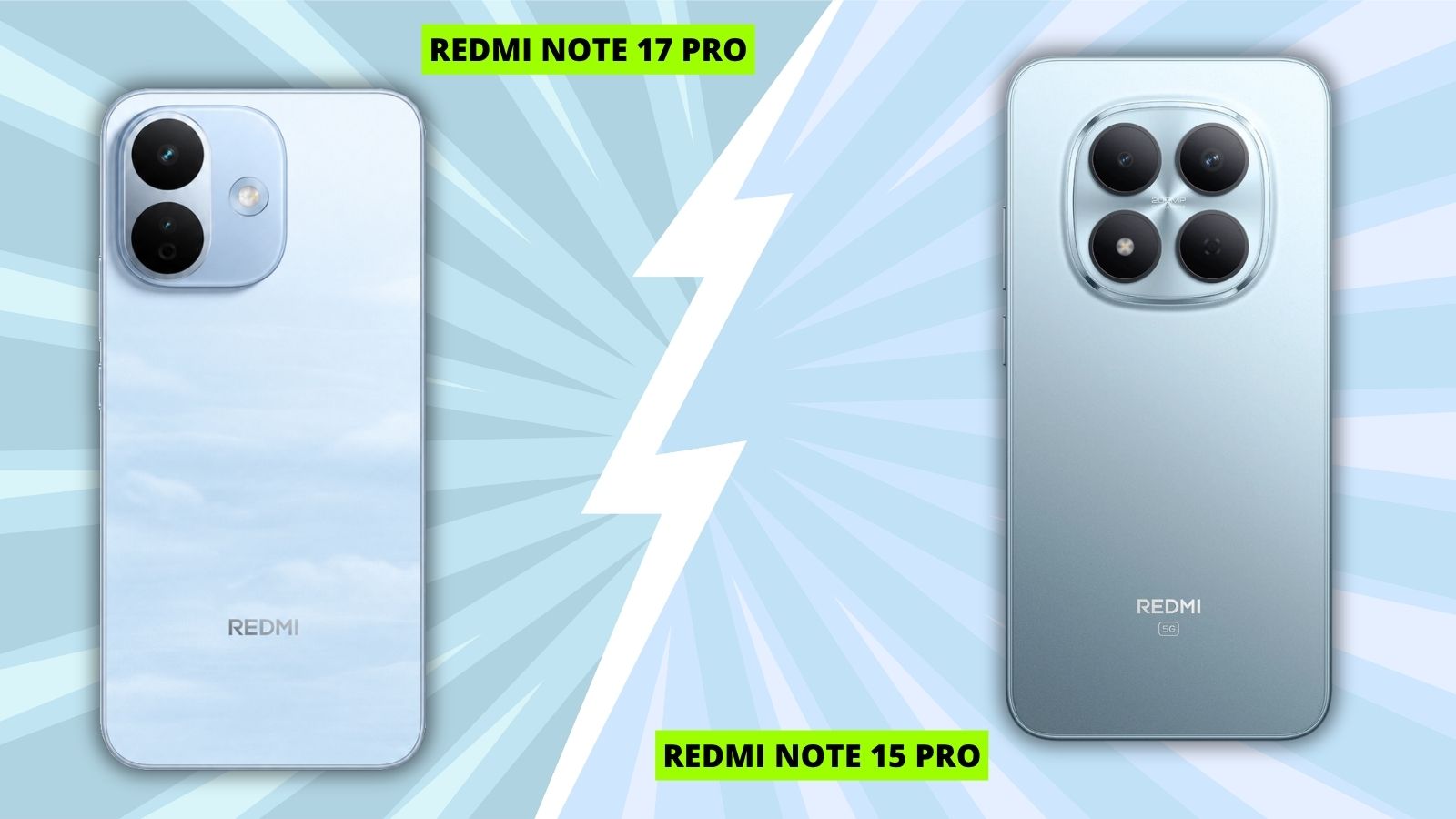
The aesthetics of the standard model continue to the big brother: Redmi Note 17 Pro 5G is equipped with the same design language, changing only the position of the LED flash and the color options (among them the stunning Sky Blue shade).

The gap between the two Pro devices is clear, since Note 15 Pro 5G also uses a central squared module. The display also changes: flat on the latest generation model and Micro Quad Curved on the predecessor.
It remains to be seen whether there will be changes in the transition from China to foreign markets. While we wait for official details, here are the specs for comparison.
| Redmi Note 14 Pro 5G (ITALY) | Redmi Note 15 Pro 5G (ITALY) | Redmi Note 17 Pro 5G (CHINA) |
| 162,33 x 74,42 x 8,4 mm 190 grams | 163,61 x 78,09 x 7,78 mm 204 grams | 163,45 x 78,27 x 8,46 mm 226 grams |
| IP68 | IP68 | IP66/IP68/IP69/IP69K |
| u2022 AMOLED u2022 Dual Edge u2022 6,67u2033 1.5K (2.712 x 1.220) u2022 120 Hz u2022 12 bit u2022 3.000 nit u2022 PWM Dimming 1.920 Hz u2022 Gorilla Glass Victus | u2022 AMOLED u2022 Micro Quad Curved u2022 6,83u2033 1.5K (2.772 x 1.280) u2022 120 Hz u2022 12 bit u2022 PWM Dimming 3.840 Hz u2022 3.200 nit u2022 Gorilla Glass Victus 2 | u2022 AMOLED u2022 Flat u2022 6,83u2033 1.5K (2.772 x 1.280) u2022 120 Hz u2022 12 bit u2022 PWM Dimming 3.840 Hz u2022 3.500 nit u2022 Gorilla Glass Victus 2 |
| Dimensity 7300 Ultra 4 nm TSMC | Dimensity 7400 Ultra 4 nm TSMC | Snapdragon 6s Gen 4 4 nm Samsung |
| 4 x 2,5 GHz – Cortex-A78 4 x 2,0 GHz – Cortex-A55 | 4 x 2,6 GHz – Cortex-A78 4 x 2,0 GHz – Cortex-A55 | 4 x 2,4 GHz – Cortex-A78 4 x 1,8 GHz – Cortex-A55 |
| Mali-G612 MC2 | Mali-G615 MP2 | Adreno 710 |
| 8 GB di RAM LPDDR4X | 8/12 GB LPDDR4X | 8/12 GB LPDDR4X |
| 256 GB UFS 2.2 | 256/512 GB UFS 2.2 | 128 GB UFS 2.1 256/512 GB UFS 3.1 |
| Micro SD: ✖ | Micro SD: ✖ | Micro SD: ✖ |
| Raffreddamento al liquido con camera di vapore | Raffreddamento al liquido con camera di vapore | Raffreddamento al liquido con camera di vapore |
| Lettore d’impronte sotto lo schermo (ottico) | Lettore d’impronte sotto lo schermo (ottico) | Lettore d’impronte sotto lo schermo (ottico) |
| u2022 200 MP f/1.65, OIS u2022 8 MP f/2.2, ultra-wide u2022 2 MP f/2.4, depth | u2022 200 MP f/1.7, OIS u2022 8 MP f/2.2, ultra-wide | u2022 50 MP f/1.8 u2022 secondary sensor |
| Selfie da 20 MP f/2.2 | Selfie da 20 MP f/2.2 | Selfie da 8 MP f/2.2 |
| 5.110 mAh | 6.580 mAh | 9.000 mAh |
| 67W | 67W | 67W |
| Dual SIM 5G | Dual SIM 5G | Dual SIM 5G |
| eSIM: ✖ | eSIM: ✖ | eSIM: ✖ |
| Wi-Fi 6 | Wi-Fi 6 | Wi-Fi 5 |
| Bluetooth 5.4 | Bluetooth 5.4 | Bluetooth 5.1 |
| NFC: ✓ | NFC: ✓ | NFC: ✓ |
| GPS | GPS | GPS |
| USB-C | USB-C | USB-C |
| Speaker stereo | Speaker stereo | Speaker stereo |
| Mini jack cuffie: ✖ | Mini jack cuffie: ✖ | Mini jack cuffie: ✖ |
| Infrarossi: ✓ | Infrarossi: ✓ | Infrarossi: ✓ |
| HyperOS Android 14 | HyperOS 2 Android 15 | HyperOS 3 Android 16 |
| Prezzo di listino 8/256 GB – €399.9 | Prezzo di listino 8/256 GB – €379.9 8/512 GB – €429.9 12/512 GB – €449.9 |
Redmi Note 17 Pro+: the big unknown of the series
You’ll surely have noticed the absence of a superior version: usually the Note series debuts with at least 3 models, plus two 4G phones (base and Pro) in some countries – including Italy.
This time the Chinese event left out the flagship device, and according to rumors there is a good reason. First, the nomenclature will change: no Pro+ but Redmi Note 17 Pro Max, to align the series with the flagship line (in China there exist Xiaomi 17, 17 Pro and 17 Pro Max).
Secondly, we expect a first for the brand, since the mid-range will be the first Xiaomi with a silicon-carbon battery of 10,000 mAh, surpassing the current record set by Redmi Note 17 Pro (9,000 mAh).
Among other features there are rumors of a 200 MP sensor and the Dimensity 7500 chipset; moreover it would be the only model in the series with a triple camera, adding an ultra-wide and a telephoto lens.
What will change with the Global versions?
Now that we’ve gone through all the details of the new series, the only thing left is to look to the future. For now the comparison focuses on the Chinese models, while the Global debut is expected by the end of the year (at least for the Indian market).
For Italy, neither the date nor a possible timeframe is known: best not to guess and wait for credible leaks or an official confirmation.
Regarding the differences between China and Global, our Redmi Note 17 series should introduce at least two “certain” changes. According to a well-known insider, Note 17 Pro Global will replace the secondary 2 MP sensor with an 8 MP ultra-wide, but this is still a leak.
More credible is the fate of the new extra-large batteries: as tradition for European markets, the series is anticipated with trimmed batteries. Our Redmi Note 17 and 17 Pro should drop to 7,700 mAh and 8,340 mAh, a respectable power but still below the targets of the Chinese counterparts (8,000 and 9,000 mAh).
Reviews and deeper looks

Take a look at our reviews and in-depth analyses dedicated to the range and find out which Redmi Note is right for you!
Prices in comparison: waiting for the Global release
For now it is not useful to compare the prices of the two series, since the Redmi Note 17 family is still unreleased in Italy. Chinese prices are not indicative because the euro conversion also takes other factors into account, so it’s necessary to wait until the Global event and the Italian market announcement.