


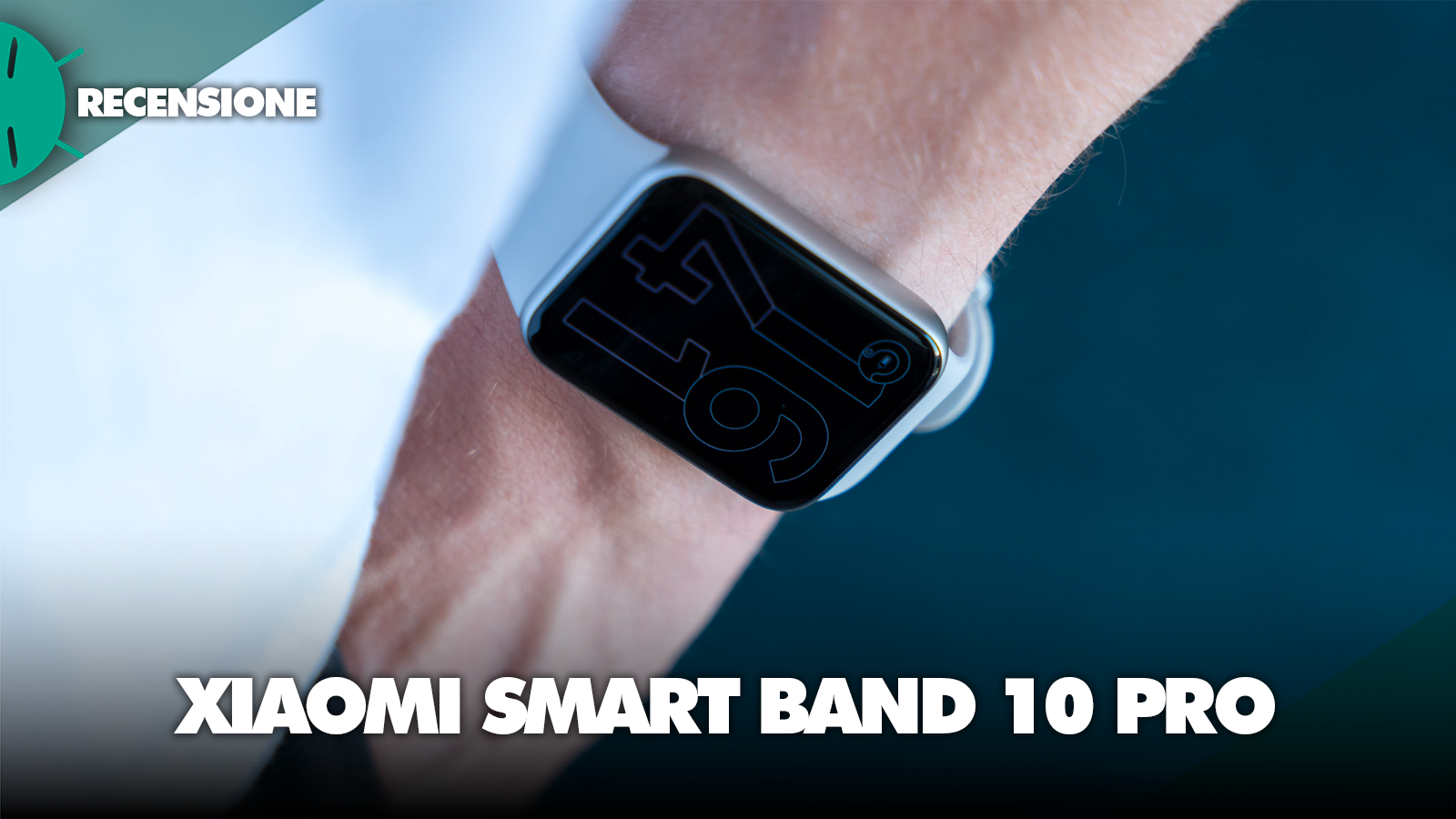
The simple step counters have evolved to encompass more and more features once exclusive to the most complete smartwatches. The Xiaomi Smart Band 10 Pro fits exactly into this vein, aiming to offer an advanced user experience while maintaining a compact form factor.
The update from the previous generation focuses on structural refinements, a significantly brighter display and a renewed focus on physical recovery metrics, confirming the company’s intention to perfect a winning formula without overhauling its essence.
Xiaomi Smart Band 10 Pro Review: few changes to a product that keeps its promises

Design, materiali e display
The previous model used a standard aluminum alloy frame paired with a plastic back, while the new Xiaomi Smart Band 10 Pro relies on a shell made of 6M46 aerospace aluminum alloy, with the back remaining in black polymer.
The metal delivers a decidedly more solid and premium feel than cheap polycarbonate smart bands, and it still keeps the device’s weight under control. Weighing in at 21.6 g bare (without the strap), it is also lighter than the 24.5 g of the Smart Band 9 Pro.

The dimensions have also been optimized. The thickness now stands at only 9.7 mm, a slim profile that makes the bracelet decidedly less bulky than a high-end smartwatch during everyday use and, above all, not bothersome during overnight sleep monitoring.
There is also a ceramic variant Pearl White, slightly thicker and heavier. The metal model I evaluated is distinguished by its sobriety, but both are characterized by the total absence of physical buttons.
All interaction is delegated to the touch display, a choice that ensures clean and elegant lines, but that can prove limiting during water workouts or when your hands are very sweaty, situations in which mechanical feedback would have been preferable.


The panel is a AMOLED 1.74″ with a resolution of 480 x 336 pixels, protected by a 2.5D curved glass that blends seamlessly with the aluminum chassis, creating a striking design on all four sides. This gives the front a modern look, visually reducing the impact of the ultra-thin bezels.
If the screen size is identical to that of the past, the refresh rate at 60 Hz ensures smooth animations, but brightness is the real differentiating factor: reaching a peak of 2000 nits (compared to 1200 nits of the previous version), the panel offers decent readability even in the most challenging situations.

Hardware, prestazioni e connettività
Under the hood, the Xiaomi Smart Band 10 Pro relies on the Bluetooth 5.4 protocol to ensure a stable and energy-efficient connection with the smartphone.
The overall fluidity of the interface is excellent, thanks to both the responsive display and the optimization of the operating system, free of noticeable lag when scrolling widgets and opening internal applications.
As noted in the preface, the metal model analyzed here is devoid of the NFC module. This component is, in fact, reserved for the more expensive ceramic edition, a commercial choice that forces the user to carefully assess their own needs at the time of purchase, precluding those who choose the base version from the convenience of contactless payments directly from the wrist.

Another hardware limitation, justifiable by the price positioning but still noteworthy, is the total absence of a microphone and a speaker. This means that it is not possible to interact with any voice assistant, nor manage calls via Bluetooth directly from the bracelet. This is a shortcoming that distances it from the category of true smartwatches.
Call handling is therefore limited to the incoming call notification only, with the option to reject or mute them, but always forcing the user to take out the smartphone to answer.
A very interesting development on the connectivity front is the Dual Device Sync feature. This capability allows the tracker to remain connected to two different devices simultaneously.
For a user who owns, for example, a work smartphone and a personal one, this continuous synchronization allows you to centralize the reception of notifications on a single wrist screen, greatly simplifying the management of your daily digital routine.
Batteria e ricarica
Battery life has always been one of the fundamental pillars of Xiaomi’s Smart Bands, and this model is no exception. Powering the system is a 350 mAh battery, capable of delivering up to 21 days of continuous use between charges.
Achieving three weeks of battery life is possible only by disabling the most power-hungry features: you need to give up the Always-On Display (AOD), limit the screen brightness, rely on wrist-raise activation, and reduce the frequency of automatic biometric measurements.
With usage that could be described as “intense” (that is, with continuous heart-rate monitoring, sleep tracking, hundreds of notifications per day and several walks with GPS tracking active), the battery life settles around 15 days.
If, however, you decide to fully exploit the potential of the AMOLED display by keeping the AOD constantly on, the battery life suffers a drastic but predictable drop, while still delivering about 8 days of operation. These are, in any case, excellent results that free the user from the anxiety of daily charging.
Regarding charging, the device relies on a proprietary cable with magnetic attachment. The real novelty in this area is support for fast charging: you can charge the battery from 0% to 80% in just 25 minutes. This means you only need to connect the bracelet to power during a shower or a quick breakfast to get enough autonomy to tackle a full week of moderate use.
A full charge at 100% takes just under 90 minutes.
Sensori e monitoraggio sportivo
The core of the device has received a substantial update. The new dual-light PPG optical sensor (dual-PD) promises an accuracy in heart-rate detection of 98.2%.
Physiologically, as with all wrist-worn optical sensors in this price range, the sensor shows some delay or uncertainty in the sudden changes of pace typical of high-intensity interval training.

The most significant addition, however, is the monitoring of heart rate variability (HRV) during sleep. This parameter is fundamental for assessing the level of recovery of the autonomic nervous system.
Cross-referencing HRV data with sleep quality (now analyzed through the new Algorithm 2.0 which improves by 11% the detection of sleep onset and wake stages) the device is able to provide accurate estimates of the post-workout fatigue levels.
In addition to this, there is the continuous measurement of blood oxygenation (SpO2) and an advanced tracking of the menstrual cycle.
On the sports front, the band supports more than 150 training modes, many of which are equipped with automatic recognition.
An interesting new feature is the dedicated cycling mode, which allows real-time data synchronization on the smartphone screen: by placing the phone on the handlebars, it will function as a true cycling computer, leveraging the sensors of the wristband.
The outdoor route tracking is entrusted to an integrated GPS chip compatible with Multi-GNSS systems (BeiDou, GPS, GLONASS, Galileo, QZSS). Dual-band GPS technology, found on more expensive devices, is not present, but the accuracy proves more than adequate for reliably mapping urban routes, recording metrics that are consistent for pace and distance.
Finally, the water resistance rating of up to 5 ATM ensures total water resistance, making the device perfect for swimming in the pool and resistant to sweat and rain.
Software
The proprietary operating system HyperOS 3 handles user interaction. The software ecosystem is divided into two components: the on-device interface and the companion application Mi Fitness to be installed on the smartphone.
The on-wrist experience is smooth and visually appealing. The weather forecast widgets are well styled, the media controls for apps like Spotify respond promptly and the navigation between menus is intuitive.
The reception of notifications is punctual, fully supporting messaging systems such as WhatsApp; unfortunately, in line with the system’s “basic” nature, the notifications are read-only and there is no possibility to compose textual responses or send preset emojis.


Curious and perhaps unexpected is the integration of an unprecedented “Game Mode”, designed to show progress and reports of gaming sessions, a niche feature that will probably attract a very specific audience of gamers but that does not align well with the product’s sporting nature.
The Mi Fitness app has seen improvements in compatibility, now offering a much more stable and deeper integration with iOS devices, overcoming the annoying issues of disconnection or partial synchronization experienced in previous generations.
However, the smartphone software still bears some criticism. Although it collects an enormous amount of data, the presentation of the more complex metrics appears sometimes chaotic. In particular, the recommendations regarding the interpretation of sleep and the programs for improving rest appear presented in a somewhat confusing manner compared with market counterparts.
Prezzo e considerazioni finali
In Italy, the price list sets a starting price of €99.90 for the standard aluminum version (like the one tested by us), currently on sale for €79.90 on both the official Xiaomi store and on Amazon.
For those who do not want to forgo wrist payments and desire more exclusive finishes, the Ceramic White version with NFC module is offered at a list price of 119.90 euros, temporarily discounted to 99.90 euros.
Judging the device by its promotional price, the Xiaomi Smart Band 10 Pro proves itself to be an excellent hybrid between a fitness tracker and a compact smartwatch. The materials, the ultralight weight, the display, and the battery life that lasts for weeks all represent indisputable strengths. The introduction of the HRV metric finally elevates the usefulness of nighttime tracking into a real tool for assessing physical recovery, addressing one of the most evident shortcomings of the previous generation.
On the other hand, the absence of the NFC module on the standard version, the lack of a microphone and speaker for Bluetooth calls, or the use of a voice assistant and a Mi Fitness app that still requires greater refinement in the presentation of data, prevent the device from making the final leap toward absolute perfection.
However, for those seeking a reliable sports tracking and an elegant design that won’t weigh down the wrist, the Xiaomi Smart Band 10 Pro represents a highly recommended upgrade.
As an alternative for those who don’t want such a large display we can recommend the Xiaomi Smart Band 10 classic, while those who don’t want a display at all can look at Google’s new offering, the Fitbit Air.
Se non visualizzi correttamente il box qui sotto, prova a disattivare AdBlock.
I link di acquisto presenti in questo articolo generano una piccola commissione per GizChina.it. Scopri tutti i dettagli qui.