


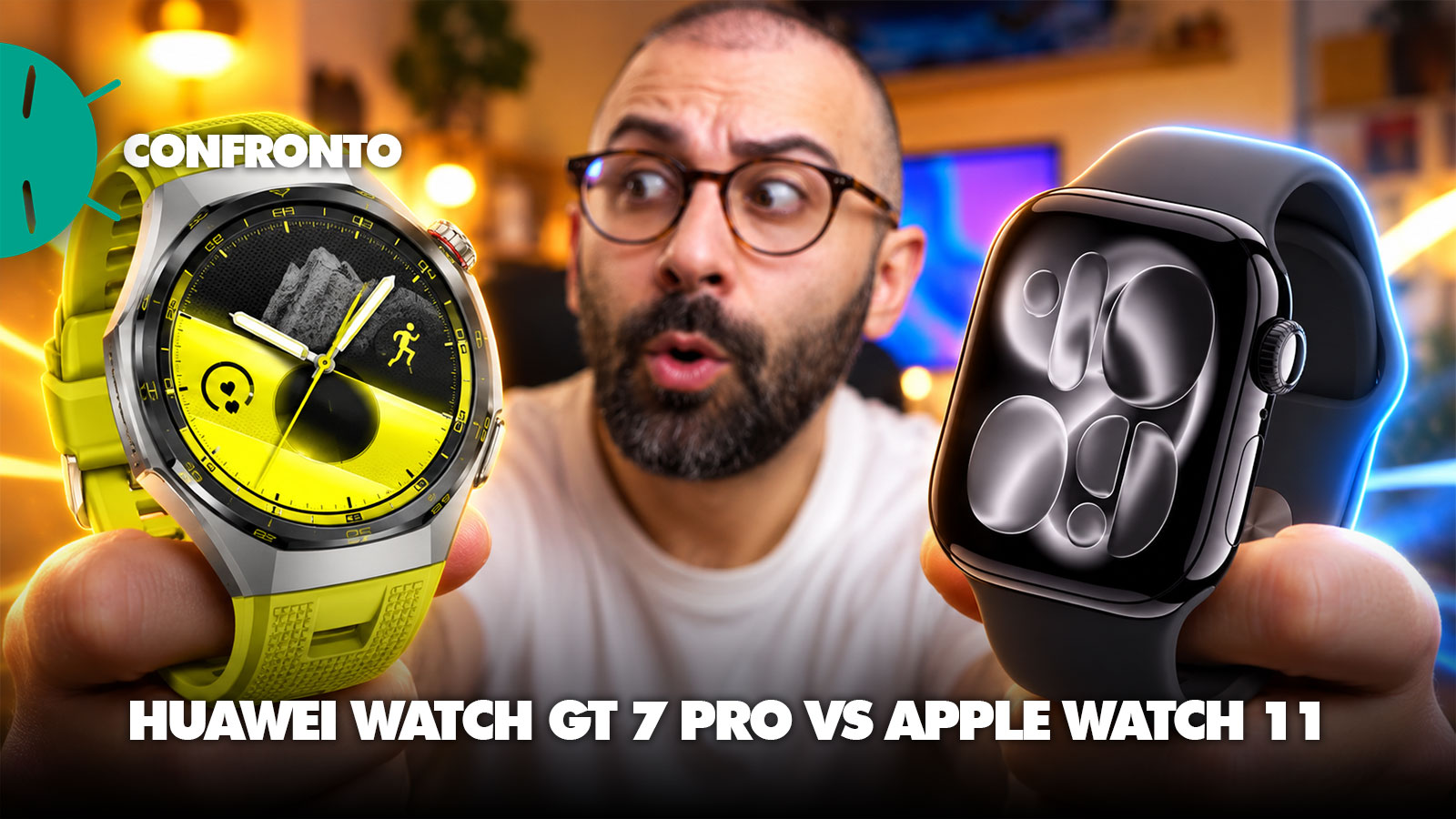
Apple Watch has over the years become almost the automatic benchmark when talking about smartwatches, but not necessarily because ite22s always the best in every single aspect, but because Apple has managed to build around its watch an extremely coherent experience: it works well, communicates perfectly with the iPhone, has tons of apps and has now become part of the collective imagination as much as the smartphone itself.
Huawei Watch GT 7 Pro comes from another direction, and in the end ite22s enough to look at them side by side to understand: on one side there is a device that has never tried to hide its technological nature, on the other a product that deliberately tries to resemble first a watch and then a smartwatch, and the comparison becomes interesting precisely starting from this aspect.
The new GT 7 Pro is a decidedly more ambitious product than the Watch Fit 5 Pro that we had compared with Apple Watch Series 11 a few months ago; Huawei this time uses titanium, ceramic and sapphire, introduces a much more sport-specific component and pushes the autonomy to numbers that belong almost to another category of product. Apple continues instead to do very well what it knows how to do: Series 11 is fluid, mature, complete and hardly replaceable if you really take full advantage of the iPhone ecosystem.
So they are two premium smartwatches, but with profoundly different priorities, and it is precisely by wearing them on the wrist for a few days that this distance becomes much more evident than a simple specifications table might suggest.
Huawei Watch GT 7 Pro vs Apple Watch 11
Design, construction and materials
Personally I have always had a certain preference for smartwatches that maintain the look of a traditional watch, and from this point of view the Huawei Watch GT 7 Pro starts ahead. The circular case, the pronounced bezel and the rather muscular design give it a personality that Series 11, deliberately much more minimalist, doesne2e2t even try to have.
Apple continues with the design we know practically from forever, refined generation after generation. The Watch 11 is slim, light and especially available in two sizes, 42 and 46 mm, so ite2e2s much easier to find the right size even if you have a small wrist, or vice versa. On Huawei this freedom doesne2e2t exist: GT 7 Proe2a0is available only in 46 mm, weighs about 56 grams without the strap and is just over 11 mm thick; I would be lying if I told you that on the wrist ite2e2s like not feeling it, especially in the first days, and on a very petite frame it can feel substantial. To tell the truth, aesthetically and constructively the GT7 Proe2e2s dimensions are its only “limit”, which done2e2t make it suitable for all wrists.

Where Huawei immediately regains ground is in the choice of materials, because the case is made of titanium alloy, the bezel uses nanoceramic and on the display we find sapphire glass, a standard equipment set on this model, not reserved for more expensive variants rich in extras.
With Apple the story is different, because the Series 11 more affordable uses aluminum and Ion-X glass; to reach titanium and sapphire you have to pay quite a bit more. The standard version remains well built and the new Ion-X is claimed to be more resistant to scratches than in the past, but simply comparing materials and price, Huawei offers a decidedly richer equipment.

I also like the EasyCross strap of the GT 7 Pro; with this type, the excess part is tucked inward and does not remain loose during a run or workout, while the fluoroelastomer used is soft and easy to clean, and in addition the quick-release system allows you to swap it without tools.
Apple, on the other hand, continues to have a huge advantage in accessory choice: the proprietary quick-attach system is very convenient and the range of straps, original or not, is practically endless. So we are talking about two almost opposite aesthetic concepts, with the Apple Watch representing the quintessential, most discreet and universal smartwatch and the Huawei GT 7 Pro with more character and a sense of greater ruggedness. On a small wrist I would undoubtedly choose Series 11, but if you want a watch that has presence and truly premium materials, the GT 7 Pro has a lot of charm.
Display
On both watches the display is already so good that it is hard to talk about real defects; Huawei uses a circular 1.47-inch AMOLED, 466 x 466 pixels, protected by sapphire glass and capable of reaching 3,000 nit of brightness. And I must say that brightness is one of the features I appreciated most, because indoors any modern smartwatch looks good, but the difference shows when you are outdoors, perhaps in direct sun, cycling or in the mountains, where reflections can become annoying. On the GT 7 Pro the information remains always very clear, even with dense screens of numbers and graphs during sport activity.

The sapphire then helps to use the watch with much less attention than usual. During weeks of use, both I and Luca or Dario, my colleagues who tried this watch before me, managed to “graffiare” the screen, a sign of a durability sought after and intended.
Apple Watch Series 11 reaches up to 2,000 nits, so on paper Huawei pushes further, but the quality of the Apple display remains excellent. The strong point of Series 11 is mainly how watchOS uses the panel: fonts, animations and screens have a graphical coherence that remains extremely hard to replicate. On Huawei the watch faces are very beautiful and the circular display particularly enhances those that imitate an analog dial, but in truth Apple makes better use of space to show information and apps.

It’s almost a matter of character: I prefer Huawei’s panel when I want the smartwatch to look like a watch, and the Apple one when I actually use it as a small digital interface on the wrist.
Prestazioni, sensori e monitoraggio
Apple Watch Series 11 is still one of the most immediate smartwatches you can use: if you touch something, it happens exactly what you expect, without hesitation, without screens that take half a second too long to load and without that typical feeling of some wearables where hardware and software seem to coexist more than be designed together.
On tracking Apple also starts from established bases: heart rate, ECG, sleep, daily activity, fall and incident detection, as well as the features introduced more recently like Sleep Score and notifications related to possible patterns associated with hypertension.

Huawei, however, with GT 7 Pro has chosen to push much further beyond the classic step counting; the Health Insights system brings together heart rate, HRV, skin temperature, sleep quality, stress and physical activity to build an indication of Physical Readiness. The part I found most successful is not so much the numeric score itself, but the Morning Brief. In the morning the watch tries to condense the work done by the sensors during the preceding hours and suggests whether the day is more suitable for an intense workout or if it would be better to ease off. It’s a smarter way to present data that, left alone, would risk appealing only to the most passionate users, who after the first weeks of euphoria would almost surely overlook it.
The GPS has also been improved. The GT 7 Pro uses a dual-band GNSS system with support for six constellations, and the tracking has generally been very accurate. The AI-XDR algorithm also attempts to reconstruct the route using the accelerometer and gyroscope when GPS loses signal, for example when entering a tunnel. It works well in some situations and less well in others, so I would avoid presenting it as an infallible solution. The real difference between the two models, however, becomes apparent when you switch to sport.

GT 7 Pro has received a very specific focus on skiing, with more than 3,000 topographic maps of resorts, slope data, Turn Detection and Team-Up to follow other members of the group. In cycling it can pre-analyze climbs of a GPX route, show elevation and gradient during ascent and warn of tight curves on the descent. Golf has a dedicated mode with course maps, shot distance, pin position and scorecard. Apple is probably simpler for those who want to go running, hit the gym and record activities without thinking too much. Huawei, instead, speaks more to those who already have a precise sport and want to derive from the watch information that we normally associate with more specialized products.
Autonomia
In terms of autonomy, the Apple device continues to lose every matchup, regardless of who its challenger is, even more so with this GT 7 Pro, where the comparison is really “ridiculous”. Apple Watch Series 11 officially lasts around 24 hours of use. In certain conditions you can go beyond and fast charging makes it relatively easy to top up energy in the morning while you get ready or before going to bed, but the routine remains: sooner or later, practically every day, you have to think about the charger.
With GT 7 Pro after a while you simply stop looking at the percentage; Huawei states 21 days with light use, 12 days with typical use and up to 51 hours of continuous tracking in Trail Running mode. In my test I wanted to make it more concrete: I started for ten days without bringing the charging base and used the watch almost without compromises, leaving automatic monitoring, Always-On Display and GPS on during walks. After ten days I was still a little under 20%. I managed to get through the following night and another day before recharging.

For me this changes much more than the battery life written in the spec sheet. I can sleep with the watch on every night without wondering when to recharge, head out for a weekend without bringing another cable and tackle a long outdoor activity without having to manage power-saving modes. Apple Watch Series 11 does many more things in the background and this naturally has an energy cost, but the difference remains enormous, and if autonomy ranks in the top three priorities when choosing a smartwatch, the comparison becomes quite unbalanced.
Software and apps on smartphone
This remains, however, the territory where Apple manages to create the greatest distance, also because watchOS doesne2e2t simply offer more applications: it offers a greater amount of interactions truly integrated with the smartphone. Apple Pay, Maps, Music, Siri, Notes, notifications, calls and Apple services work naturally because the watch and iPhone were designed as parts of the same ecosystem.
Huawei cannot fully replicate this experience, especially on iOS. HarmonyOS has nevertheless become an excellent smartwatch system: the animations are smooth, the screens scroll quickly and the side information panels are one of the parts I like, because they can contain a lot of data, even though Huawei manages to avoid that overload feeling that often occurs on the most technical sport watches.

The GT 7 Pro has, however, one feature that the Apple Watch cannot offer: it works with both Android and iPhone. It is a freedom that becomes interesting especially for those who change smartphones often or simply do not want to tie the watch purchase to the phone. There are still some inevitable compromises: the catalog of installable apps is much smaller than the Watch App Store, Celia is still fairly limited and payments via Curve require more steps than Apple Pay. Yes, there is NFC and it works, but the experience still doesne2e2t have the same immediacy as the Apple system.
Prezzo e considerazioni
Huawei Watch GT 7 Pro is offered in Italy at €429, with a launch promo that using code AGIZGT770 saves you €70, until October 18, 2026, a figure that basically puts it in the same ballpark as the Aluminum Apple Watch Series 11.
And it is precisely here that the comparison becomes interesting: at the same level of spend, Huawei already uses titanium, ceramic and sapphire glass, while to find comparable materials in the Apple catalog you have to look at decidedly more expensive configurations, about double the price. With the GT 7 Pro, two years of Huawei Care Pass are also included, which covers screen, battery, rear cover and crown under specific conditions.

This does not automatically make Huawei better, because as always it depends on what you want to do with the watch. If I had an iPhone and used Apple Pay, Siri, third-party apps, music and Apple services directly from the wrist, I would still choose Series 11. The integration remains deeper and the software experience is still superior. If, instead, I were to buy a watch mainly for sport, health, GPS and everyday use, GT 7 Pro would start to convince me quite a bit more. It offers more premium materials for the same price, lasts almost two weeks in normal use, is compatible with both operating systems and has very sophisticated tools for activities like cycling, skiing, trail running and golf.
Apple Watch 11 remains a better smartwatch for those who mainly seek the “smart” part. Huawei GT 7 Pro, as I see it, is a more interesting watch for those who want something to wear all the time, use in sport and forget for days about recharging. And this, more than a simple price difference, is the real choice that separates the two products.
I link di acquisto presenti in questo articolo generano una piccola commissione per GizChina.it. Scopri tutti i dettagli qui.
Se non visualizzi correttamente il box qui sotto, prova a disattivare AdBlock.
⭐️ Scopri le migliori offerte online grazie al nostro canale Telegram esclusivo.