

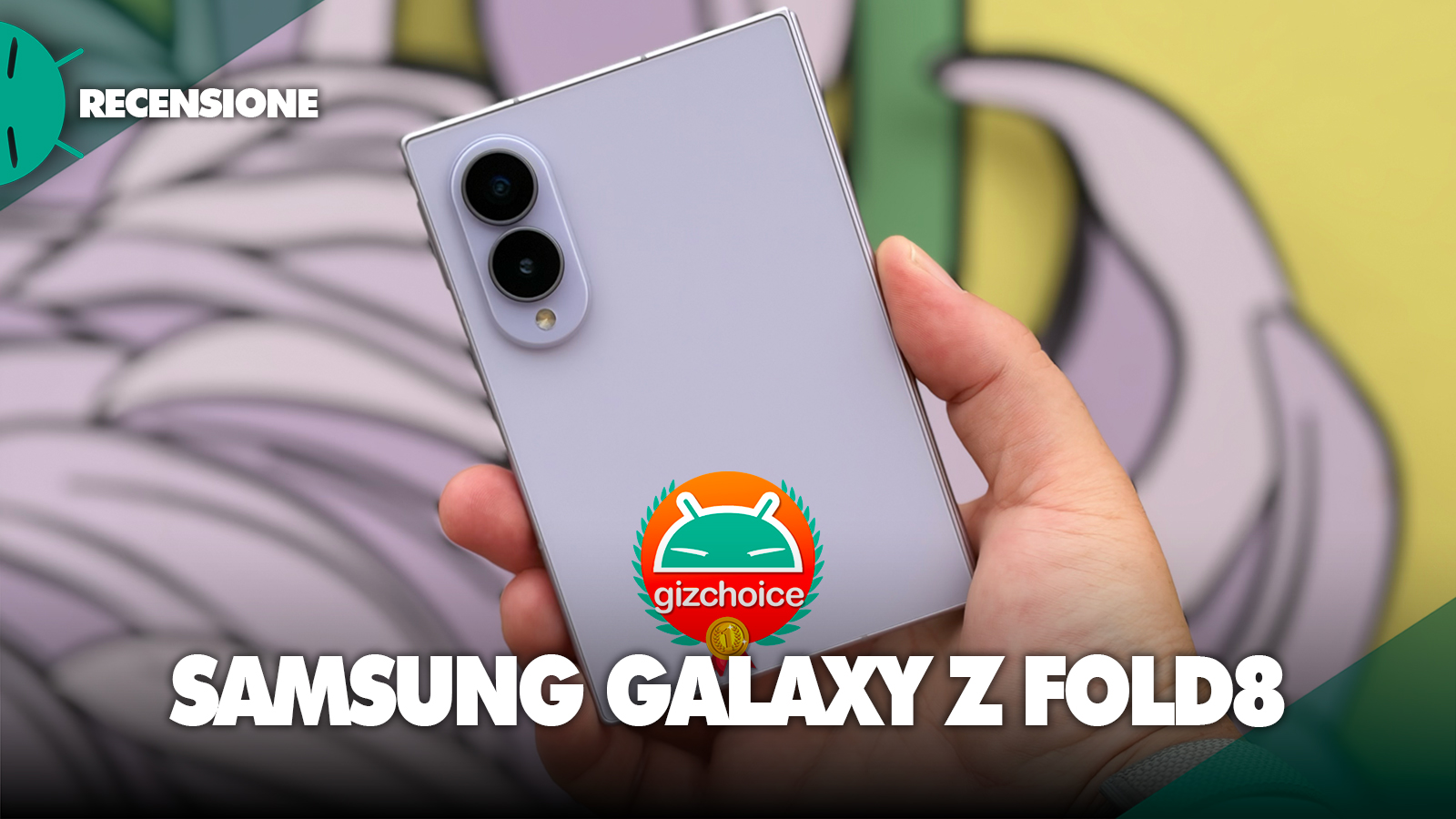
After years spent refining the same idea of a folding phone, Samsung has decided to change its philosophy completely. The Galaxy Z Fold8 is shorter, wider and above all much more comfortable to use when closed. It is a change that on paper may seem marginal, but just a few minutes in hand are enough to understand how much it can impact daily usage.
And I’ll tell you right away: among all the Galaxy Unpacked novelties, this is probably the product that surprised me the most. If in recent years I had always considered the Fold series as an extremely interesting smartphone category but still full of compromises, this new generation made me change my mind.
Attention though: the Galaxy Z Fold8 is not the perfect smartphone and not the best folding device in every respect. There are still some important compromises, especially considering the selling price above 2,000 euros. However Samsung has finally understood what the real “limit” of its previous Folds was, deciding to tackle precisely the aspect that probably influenced daily use the most.
After trying it, the feeling is that Samsung has not simply built a new foldable, but has redefined how such a smartphone should be conceived. And it did so also thanks to a series of software niceties that, on a smartphone with this format, make a lot of sense.
Samsung Galaxy Z Fold8 Review
Samsung Galaxy Z Fold8 Video Review
Design and Materials
When the Galaxy Z Fold8 is turned off, you can immediately notice that something has changed. The proportions are completely different from those of the previous Folds. The device measures 123.9 x 81.9 millimeters when closed, and when opened it reaches a width of 161.4 millimeters with a thickness of only 4.5 millimeters. It is also notably light: 201 grams.
The first impression is almost odd. When closed, the Galaxy Z Fold8 really resembles a passport. It is short, fairly wide and very unlike any other Samsung smartphone currently on sale in Italy. In the first minutes you almost feel like you are using a device that is “too small,” but that sensation quickly fades: after a few minutes you realize that Samsung has not simply shortened the phone, but has completely rethought how it should be used.
<!– wp:pgcsimplygalleryblock/slider {"sliderAdminWidth":840,"startPosIndex":0,"galleryType":"pgc_sgb_slider","galleryId":"04c99849","images":[{"id":678194,"title":"recensione-samsung-galaxy-z-fold8-1","url":"https://gizchina.it/wp-content/uploads/2026/07/recensione-samsung-galaxy-z-fold8-1.jpg","link":"https://gizchina.it/?attachment_id=678194","alt":"Recensione Samsung Galaxy Z Fold8: design del nuovo smartphone pieghevole Samsung","description":"","caption":"","mime":"image/jpeg","type":"image","width":1200,"height":675,"sizes":{"thumbnail":{"height":150,"width":150,"url":"https://gizchina.it/wp-content/uploads/2026/07/recensione-samsung-galaxy-z-fold8-1-150×150.jpg","orientation":"landscape"},"medium":{"height":169,"width":300,"url":"https://gizchina.it/wp-content/uploads/2026/07/recensione-samsung-galaxy-z-fold8-1-300×169.jpg","orientation":"landscape"},"full":{"url":"https://gizchina.it/wp-content/uploads/2026/07/recensione-samsung-galaxy-z-fold8-1.jpg","height":675,"width":1200,"orientation":"landscape"}},"imageMeta":{"aperture":"5.6","credit":"Luca Zaninello","camera":"ILCE-7CM2","caption":"","created_timestamp":"1783935607","focal_length":"70","iso":"2000"},"meta":false}]}In the previous Galaxy Z Fold iterations, the external display was wide enough for most operations but still fairly tall, often forcing you to move the grip to reach the top of the screen or requiring both hands for simple tasks. With the Galaxy Z Fold8, all of this changes.
Thanks to the new format, practically every part of the display is within easy reach of the thumb. Messages, notifications, social networks, browser, navigation and all those operations that are usually quick become truly convenient even with one hand.

And this is the most important step Samsung has taken. For the first time I used a Galaxy Fold without constantly feeling the urge to open it. The external display is finally enough to perform all the day’s quick tasks and this makes it much more natural to decide when to use the large inner screen.
Another aspect I appreciated is the new balance of the device. Despite the larger display, the Fold8 feels more stable when used with one hand and is less “slanted” than previous generations. It’s a hard-to-describe improvement, but noticeable in daily use.
From a build-quality perspective we are at the top again. The frame is made of Armor Aluminum, the new internal structure uses titanium components to improve rigidity and the hinge immediately conveys a sense of extreme solidity. The opening is smooth, precise and slightly more stable than previous generations. Unfortunately there is no Flex Mode, and it’s a pity because it was one of the modes I used most with the previous Folds.
Anyway, there’s no doubt: Samsung remains one of the industry benchmarks for the build quality of foldables. Tolerances are extremely tight, the two halves align perfectly and the device immediately conveys that premium product feel you expect from a device in this price range.

The central crease is still there. It’s right to note this, because it’s easy to raise unrealistic expectations. Run your finger across the display and you feel it and the backlight remains visible. However it is definitely far less pronounced than last year’s folds.
Even the thickness is convincing. Open, the Galaxy Z Fold8 is surprisingly slim and almost feels like using a small tablet. Closed, it remains a bit thicker than a traditional smartphone (albeit only slightly), but the lighter weight and new proportions make it much more pleasant to carry in the pocket compared to Fold devices of years past.
The IP68 rating remains unchanged. The phone can be submerged in water without issue, but it still doesn’t offer complete protection against dust and sand. It’s not a Samsung-only limitation, as it concerns nearly all foldables on the market today, but given the price above 2,000 euros it’s still an aspect I’d like to see improved in future generations.
If I had to sum up Samsung’s design work in one sentence, I’d say this: they didn’t try to make the Fold the thinnest in the world, they tried to make the Fold the most comfortable to use. And, at least in my view, they succeeded.
Display
The outer display is probably the most important novelty across the entire Galaxy Z Fold8. Samsung has chosen a 5.5-inch Dynamic AMOLED 2X panel with an adaptive refresh rate up to 120 Hz and a brightness that makes it usable even under direct sunlight.
However, if you limit yourself to reading the diagonal, you risk completely misunderstanding the device’s philosophy. Five and a half inches in 2026 may seem small, but the greater width completely changes the screen’s perception: it isn’t a display designed to replace the inner screen, but it’s finally large enough to use the phone normally without opening it every time.

Typing on the keyboard feels much more natural, reading a WhatsApp conversation is noticeably more comfortable, and even browsing social networks no longer gives the sensation of using a “compressed” screen. In short, it’s probably the first external Fold display that never made me think: “I’ll just open the phone.”
In fact, during testing I often found myself doing the exact opposite: using the external display for fast tasks and opening the Fold only when I really needed the larger screen. And this, in my opinion, is Samsung’s greatest achievement with this generation. More days passed and I realized I opened the device less and less. Probably the best compliment you can give to the new external display is that it no longer forces you to open the Fold for the most common operations, but allows you to use it exactly like a traditional smartphone.
But if the external display is the element that changes how you use the Galaxy Z Fold8 when it’s closed, the inner display remains the main reason to buy a folding device: Samsung has chosen a 7.6-inch Dynamic AMOLED 2X panel with a QXGA+ resolution, adaptive up to 120 Hz and a peak brightness that reaches 3,000 nits. True top-of-the-line numbers, but once again it’s the proportions that make the difference.
Hardware and Performance
Under the hood of the Galaxy Z Fold8 lies the Snapdragon 8 Elite Gen 5 for Galaxy, the most powerful processor currently available for Samsung smartphones. It is paired with 12 GB of RAM in the 256 GB and 512 GB storage variants, while the 1 TB model brings up to 16 GB of RAM. Storage uses latest-generation UFS memories, extremely fast for read and write operations.
In daily use the Fold8 behaves exactly as you would expect from a flagship: apps open instantly, multitasking is virtually instant and even switching between the outer and inner displays without slowdowns.

It is a smartphone designed for heavy use. You can open multiple apps at once, edit photos, edit video, handle complex documents or play the heaviest titles on the Play Store without ever feeling performance constrained.
But beyond benchmarks, what stands out most is the consistency of performance. During the test I never experienced slowdowns, forced app reloads or multitasking hesitations, even when rapidly flipping through many apps. It’s a device that always feels like it has plenty of headroom left.
Even in the most demanding games the processor offers high and steady performance. The frame rate remains stable and the cooling system keeps temperatures under control fairly well, although during long gaming sessions the top part of the shell tends to warm up. This is entirely normal given the device’s extremely thin profile when open. Wi-Fi 7, Bluetooth 6.0, NFC, Ultra Wideband, Dual SIM with eSIM, USB-C 3.2 and stereo speakers complete the package.
The in-display fingerprint sensor remains embedded in the side power button. Some may consider it less modern than under-display optical readers, but in practice it remains one of the fastest and most reliable options on Android today. The proximity sensor is also solid; in my tests it never missed a beat in calls or when listening to voice messages on Telegram and WhatsApp.
Cameras
The Samsung Galaxy Z Fold8’s camera system consists of a 50‑MP main camera with optical stabilization and a 50‑MP ultra‑wide camera. There is no dedicated telephoto lens, a choice that clearly differentiates this model from the Galaxy Z Fold8 Ultra, but which is also the most evident compromise of the entire spec sheet.
This is an aspect that initially gave me some doubt. We are talking about a device that costs over 2,000 euros and, at this price, you expect a photo setup with no compromises. After trying it, you have to admit Samsung has done a very good job optimizing the two sensors present.