


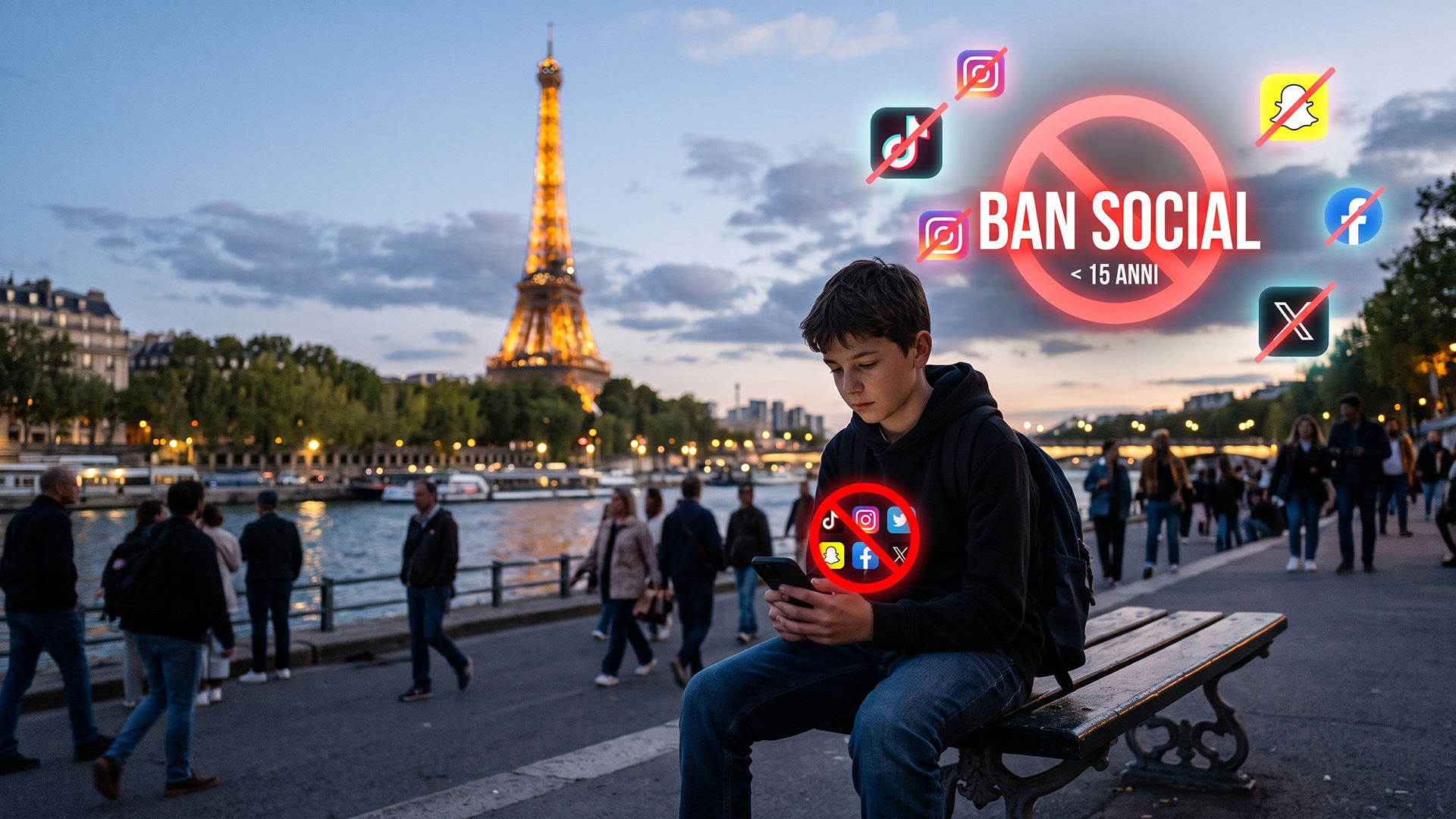
France has drawn a clear line on the use of digital platforms by minors, establishing a continental benchmark.
The law, driven by growing concern for mental health of adolescents, fits into a broader wave of international regulations aimed at protecting the most vulnerable from the adverse effects of online content.
France bans social networks for minors under 15
The measure, strongly supported by President Emmanuel Macron as a significant act of his second term, will be implemented following two precise deadlines.
From the month of September, coinciding with the start of the school year and with the introduction of the ban on smartphone use inside high schools, it will no longer be possible for minors under 15 to open new profiles.
The directive will reach full effect in January 2027, a moment when the restriction will be extended rigorously to all existing accounts.
To operationalize this digital barrier, tech companies will have to integrate certified age-verification systems by the French authority for digital communications, the Arcom.
The government has reassured the public about the effectiveness and safety of the monitoring tools, rejecting fears of privacy violations.
Alarming data and health impact
The urgency of this political action is driven by statistics described as worrying. According to the French health observatory, 90% of young people aged 12 to 17 regularly access the Internet via their own devices, and 58% of these use social networks regularly.
Specifically, daily time spent on apps like TikTok reaches on average 1 hour 21 minutes.
Continued exposure to uninterrupted video streams, driven by predictive algorithms, has highlighted widely documented negative consequences. These range from lowered self-esteem to the development of eating disorders, depression, and forms of self-harm.
Several French families, supported by pediatricians and associations for the protection of minors, have welcomed the law as a necessary move, comparing the blocking of digital platforms to the strict regulation imposed on alcohol consumption.
Europe and the rest of the world
Paris’s decision follows in the footsteps of Australia, a pioneering nation that has recently barred the use of social networks for minors under 16, introducing million-dollar penalties for non-compliant multinationals.
The entire European continent is moving in the same direction: the United Kingdom has already planned similar bans expected for 2027, while countries such as Spain, Denmark and Greece are refining their proposed laws.
The President of the European Commission, Ursula von der Leyen, has urged strict measures at the community level, firmly stating that social networks are not toys.
The Commission believes that the safety responsibility of a product should fall entirely on those who design it, comparing digital guarantees to the safety systems provided by car manufacturers.
Criticisms and the problems arising
Despite broad support for the measure, the law has faced obstacles and doubts, particularly from political opposition and some human rights organizations.
Critics highlight the risk that stringent age checks could effectively erase online anonymity for any user, making web browsing constantly monitored.
Moreover, media scholars note that young people, equipped with excellent IT skills, can easily bypass age barriers, ending up retreating to virtual spaces even less regulated and more dangerous.
It remains to be seen whether the protection infrastructure devised by the French state will prove inviolable or whether it will require constant technical adjustments over the years.