


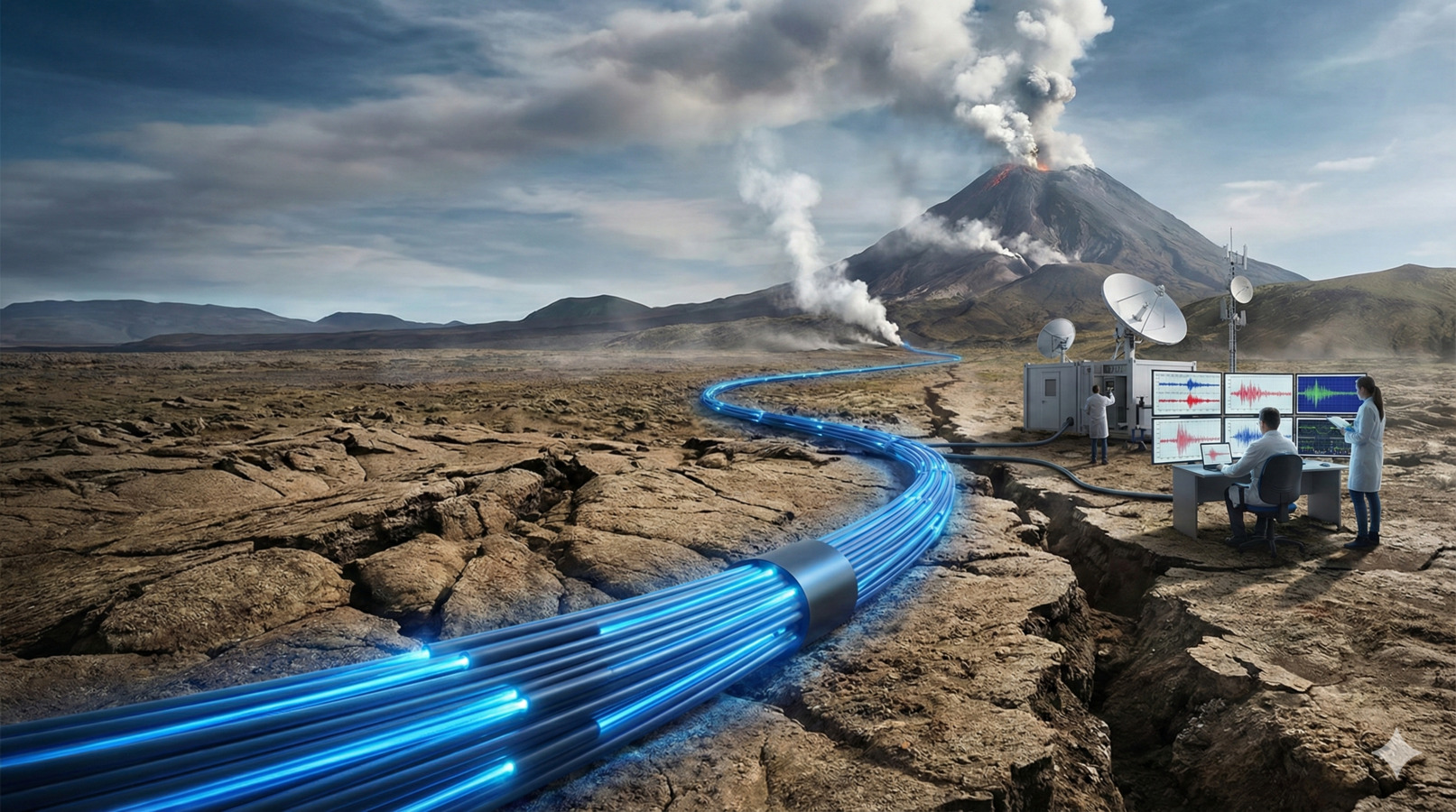
A recent Memorandum of Understanding signed by the National Institute of Geophysics and Volcanology (INGV) and FiberCop marks the start of a collaboration aimed at transforming ordinary telecommunications cables into a large network of sensors for geological monitoring.
The agreement aims to enhance the capabilities for observing geophysical phenomena, pairing traditional instruments with advanced technology based on leveraging network infrastructure.
The country’s fiber-optic cabling thus ceases to be merely a vehicle for internet traffic and becomes a powerful tool for civil protection and prevention.
FiberCop and INGV, the fiber network as a sensor for geological monitoring

The technology underlying this innovation is called Distributed Acoustic Sensing (DAS). Through this system, the connections in optical fiber are converted into a dense network of sensors sensitive to the faintest ground vibrations.
The peculiarity of the DAS lies in its intrinsically distributed nature: the system is capable of deriving an actual measurement point every five meters along the entire length of the network.
This exceptional sampling density exponentially increases the probability of recording extremely low-magnitude events, proving particularly useful during seismic swarms or in harsh environments for traditional seismographs, including deep-sea seafloor.
From the island of Vulcano to the Phlegraean Fields
The first practical applications have already provided concrete and high scientific value. On the island of Vulcano, for example, scientists have intercepted over 1,400 seismic events in the course of a single month.
The processing of a substantial amount of data, exceeding twenty terabytes, has been successfully addressed thanks to the use of artificial intelligence and high-performance computing systems, offering the possibility to study in detail the state of the hydrothermal system in the area.
Meanwhile, another essential area of study is underway in the Phlegraean Fields, a territory highly sensitive due to its complex bradyseismic dynamics.
Here, a stretch of about twenty kilometers of fiber connects the areas of Bagnoli and Bacoli. For this specific sector, INGV has developed a dedicated software that, leveraging advanced algorithms, analyzes signals acquired in real time and performs automatic detection of every single soil anomaly.
Safety and resilience of the territory
The leaders of the two entities emphasize the value of the agreement for the protection of citizens. Fabio Florindo, president of INGV, notes that the adoption of these innovative methodologies can strengthen the effectiveness of field observations, ensuring continuous, integrated and efficient monitoring, especially in areas with higher geological risk.
For his part, Massimo Sarmi, President and CEO of FiberCop, underscores how the connectivity asset can evolve into a platform for environmental protection.
The agreement shows how technological innovation can blend with responsibility toward the community, placing telecommunications networks as a fundamental element for national resilience.
The future prospects of the agreement include further collaborations with the academic world and participation in European projects to explore new functionalities of optical sensors, reaching even measurements of thermal and mechanical variations of the ground.