


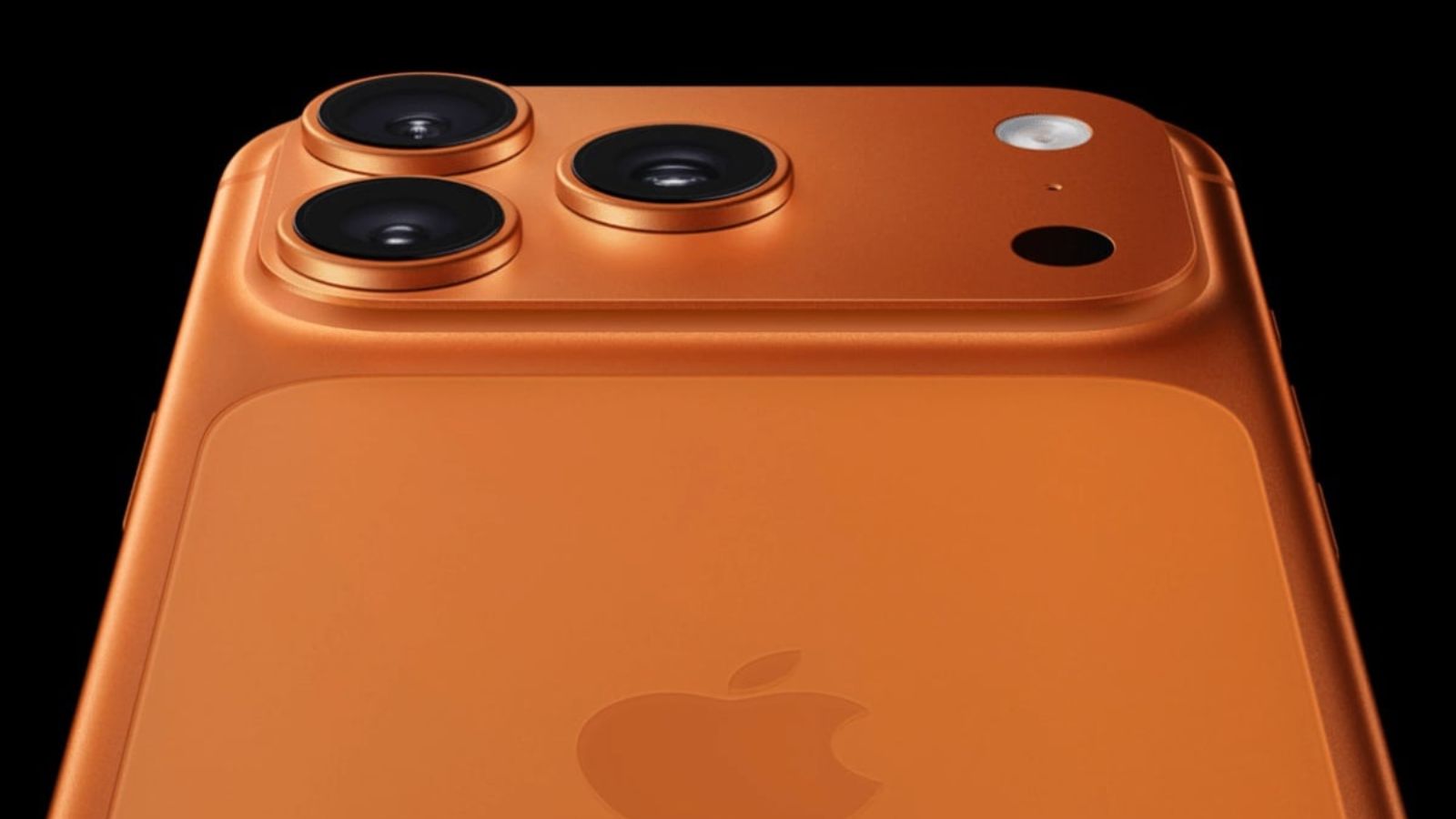
Although Apple has recently updated its standards by introducing 48 MP sensors on its flagship models, new rumors suggest that the Cupertino-based company is planning a far more massive generational leap.
However, according to the latest market analyses, this epoch-making change could take several more years, placing the iPhone on a trajectory that would lag behind Samsung’s Galaxy S rivals in terms of specifications by a substantial delay.
iPhone with 200 MP cameras? Here’s when it should happen

The current rear cameras of iPhones rely on 48 MP sensors, a choice that offers an excellent balance between resolution and light management.
However, a recent report has reignited interest in a future of extremely high resolution. An investor note prepared by Morgan Stanley, and reported by Apple Insider, outlines a scenario in which the first iPhone equipped with a 200 MP camera could debut on the market only in 2028.
This forecast pushes back Apple’s hardware innovation clock, suggesting that the transition will happen, but with extended timing relative to the competition. If the analysis proves correct, we would be looking at a long-term strategy, where the California-based company prefers to wait for technological maturation rather than chasing immediately the numbers proposed by rivals.
A Strategic Victory for Samsung Technology
A crucial aspect highlighted by the report concerns the origin of the components. It seems that Apple could indeed rely on the 200 MP sensors produced by Samsung to equip future iPhones.
This would represent a significant victory in terms of design and supply for the South Korean giant, consolidating an industrial partnership that sees the two companies collaborate closely despite fierce commercial rivalry in stores.
This would not be an isolated case: Samsung has recently secured orders to supply ultra-wide 48 MP sensors for future iPhone models.
The possible adoption of ISOCELL 200 MP sensors would mark another point in favor of Samsung’s semiconductor division, confirming the quality of its hardware solutions. It remains to be clarified whether Apple will opt for sensors already existing in Samsung’s catalog or whether it will require, as is often the case, the development of a custom and optimized sensor specifically tailored to iOS needs.
Validation of the Galaxy S Philosophy
The potential transition of Apple toward 200 megapixels would carry with it a not insignificant symbolic meaning. If Cupertino were to embrace this resolution, it would constitute a retrospective validation of Samsung’s strategy.
The Korean company, in fact, introduced 200 MP sensors as early as 2023 with the launch of the Galaxy S23 Ultra, betting on this technology as the main path for the future of mobile photography.
An Apple arrival to these standards in 2028 would mean adopting the same philosophy five full years after the main competitor. This scenario would show that Samsung’s early move was not just marketing, but a correct vision of the sector’s technological evolution.
Beyond the numbers
From a purely technical standpoint, it is important to underline that a 200 MP sensor is not necessarily bigger in physical dimensions than the current 48 MP cameras on iPhones. The real difference lies in pixel density and the resolution offered.
This very high pixel count allows capturing an unprecedented level of detail, but requires adequate support from the rest of the hardware.
To fully leverage such a sensor, it is necessary to pair it with extremely powerful chips and advanced image processing algorithms. Multi-frame capture and noise reduction become essential to handle such complex files without sacrificing quality, especially in low light conditions.
The challenge for Apple, therefore, will not only be implementing the sensor itself, but achieving perfect integration with the image processor to justify, in a few years, the move to such a high resolution.