In recent years, compact wireless microphones have become one of the most-used accessories for creators, videographers and communication professionals. They are no longer just for interviews or structured productions: today they accompany daily Reels, vlogs, reviews, video podcasts and content recorded directly with a smartphone.
In this scenario, DJI has progressively built a range suited to practically every type of user. On one side we find the more complete models, designed for professional productions; on the other, the Mic Mini family, born to offer a lighter, more immediate system and easy to carry with you at all times.
With the new DJI Mic Mini 2S, however, the concept of “Mini” changes slightly in meaning. The dimensions remain extremely compact, but the functions begin to approach those of higher-end products. The most important novelty is certainly the internal recording in format 32-bit float, complemented by the ability to connect up to four transmitters, AI-based noise cancellation and built-in memory in each microphone.
DJI Mic Mini 2S Review
Bundles, accessories and available versions
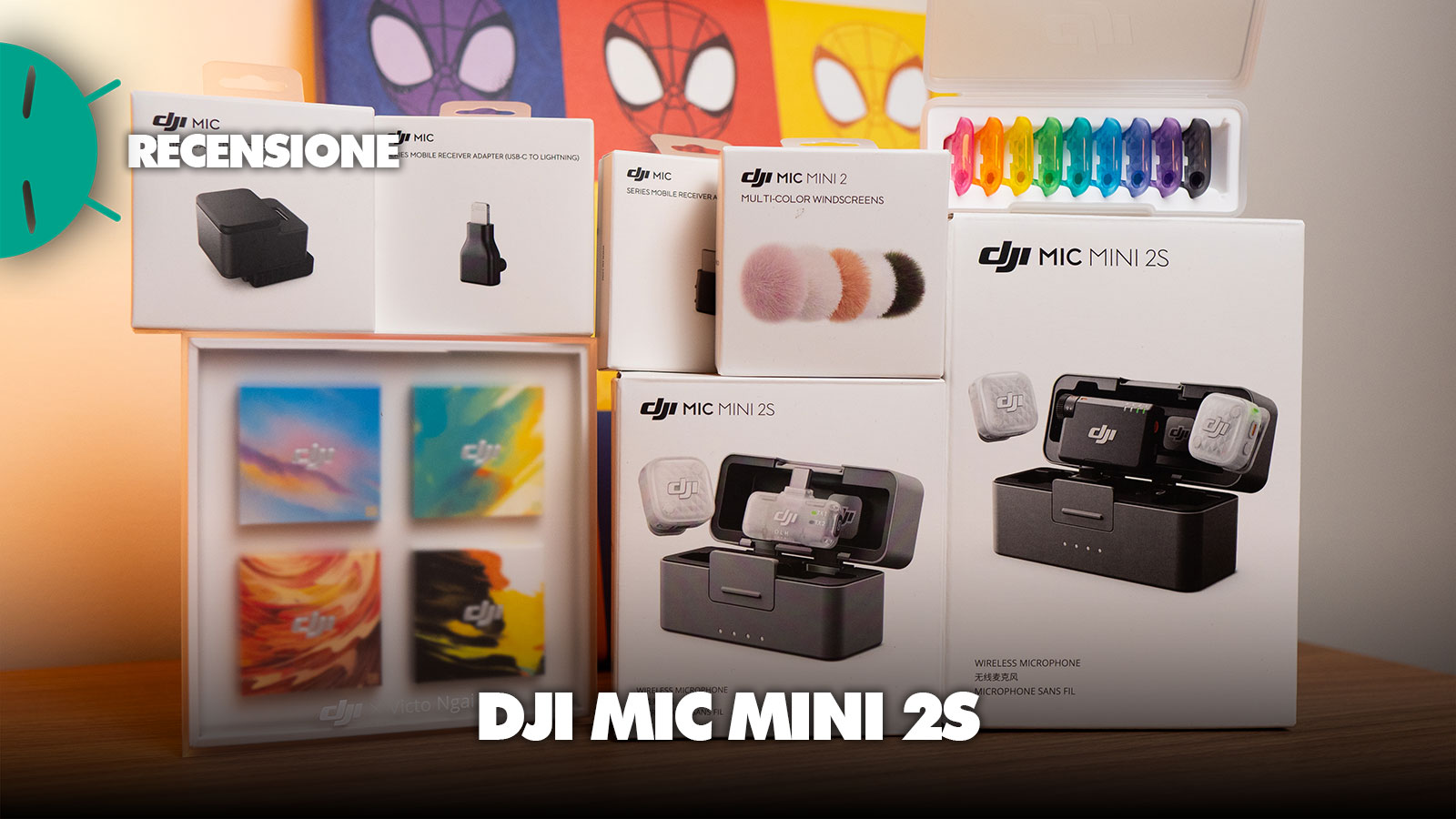
One of the most interesting aspects of the DJI Mic Mini 2S is the number of configurations available; DJI does not force all users to buy the most complete kit, but offers several bundles designed for different recording modalities. The main configuration includes two transmitters, a standard receiver and the charging case: it’s the most suitable package for those who work with mirrorless cameras, conduct two-person interviews or want to have a complete and expandable system right away. There is also a version composed of one transmitter and a standard receiver, more suitable for those who mainly record solo but use cameras, computers or different devices.

For creators who work mainly with smartphones, DJI offers instead a bundle with one transmitter, a small USB-C receiver and the charging case. It is probably the most practical solution for Reels, TikTok, YouTube Shorts, on-the-move videos and content where the smartphone is the main recording device. Finally, it is possible to purchase the single transmitter separately. This is a particularly useful option considering that the Mic Mini 2S receiver can handle up to four microphones simultaneously. A kit designed for two-person interviews can therefore be expanded later and used for podcasts, roundtables or content with more guests.
The included package naturally varies depending on the bundle chosen, but in the most complete box you will find the transmitters, the receiver, the charging case, the USB-C adapter for smartphones, the 3.5 mm TRS cable for cameras, the wind protections, the clips, the magnets and a soft carrying case. The Lightning adapter, however, must be purchased separately. The attachment of the transmitters can occur either via the back clip or using the magnet. With only 12 grams of weight, the microphone remains unobtrusive even on t-shirts and light fabrics, without pulling the collar downward too much.

Also returning are the interchangeable magnetically attached front covers. At first glance they might seem just an aesthetic element, but they become surprisingly useful when using three or four transmitters: assigning a different color to each person allows you to immediately recognize the microphones and simplifies track organization during editing.
Technical specifications and features
The DJI Mic Mini 2S use a condenser microphone with an omnidirectional polar pattern; the stated frequency response ranges from 20 Hz to 20 kHz, while the signal-to-noise ratio reaches 72 dB. The system transmits audio at 48 kHz and 24 bit, while internal recording can be performed at either 24 bit or in 32-bit float format. Each transmitter includes nominal 16 GB of memory, of which about 14.5 GB are usable for recordings. The available space allows storing up to about 28 hours of audio at 24 bit or approximately 22 hours using the 32-bit float format.

The internal recording represents the real evolution compared to previous Mini models; here the audio is no longer transmitted only to the receiver, but can be saved directly on the transmitter. If the wireless connection were to be interrupted, the local file would continue to be recorded, greatly reducing the risk of losing an important take. The 32-bit float also offers a very wide margin for recovery in post-production; a voice recorded at a too-low level can be amplified more easily, while a sudden peak has less chance of permanently compromising the file. This does not mean you can completely ignore gain and proper microphone positioning, but it represents an important safety net in less predictable situations.
In addition to this function are Clipping Control, which automatically intervene on the most sudden peaks, and volume balancing, designed to make the recorded passages more uniform across different intensities. There is also a Safety Track, i.e., a second track recorded at a 6 dB lower level. It can come in handy especially when recording directly on the camera and you want to have a backup copy less exposed to distortion. The channel management modes include Mono, Stereo, Safety Track and Quadraphonic. The latter allows separating the recordings of four transmitters, making it particularly interesting for podcasts and interviews with more participants. To fully take advantage of this configuration, it is necessary to switch from the DJI Mimo app and, in some camera workflows, use the dedicated compatible accessories.

The transmission takes place on the 2,400 to 2,4835 GHz band, with a theoretical range that can reach up to 400 meters using the standard receiver in ideal conditions and with line of sight. With the mobile receiver the distance is reduced, but it remains more than sufficient for most social or light productions. The system also uses Bluetooth 6.0 and can connect directly to devices compatible with OsmoAudio, eliminating the need to use the receiver with some DJI cameras. This makes the setup particularly clean with action cameras and Osmo family devices.
Regarding battery life, DJI states about 11 hours for each transmitter and 10 hours for the receiver, with noise cancellation and internal recording disabled. The case allows fully charging two transmitters and one receiver for about 3.2 times, bringing the system’s overall endurance to around 40 hours. Naturally, enabling the 32-bit float, internal recording and noise cancellation simultaneously reduces the actual endurance. It remains more than adequate to cover an entire day of recordings without particular concerns.

Many of the advanced settings are managed through the DJI Mimo app. From here you can adjust gain, choose the internal recording format, activate the Safety Track, modify channel configuration, and select the level of noise cancellation. Essential functions, such as starting recording, pairing and activating the noise reduction, remain accessible through the physical buttons. The app is therefore not indispensable for every use, but becomes practically mandatory when you want to fully leverage the system.
Among the most notable omissions are timecode, a display on the receiver and the 3.5 mm input on the transmitter to connect an external lavalier. The Mic Mini 2S must therefore remain visible and worn directly, while those who need to hide the microphone under clothing will have to look toward a higher-end product.
Quality of audio recordings
From a sonic perspective, the DJI Mic Mini 2S confirms the good quality achieved by the company in previous generations; the voice is recorded clearly and intelligibly, with a sound profile already fairly rich on the mid-low frequencies. The default sound is not overly thin and manages to reproduce a pleasant voice even without special post-production adjustments. This is an advantage especially for those who produce content quickly and want to achieve a usable result without spending too much time on equalization and compression.
Through DJI Mimo you can choose three vocal profiles: Normal, Brilliant and Rich. The first offers the most balanced result and is probably the best choice in most cases. Brilliant emphasizes the higher frequencies more, making the voice more present, while Rich tries to add further body and warmth.

However, the differences among the three profiles are not drastic. They can help slightly tailor the sound to the timbre of the person recorded, but they do not radically change the microphone’s character. To obtain a more precise customization you’ll still need to intervene in post. The real qualitative advantage of this generation does not come from a clear change in the microphone itself, but from the ability to record internally in 32-bit float. The base performance remains close to that of the Mic Mini 2, but the local file offers much more freedom when recovering abrupt volume changes or recordings made with imperfect gain.
Also very interesting is the AI-based noise cancellation, available in two levels. The Base mode is designed to attenuate constant and relatively light noises, such as fans, air conditioning and ambient office noise. The Forte mode intervenes more decisively and is more suited for outdoor recordings, traffic or particularly noisy environments.

In situations with continuous noise, the algorithm convincingly isolates the voice. As with almost all mics in this category, difficulties increase with irregular sounds: people speaking suddenly in the background, sharp knocks or passing vehicles can be attenuated but not completely eliminated. The most aggressive mode yields the most evident result, although in some cases it can make the voice sound slightly more artificial. It is therefore advisable not to enable it automatically in every recording, but to use it when ambient noise would genuinely compromise intelligibility. There is also a Low Cut filter that extends the frequency response from 100 Hz to 20 kHz. Its job is to reduce some low-frequency noises, such as vibrations, wind, distant traffic or hum from air conditioning.
Price and final considerations
The DJI Mic Mini 2S arrives on the Italian market with a higher price than the previous generation. The complete bundle with two transmitters, a receiver and the charging case costs 189 euros. The version with one transmitter and a standard receiver is offered at 99 euros, as is the kit composed of one transmitter, mobile receiver and case. The single transmitter costs 69 euros. Among optional accessories you will find the charging case sold separately for 33 euros, the set of colored magnetic covers for 19 euros and Time-series covers for 39 euros. The comparison with the Mic Mini 2 is inevitable: the previous full kit was launched at a noticeably lower price and, from the standpoint of pure sonic performance, the differences between the two generations are not huge.
The question to ask is therefore very simple: how valuable are internal recording and the 32-bit float in your workflow? For a creator who records solo, in controlled environments and with the receiver always nearby, the Mic Mini 2S remains a valid and more affordable solution. Those who conduct interviews, events, unique content or productions with more people will find in the Mic Mini 2S a decidedly safer and more versatile system. Internal recording prevents a wireless drop from ruining a take. The 32-bit float offers greater editing freedom, while compatibility with four transmitters allows the system to grow over time without buying a second kit.
The price of 189 euros isn’t particularly low compared to the previous Mini models, but it remains interesting given the features offered. There are still some compromises: there is no timecode, the input for an external lavalier is missing, the receiver does not include a display, and many advanced adjustments must go through the application. Despite these concessions, the DJI Mic Mini 2S represents one of the most complete compact wireless systems in its class.
I link di acquisto presenti in questo articolo generano una piccola commissione per GizChina.it. Scopri tutti i dettagli qui.
Se non visualizzi correttamente il box qui sotto, prova a disattivare AdBlock.
⭐️ Scopri le migliori offerte online grazie al nostro canale Telegram esclusivo.