


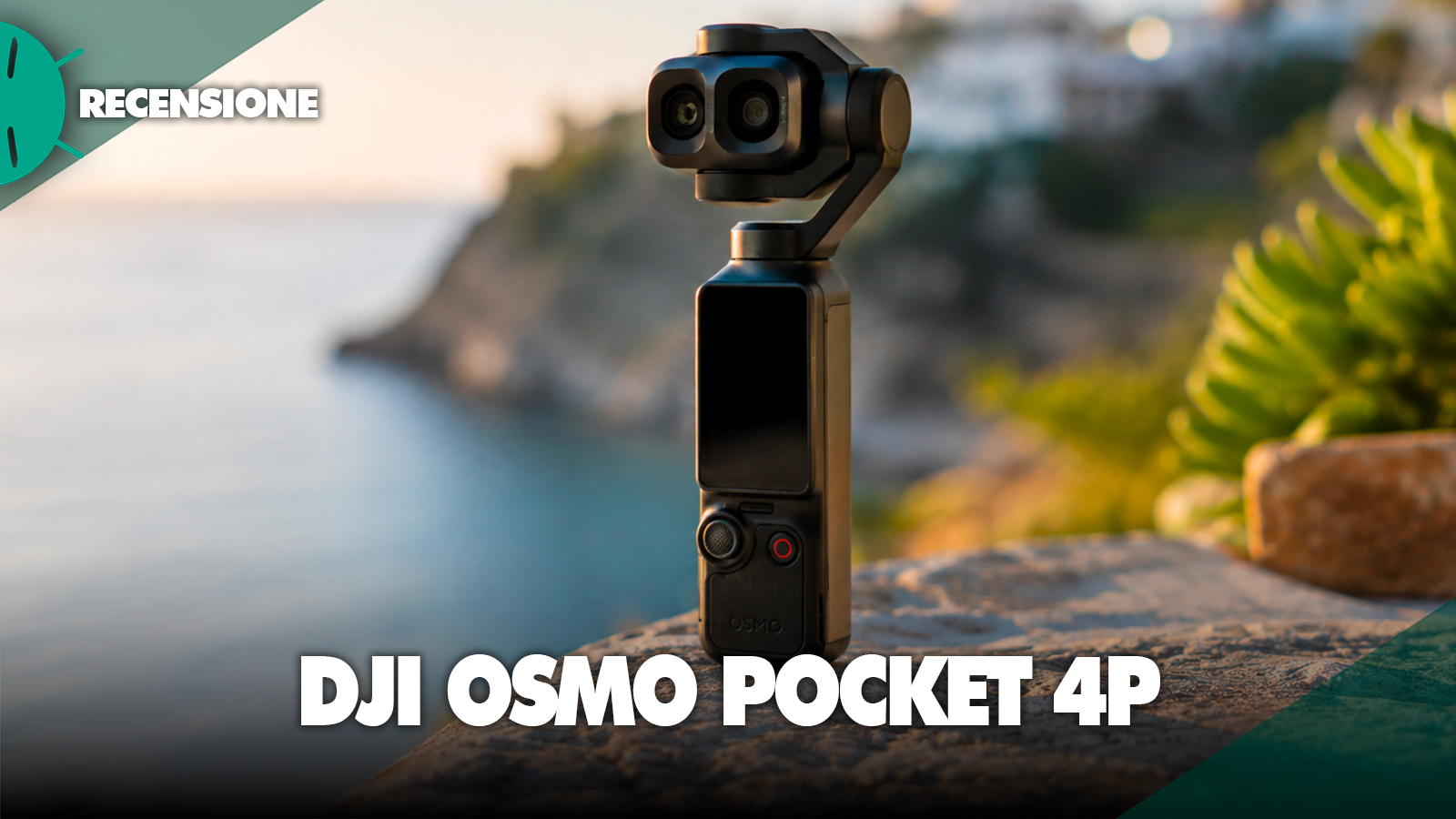
When DJI introduced the first Osmo Pocket, it almost managed to create a product category that didn’t exist until then. The idea of housing a three-axis stabilized camera inside a truly pocketable body was so brilliant that over the years it has become the reference tool for creators, videographers, journalists and anyone who needs to record quality content without lugging mirrorless cameras, a gimbal and lenses.
Well, with the DJI Osmo Pocket 4P the Chinese company doesn’t just update the previous design, but introduces several innovations that substantially change the way you use a camera of this type. The most evident is certainly the new dual-lens system, a solution that allows switching from a wide-angle focal length to a mid-telephoto without resorting to digital crops, greatly increasing versatility during recording.
Alongside this novelty we find a new 1‑inch sensor, the D-Log 2 color profile at 10-bit, a dynamic range of no less than 17 stops, the new ActiveTrack 8.0 system and numerous software refinements that make this Pocket the most complete DJI has ever built.
After several years in which the market seemed to have stabilized, DJI returns to innovate a sector it has itself created. The question, however, remains the same: is the price really worth it? And above all, does it represent a genuinely interesting upgrade for those who already own a Pocket 3 or does it remain a camera destined exclusively for creators?
DJI Osmo Pocket 4P Review: the best pocketable camera of 2026?
Packaging and Bundles
DJI continues to offer packaging that is extremely well curated, as we have come to expect for many years. The unboxing experience is premium and immediately conveys the sense of facing a product designed for professional use. The standard version includes everything you need to start recording right away: the camera, the protective cover, the USB-C cable for charging and data transfer, the wrist strap and the essential accessories for daily use.
There are also two “Combo” bundles. The Standard Combo represents the entry point to the range and includes everything needed to start recording immediately, from the camera to the protective case, including the grip with a 1/4‑inch thread, the USB-C cable, the wrist strap and the handy fill light.
For those who create content more frequently, the Vlog Combo is available, adding a series of particularly interesting accessories such as the DJI Mic Mini 2 for higher‑quality audio recording, the new FrameTap for remote camera control, the Osmo mini tripod and a roomier premium case.
Personally, if the aim is to use the Osmo Pocket 4P for YouTube, Instagram or TikTok, I believe the Vlog Combo is the most sensible choice: the price difference compared to the Standard version is relatively modest and buying the same accessories separately would be considerably more expensive, in addition to providing a complete user experience from day one.
Design and Build Quality
Looking at the Osmo Pocket 4P up close, you might almost think it looks identical to the previous generation, but a few minutes of use are enough to realize how much work has been done under the shell. DJI has maintained the design philosophy that made the Pocket family famous: extremely compact dimensions, lightweight, and the ability to literally slip it into your jeans pocket without adding any bulk.


With around 230 grams, the Osmo Pocket 4P continues to be one of the most portable stabilized cameras on the market. It’s one of those products that always ends up in the backpack simply because it doesn’t take up space and is ready to use right away.
The materials convey a strong sense of solidity. The plastic used is of high quality, the assemblies are impeccable and even the new optical block appears very robust despite the small size. It remains one of the elements I’ve always appreciated most in the Pocket family: the three‑axis mechanical gimbal protects the camera automatically when it is turned off, reducing the risk of damage during transport. Unfortunately, unlike the Insta360 Luna Ultra, the Osmo Pocket 4P doesn’t come with a protective case for transport. A pity.

The touchscreen display continues to be one of the strengths of the interface. The rotation not only allows quick switching from horizontal to vertical mode, but also to instantly turn on the camera and start recording in just a few seconds.
It’s a feature that may seem trivial on paper, but in daily use makes a real difference. Often the best moment to shoot lasts only a few seconds, and being able to start recording almost instantly represents a huge advantage over a traditional mirrorless camera.
Sensors and Dual Lens
The real revolution introduced by DJI concerns, however, the optical section. For the first time the Pocket line integrates two physically different lenses, eliminating one of the main limits of previous generations.
The main lens uses a new 1‑inch CMOS sensor paired with an approx. 20 mm equivalent focal length and an f/2.0 aperture. This is the camera intended for most situations: vlogging, landscapes, interiors, urban shots and moving video.

Next to it sits a second lens equivalent to about 60 mm with an f/1.8 aperture, designed mainly for portraits, detail shots and sequences where you want to compress perspective further. And the difference compared to a simple digital zoom is huge.
When using a wide-angle focal length, the subject tends to appear farther away and the background adopts a much wider perspective. With the new telephoto lens, the scene changes completely: the subject gains prominence, the background is compressed and the final effect resembles that of a professional video camera much more closely.
For those who create vlogs, this means being able to quickly alternate between two completely different cinematic languages without having to change lenses or use external accessories.

Even during product shoots this solution offers clear advantages. It’s possible to switch from a wide shot to a more natural close‑up without compromising image quality through digital crops.
A further especially interesting novelty concerns the new main sensor. DJI continues to use a 1‑inch sensor but introduces a new LOFIC‑based architecture (the same seen in the Xiaomi 17 Ultra, for example), a solution designed to dramatically increase the available dynamic range.
In practical terms this means being able to record many more information both in highlights and shadows at the same time.
Imagine a classic sunset shot or a person backlit in front of a window. In such situations a traditional camera tends to sacrifice one area of the image: either the sky is blown out or the subject’s face becomes too dark.

Thanks to the new sensor architecture, DJI claims a dynamic range up to 17 stops, a figure that on paper approaches that of significantly more expensive cameras intended for the cinema sector. Naturally the figure tells only part of the story, but the principle is extremely interesting because it offers more freedom both during recording and in the subsequent color grading phase.
For those who routinely work with software such as DaVinci Resolve, Premiere Pro or Final Cut Pro, it means being able to recover a much higher amount of detail without introducing digital noise or artifacts that are particularly evident.
D-Log 2 at 10-bit
Among the updates I personally consider most important is the introduction of the new D-Log 2 color profile at 10-bit. Beginners might think it is just a flatter image, but in reality the functionality is quite different.
A Log profile intentionally records a flat and low-contrast image because its aim isn’t to be immediately pleasing, but to preserve as much color information as possible.

Thanks to the 10‑bit recording you capture over a billion colors, compared to about 16 million in a traditional 8‑bit file. This means you can adjust exposure, white balance and intervene on color correction with a significantly higher degree of freedom, reducing the risk of color banding and maintaining much more natural transitions between tones.
It’s a feature that many casual users will probably never use, but it represents an important step toward increasingly professional use of the Pocket family.
In short, combining the new sensor, the greater dynamic range and the D-Log 2, DJI has clearly aimed to bring the quality of its pocket cameras closer to that of products that, until a few years ago, belonged to completely different categories.
Video Quality, Stabilization and ActiveTrack 8.0
If the design represents a relatively conservative evolution compared to the previous generation (apart from the dual lens), it is during filming that DJI Osmo Pocket 4P really shows the work of the company’s engineers. Many of the updates aren’t about hardware per se, but about how the sensor, image processor, stabilizer and software algorithms work together to achieve a result that, a few years ago, would have been unthinkable on a device weighing only 230 grams.
The video quality is, frankly, the main reason to buy this camera. It is clear DJI has chosen to focus on what really affects the final image: dynamic range, handling highlights, color rendering and stabilization.

The new 1‑inch sensor offers an extremely high level of detail even when using the standard color profile. Images are very sharp without looking overprocessed, with sharpening less aggressive than what you see on many high-end smartphones. This allows a more natural rendering, especially in foliage, in building textures and in skin tones.
One of the aspects that convinced me most is precisely the light handling. Scenes with strong contrast have always been a major limitation of compact cameras, but DJI has significantly improved this aspect. Even shooting in full backlight or at sunset, the sensor can maintain a high amount of information in both highlights and shadows, avoiding the “closing” effect that often characterizes products in this category.
Of course you shouldn’t expect the miracles of a professional cinema camera, but considering size and weight, the result is really impressive.

The support for recording in D-Log 2 is then a huge advantage for those who work regularly in post‑production. Recording with this color profile makes it possible to recover exposure, adjust white balance and apply color correction with a degree of freedom far higher than with a typical Rec.709 file.
The 10‑bit recording also preserves far richer color nuances, reducing the risk of banding during sky gradations or during the more delicate color transitions. It’s a feature that will probably be used mainly by professional videographers, but it clearly shows how DJI is bringing the Pocket series closer to the world of higher-end video production.
Also the ability to shoot up to 4K at 240 fps greatly expands creative possibilities. The slow motion produced is incredibly smooth and can highlight action, sports, splashes, dust explosions or any movement that occurs very quickly. In these cases the quality remains surprisingly high, especially considering this is a pocket camera.
The Mechanical Gimbal Remains the True Strength
In recent years smartphones have made huge strides in electronic stabilization, but using the Osmo Pocket 4P is enough to remind how a true mechanical stabilizer remains superior in most situations. Also because the three‑axis system developed by DJI comes directly from the experience gained with the Ronin family and remains one of the best on the market.
Walking normally yields extremely smooth footage, free of sudden jitters and, above all, very natural. Unlike electronic stabilization, the gimbal is not forced to continuously crop the image and does not introduce that artificial effect that often makes software intervention obvious.

Even when running or quickly climbing stairs, the behavior remains very convincing. Obviously it does not fully replace a larger professional gimbal, but for vlogs, reports, events and social content the result is absolutely top‑tier.
Also very interesting is the smoothness of the gimbal motor during panning movements. The rotations are extremely progressive and convey that cinematic feel which is one of the main reasons many creators continue to prefer the Pocket series to smartphones.
Another feature that benefits from the hardware evolution is the new ActiveTrack 8.0: DJI has worked a lot on the artificial intelligence that manages subject recognition, achieving a system far more reliable than in the past.
Although the Pocket series was born mainly for video, DJI continues to improve the photographic side as well. The new Osmo Pocket 4P allows you to capture images up to 37 megapixels, offering a level of detail more than sufficient for social use, small editorial jobs or to accompany web content.

Photos benefit from the same sensor used for video and this translates into natural colors, good dynamic range and generally reliable exposure.
Obviously it isn’t a camera designed to replace a dedicated high-end mirrorless or top-tier smartphone, but it still represents an interesting added value. Being able to quickly switch between photos and videos without changing devices makes the Osmo Pocket 4P even more versatile for trips, events or rapid productions.
Application
One of the often-overlooked aspects concerns the software that accompanies the camera. DJI Mimo has become an extraordinarily mature platform and remains one of the best examples of hardware/software integration in the compact camera segment.

The pairing with the smartphone takes only a few seconds and, once complete, you can control virtually every parameter of the camera directly from the phone. From the app you can adjust resolution, frame rate, color profiles, tracking modes, gimbal speed and numerous other advanced settings that would normally require much more complex menus.
Also very handy is the fast file transfer feature via USB 3.1, which allows exporting videos at high speeds, significantly reducing the time needed to start editing. Overall, DJI Mimo remains one of the best‑designed apps in the category and represents an important added value in daily use.
Autonomy and Charging
According to the company, the new camera can reach up to 210 minutes of battery life under the conditions specified in official tests, a particularly interesting figure considering the more evolved hardware.

As always, real autonomy varies significantly depending on the recording mode. Shooting in 4K at high frame rate, using continuous tracking or recording with the display always on will lead to higher consumption than declared. It remains, however, a camera that can comfortably handle a day of intermittent shooting without constant battery worry.
Very convincing is also the fast charging. The Osmo Pocket 4P recharges from 0 to 80% in about 18 minutes, a figure that dramatically changes the user experience. During a lunch break or a car trip you can recover enough energy to resume work without major limitations.
Pricing and Considerations
DJI offers the Osmo Pocket 4P with a starting price of €609 for the Standard version, while the Vlog Combo is marketed at €699. It isn’t exactly a bargain, and looking at the specs alone, some might consider spending over six hundred euros on a pocket camera to be steep.
Reality, however, is slightly different. The Osmo Pocket 4P does not directly compete with a smartphone, just as it doesn’t truly compete with a traditional mirrorless camera. DJI has built over the years a completely new category, combining the practicality of a smartphone, the quality of a dedicated camera and the smoothness of a professional gimbal in a device that truly fits in your pocket.

The new dual lens is probably the most important novelty introduced by the company in recent years, because it concretely increases creative freedom during filming and allows you to obtain shots that, with the previous generation, would have inevitably required compromises.
Very convincing are also the new sensor, the greater dynamic range, the support for D-Log 2 and the evolution of ActiveTrack, all features that contribute to making this Pocket even more mature and oriented toward professional use.
Obviously it isn’t an upgrade that everyone needs. Those who already own an Osmo Pocket 3 might carefully assess whether the new dual lens represents a concrete requirement in their workflow. If you’re coming from the early generations or you want to buy a pocket camera for the first time, this is probably the most complete option currently available on the market.
Personally I believe DJI has chosen the right path. Rather than chasing ever more impressive numbers on the spec sheet, it has focused on aspects that truly improve daily use: higher image quality, greater creative flexibility, smarter tracking and an ecosystem that is hard for competitors to match.
Osmo Pocket 4P doesn’t completely reinvent the concept introduced by previous generations, but it refines it in almost every aspect. It’s a camera that blends ease of use with professional features like few others on the market, reaffirming DJI as the definitive reference in this category.
For creators who work continuously, the asking price is certainly important, but it seems consistent with what the product offers. More than a mere gadget, the Osmo Pocket 4P is a highly versatile working tool designed to accompany creators and videomakers for many years, and this longevity is, in my view, one of the main reasons that justify the investment.
Se non visualizzi correttamente il box qui sotto, prova a disattivare AdBlock.
I link di acquisto presenti in questo articolo generano una piccola commissione per GizChina.it. Scopri tutti i dettagli qui.