


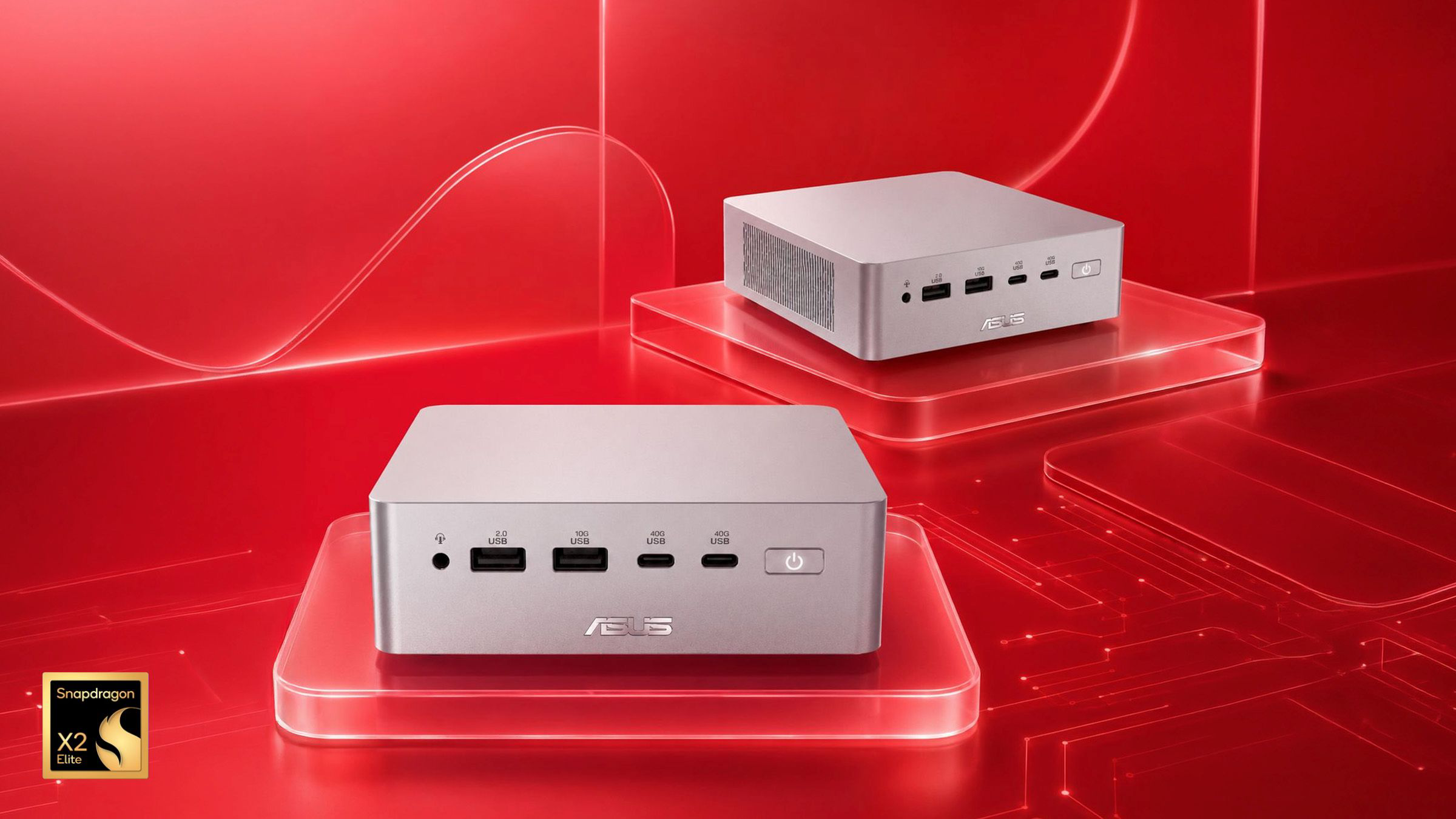
The convergence of extreme processing power and energy efficiency has led to the birth of the ASUS Ascent QN10, the first compact desktop equipped with the SoC Qualcomm Snapdragon X2 Elite.
Unveiled in preview at Computex 2026, this platform pushes beyond the notebook market boundaries to enter form factors that require a minimal footprint and high-end performance, bringing advanced processing directly to the user’s desk.
ASUS Ascent QN10 is the first mini-PC with Snapdragon X2 Elite

The central element of this system is its ability to handle extremely complex workloads while maintaining a virtuous thermal and energy profile.
The processor enables professionals to seamlessly alternate the development of large language models, the analysis of big data and the simultaneous management of countless applications.
For these activities, its NPU is crucial, capable of reaching 80 TOPS, enabling to run locally, guaranteeing maximum privacy and zero latency, advanced AI tools and orchestrators such as OpenClaw, Hermes, Cursor, Claude Desktop, OpenAI Codex and OpenCode.
Alongside this, there is an integrated enterprise-grade chip-to-cloud security system, designed to protect sensitive information.
In aesthetic terms, the ASUS Ascent QN10 has an overall volume less than 0.7 liters, about 86% smaller than the traditional 5-liter desktop form factor. This drastic reduction in footprint does not affect the processor’s performance in the slightest, as it can fit discreetly and elegantly into any working environment.
The result is a device that easily fits into an office or a home workstation, delivering incredible computing power in the smallest possible space.
An ecosystem for professionals and businesses
The system’s deep versatility makes it ideal for a wide range of operational contexts. Prosumer users have in their hands a machine capable of handling content creation, high-end multitasking and entertainment without slowdowns.
Software developers, in particular, benefit from seamless programming sessions and reduced compilation times for tools like VS Code, thanks to a generous connectivity panel that includes three USB4 ports, three USB 3.2 Gen 2 ports and one USB 2.0 port to connect all essential peripherals.
The corporate sector and industrial applications also benefit significantly from this architecture: companies can deploy quiet and secure terminals at scale, while areas such as digital signage can leverage the device’s power to manage information and advertising content in high resolution.
In this scenario, the system supports multi-monitor configurations up to four 4K displays simultaneously, ensuring reliability in continuous operational contexts.