


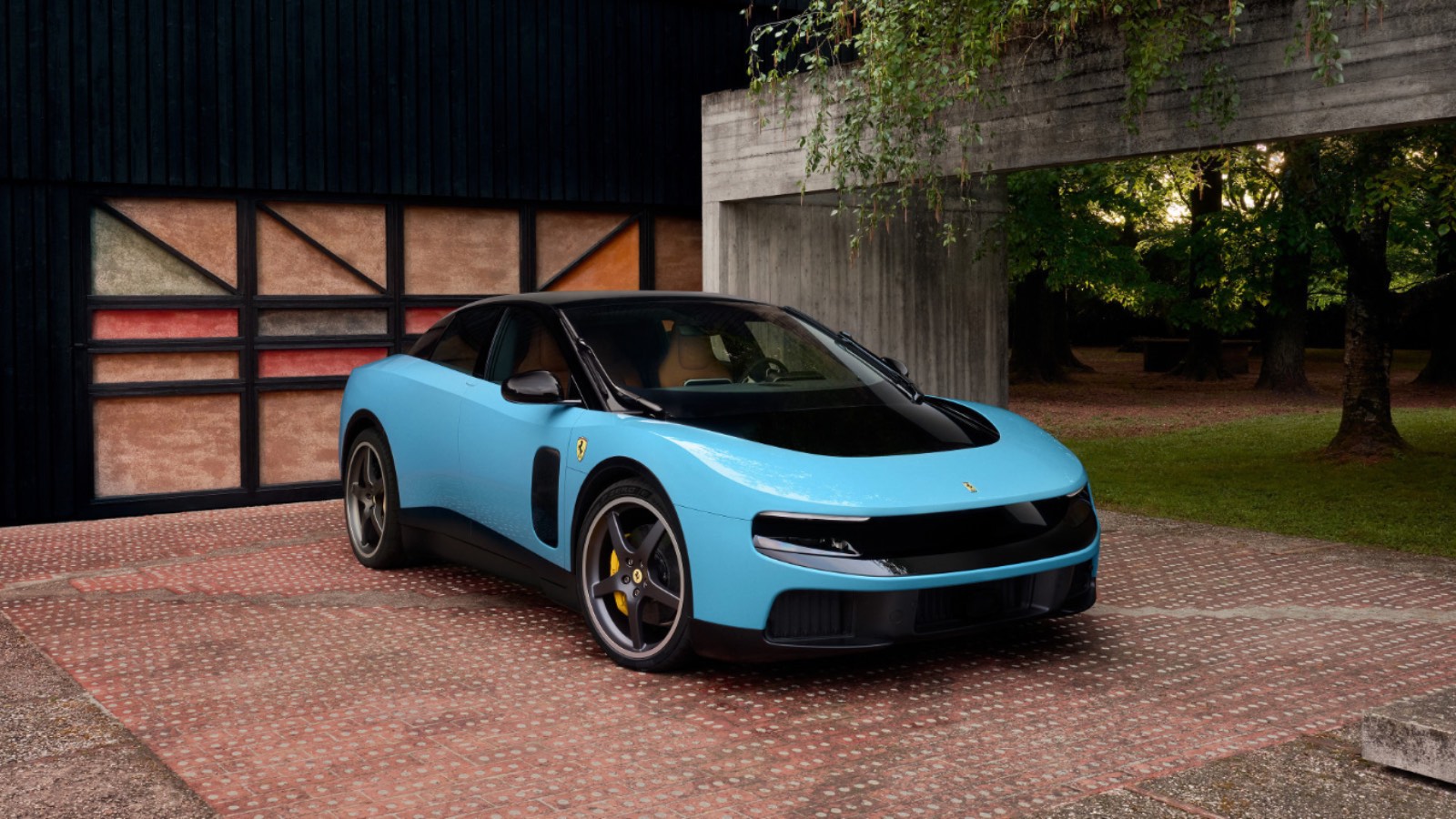
The legendary Maranello-based automaker has finally unveiled the Ferrari Luce, its first fully electric vehicle, marking a historic milestone in the supercar sector. Its debut represents not only a revolution for the Prancing Horse, but also an unprecedented technological leap thanks to a futuristic cabin that places visual excellence at the center.
The collaboration between Ferrari and Samsung Display, begun about three years ago, has led to the exclusive integration of advanced OLED panels, designed to fuse the brand’s stylistic heritage with the industry’s most innovative digital solutions.
Ferrari Luce is the first electric car from the automaker, in collaboration with Samsung Display

The multimedia heart of Ferrari Luce resides in a system composed of four OLED displays provided exclusively by Samsung, redefining the interaction between the driver and the vehicle.
The instrument cluster adopts a multi-layer design that stacks a 12.9″ panel over a 12.1″ panel to create a sense of dynamic visual depth. Thanks to the proprietary HIAA (Hole in Active Area) technology, Samsung managed to create precise holes of around 100 mm within the panels to house physical indicators and real-time graphics, such as G-force meters and torque.
This complex architecture is protected by Thin Film Encapsulation (TFE) technology, which guarantees uniform image quality and protects the display’s organic materials from exposure to external elements.

The interior design was developed in collaboration with the LoveFrom studio by Jony Ive (the former legendary Apple designer) and Marc Newson, aiming for a perfect harmony between hardware and software. A striking example of this philosophy is the 10.1″ infotainment screen, where three physical mechanical hands are mounted directly above the panel through small perforations, allowing them to rotate 360 degrees over the digital graphics.
The flexibility offered by OLED technology has allowed Ferrari designers to achieve thinner, more integrated lines, extending the smart experience to rear passengers via a dedicated 6.3″ display for climate control and travel data.


In terms of pure performance, Ferrari Luce does not disappoint, boasting four electric motors for a total output of 1,035 horsepower and a 0-100 km/h acceleration in just 2.5 seconds. The vehicle, a four-door, five-seat supercar, will launch on the market with a starting price of €550,000 — clearly the figure is expected to rise considerably with various customization options.
While production will officially begin at the end of 2026, the first units will reach the hands of fortunate owners in the second quarter of 2027.
Technical specifications
Dimensions and Mass
- Length: 5,026 mm
- Width: 1,999 mm
- Height: 1,544 mm
- Wheelbase: 2,961 mm
- Weight: 2,260 kg
- Weight distribution: 47% front / 53% rear
- Trunk capacity: 597 liters
Engine and Performance
- Architecture: Quad-motor (2 front, 2 rear)
- Total power: 1,050 HP
- Maximum torque: 990 Nm (11,150 Nm at the wheels)
- 0-100 km/h: 2.5 seconds
- 0-200 km/h: 6.8 seconds
- Top speed: 310 km/h
- Power-to-weight ratio: 2.16 kg/HP
Battery and Electric System
- Voltage: 800 V
- Gross capacity: 122 kWh
- Range (WLTP): 530 km
- Maximum charging power: 350 kW
- Voltage for active suspensions: 48 V
- Voltage for auxiliary systems: 12 V
Aerodynamics and Wheels
- Drag coefficient (Cx): 0.254
- Regenerative braking power: 500 kW
- Front brake discs: Carboceramic 390 mm
- Rear brake discs: Carboceramic 372 mm
- Front wheels: 23″ (tires 265/35)
- Rear wheels: 24″ (tires 315/30)
Interior and Price
- Seats: 5
- Materials: Recycled anodized aluminum, Gorilla Glass, leather
- Base price: €550,000