


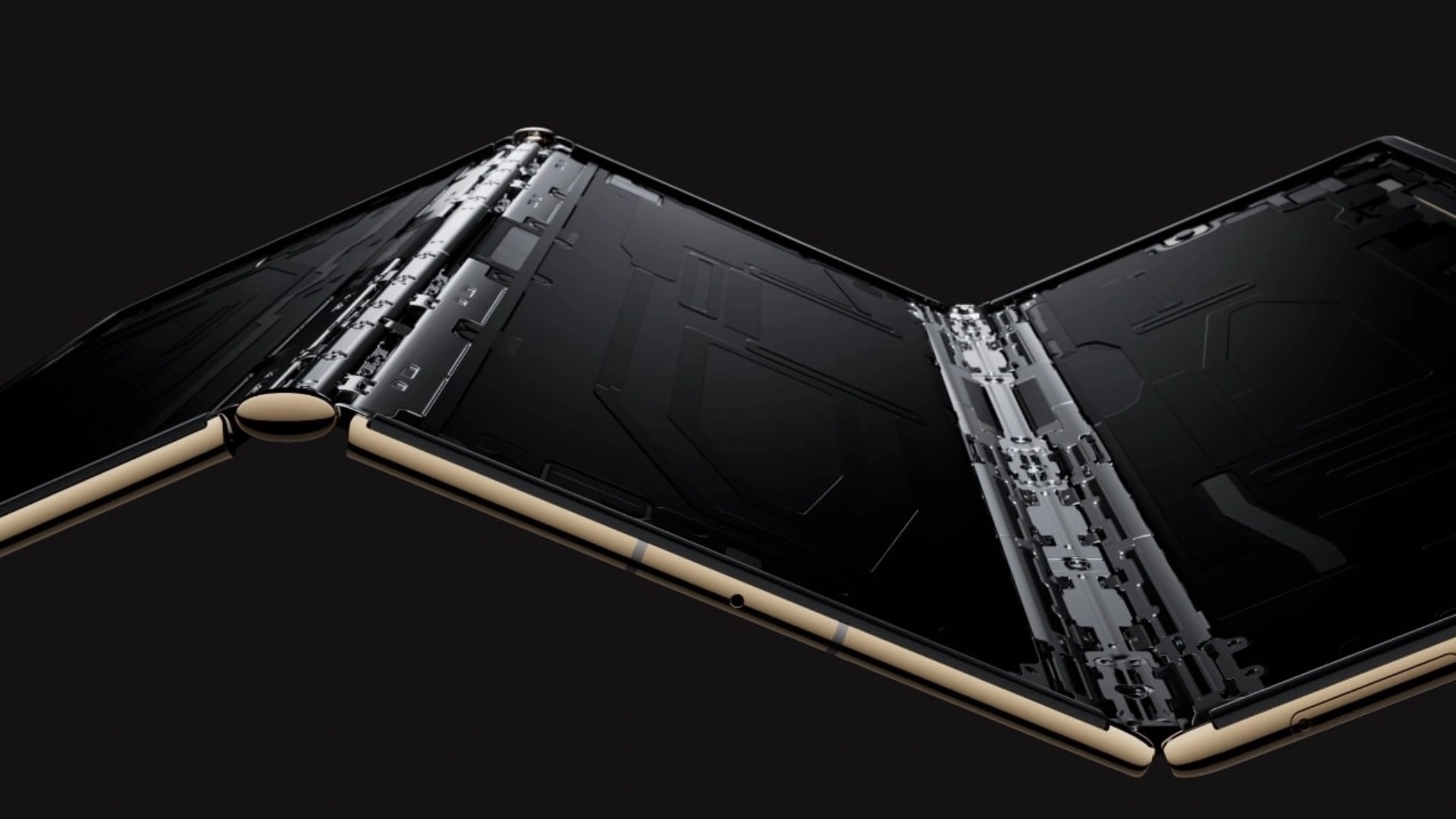
The media attention is almost entirely focused on the moves of the industry giants: on one side the feverish anticipation for the alleged iPhone Fold, which continues to generate rumors, and on the other the pragmatism of Samsung and Huawei.
The South Korean giant deserves praise for the commercial launch of the Galaxy Z TriFold, whose arrival is expected soon also on the US market, while Huawei deserves credit for having opened the way to this new category of products with the pioneering Mate XT.
However, in this rapidly evolving scenario, its absence shines for another major player in the Android ecosystem: OPPO.
OPPO’s tri-fold: what happened to it?

The absence of a tri-fold in OPPO’s catalog has raised several questions, especially considering the brand’s history of innovation. The reality, however, is quite different from what appears on the surface: the company has not stood by, but has actively experimented with this technology, reaching a step away from commercialization before deciding to backtrack.
The official confirmation of these experiments came from a high-level internal source. Zhou Yibao, OPPO Product Manager, broke the silence through a post on the Chinese social platform Weibo.
In response to users’ curiosity, Yibao revealed that the company not only explored the concept of tri-fold smartphones, but invested significant resources in developing multiple working prototypes.
The manager’s statement offers a fascinating glimpse behind the scenes of R&D: these devices were not just drawings on paper, but engineered and physically produced. Yibao candidly admitted to still having these units stored in his desk.
Despite the technology being ready and the hardware in place, management made the conscious decision to halt the project and not proceed with mass production, letting it be understood that technical feasibility is not always synonymous with commercial success.
The harsh laws of the market: costs and sustainability
Although OPPO has not issued an official statement detailing the specific reasons for this abandonment, analysis of the current economic landscape offers very clear clues. The tri-fold market is still in a very embryonic stage and financial challenges are substantial.
Even a giant like Samsung, which has a vertically integrated and optimized supply chain, is likely facing difficulties in generating profits from its Galaxy Z TriFold. According to reports, despite a selling price well above 2000 euros, Samsung would be losing money on every unit sold.
In such a context, OPPO’s caution seems not only understandable but strategically wise. The rise in component costs, combined with market demand still uncertain and with non-existent profit margins, has probably convinced the Chinese brand that the time was not yet ripe to launch a direct challenge to Huawei and Samsung.
The hope for tech enthusiasts is that the renewed global interest in foldables can act as a catalyst. If the spark ignited this year leads to greater economic sustainability and more efficient manufacturing processes, it is likely that those prototypes in Zhou Yibao’s drawer could be dusted off.