


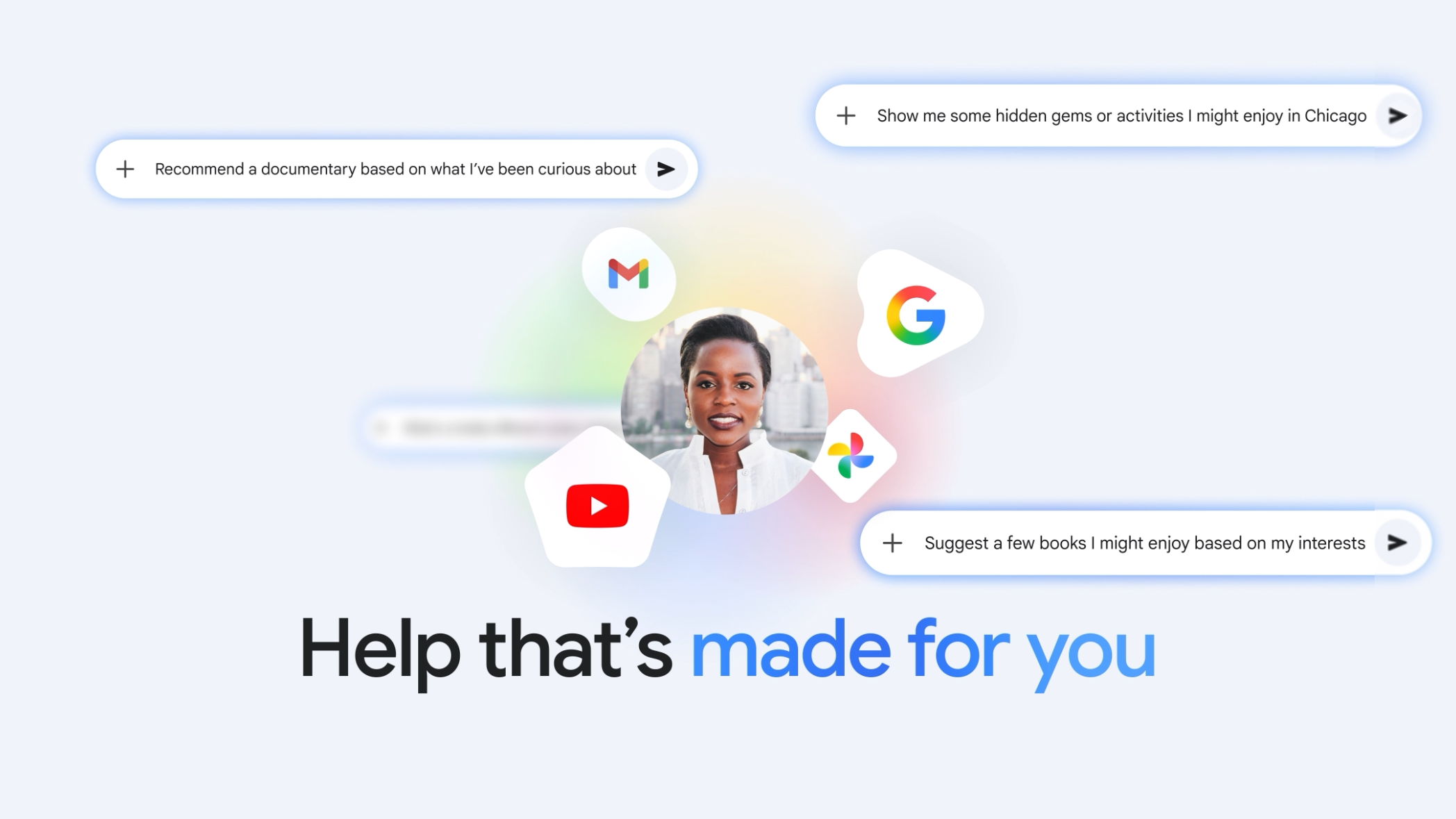
The evolution of digital assistants is about to take another leap forward, shifting the focus from a generic knowledge of the world to the deep understanding of the user’s individual context.
With the introduction of Personal Intelligence, Google has unveiled a feature that promises to radically transform interaction with artificial intelligence, making Gemini not only an executor of tasks, but a true partner capable of “connecting the dots” between the different facets of digital life.
The launch of the beta version in the United States represents the first step toward a future in which AI will be able to reason about disparate sources to offer concrete and tailored help.
Gemini and Personal Intelligence: connected ecosystem for tailor-made responses


The novelty is based on Personal Intelligence’s ability to break down silos that traditionally separate applications. Until now, interacting with your information meant navigating between standalone products: open Gmail for a flight, scroll Google Photos for a memory, or consult Maps for a place.
The new architecture, based on the Gemini 3 model and on a dedicated intelligence engine, instead allows you to securely connect Gmail, Google Photos, YouTube and Search.
A practical example, cited by the company, perfectly illustrates the power of this descriptive, non-schematic approach. Imagine you have to replace the tires of your car and find yourself in a workshop without remembering the technical specifications. Instead of frantically searching among old documents, Gemini can analyze your emails to identify the exact model of the vehicle and cross-reference this data with your Google Photos history.
If the system detects, through images, that you have recently traveled to areas with specific climates, such as Oklahoma, it will not only provide the tire size, but suggest the most suitable type (for example, “all-season” rather than standard), arguing the choice based on your real driving habits.
The system is even able to retrieve a license plate number from an old photo when needed, solving a complex problem in seconds.
Privacy as the foundation of the experience
Aware of the delicacy inherent in handling such personal data, Google has structured Personal Intelligence around the concept of “privacy by design“.
The feature is strictly opt-in: app connection settings are off by default and the user maintains full control over which services to connect.
A crucial aspect concerns the management of model training. Google has clarified that Gemini is not trained directly on raw content from the user’s Gmail inbox or Google Photos library to improve its generative algorithms.
On the contrary, the system uses personal data only at execution time to respond to the specific request, while improving the service is based on aggregated data, prompts and responses, keeping sensitive information safe within Google’s protected infrastructure.
The challenges of human understanding
Despite the potential, Google adopts a transparent approach regarding the current limits of technology, defining it still in beta. The complexity of human life and interpersonal relationships can sometimes challenge AI, leading to interpretation errors or phenomena of “over-personalization“.
It is the case of what is called “tunnel vision“: if the user has many work-related emails, the model could erroneously anchor every answer to that professional context, even when not requested.
Even more subtle is the challenge of understanding human relationships. The system could analyze a photo library full of images taken on a golf course and deduce that the user is an avid player, starting to propose related content.
However, the reality could be very different: the user could detest golf and frequent those places only to watch their child play.
These emotional and relational nuances are difficult to codify, and for this reason Google encourages users to actively correct the model (“I don’t like golf”), allowing the system to learn and refine its accuracy over time.
Towards true personal intelligence
Personal Intelligence represents a fundamental technical base for the future of AI agents. Solving what engineers call the “context packing problem“, namely the ability to synthesize and reason about enormous amounts of personal data in real time, Google is laying the groundwork for a universal assistant.
The long-term vision is that AI not only reacts to commands, but that proactively understands the user’s needs, getting closer to the goal of an artificial general intelligence (AGI) that is, above all, useful to people.