


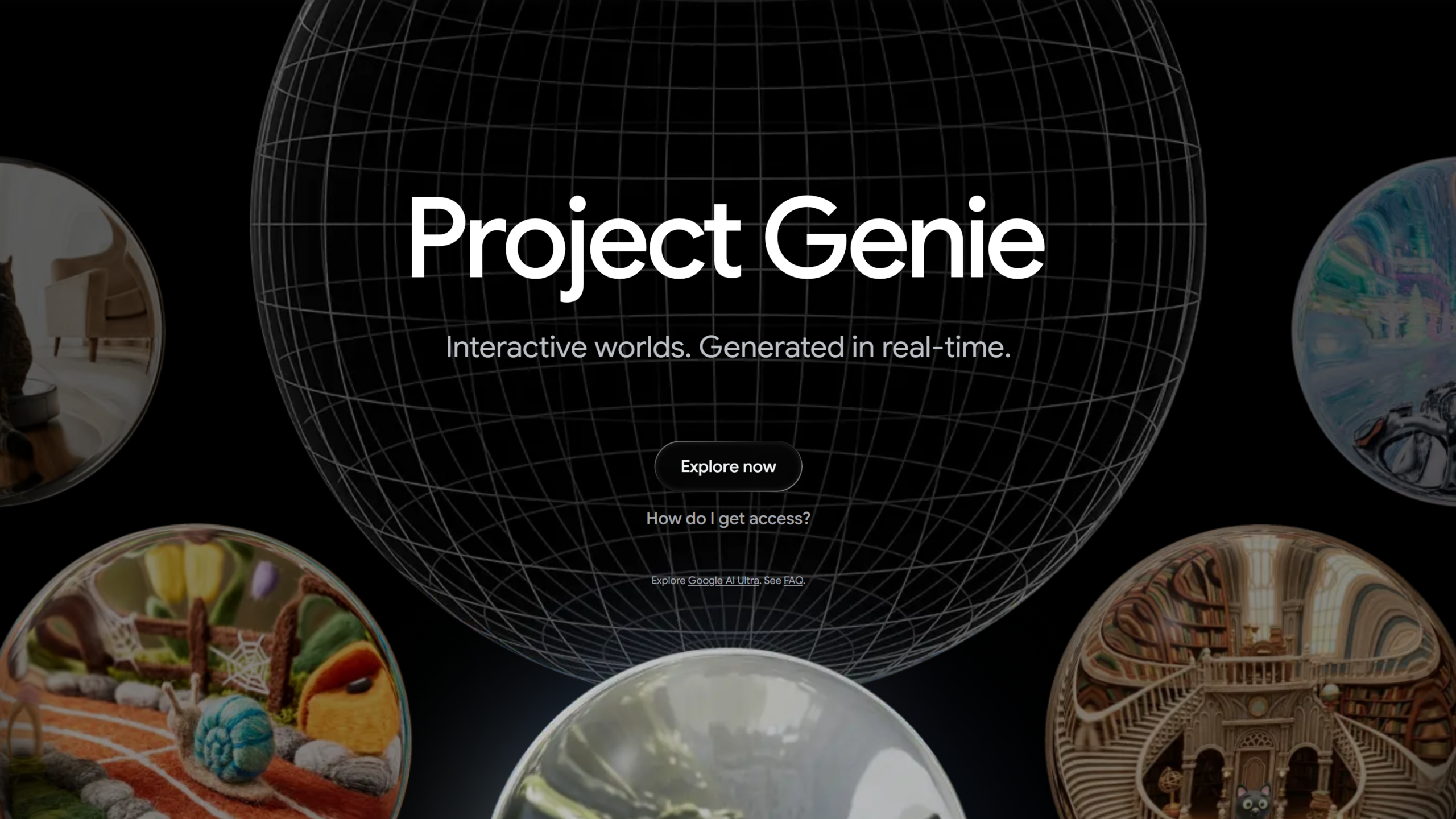
Google has accustomed the public to constant innovations in the field of chatbots and digital services, but the latest initiative to emerge from the labs at DeepMind marks a clear departure from what has been seen so far.
It is called Project Genie and it is an experiment that goes beyond the already familiar generation of texts, images, or short video clips that artificial intelligence has introduced us to.
Genie is, in effect, a generator of interactive digital worlds: a system capable of transforming a static input into an explorable environment in real time.
Google Project Genie in action, from description to simulation
The power of this technology lies in its nature as a “world model“. Unlike traditional methods, Project Genie does not require the use of graphics engines, programming skills, 3D design capabilities, or high-end hardware.
The system operates as a generative intelligence that renders the digital environment moment by moment, following the movements of the user. In practical terms, the AI anticipates the player’s actions and the resulting reactions of the environment, building the surrounding world and calculating the physics of objects in real time.
This technical feat is made possible by the synergy of three advanced models developed by Mountain View: Genie 3, Gemini and the curious Nano Banana Pro.
Thanks to their combination, you simply need to provide the system with a textual prompt, a photograph or even a simple hand-drawn sketch to be projected into a controllable sandbox scenario via a digital avatar. Applications range from pure fiction to animation, up to the reconstruction of historical contexts or scenarios for robotics.
A New Era for Content Creation
Project Genie operates on a continuous workflow that combines creation, exploration, and reworking. The phase of “world sketching” is where the initial input comes to life, expanding into a coherent environment.
Subsequently, exploration comes into play, during which the model autonomously handles cause-and-effect relationships between the user and the virtual elements. Finally, the ability to “remix” the worlds allows drawing inspiration from existing environments to build new ones.
Project Genie could represent a turning point for the video game and simulation industries. Where open-world game development traditionally requires years of work, substantial investments, and highly specialized technical skills, Genie offers rapid prototyping and creative experimentation at minimal resource costs.
Access is currently very limited
Despite the exciting premises, Project Genie is not yet a polished product intended for the mass market. Currently, access is strictly limited to subscribers of the Google AI Ultra plan residing in the United States and of age. This is the most expensive subscription tier offered by the company, at $249.99 per month.
It is worth noting that, being still in an active development phase, the experience is not without flaws: the generated worlds may show imperfections and character control could feel a bit choppy.
However, these limits do not obscure the scope of the project. Project Genie offers a tangible glimpse into a future where artificial intelligence will not merely generate static content, but will build entire interactive experiences on demand, changing the way we conceive entertainment and digital simulation.