


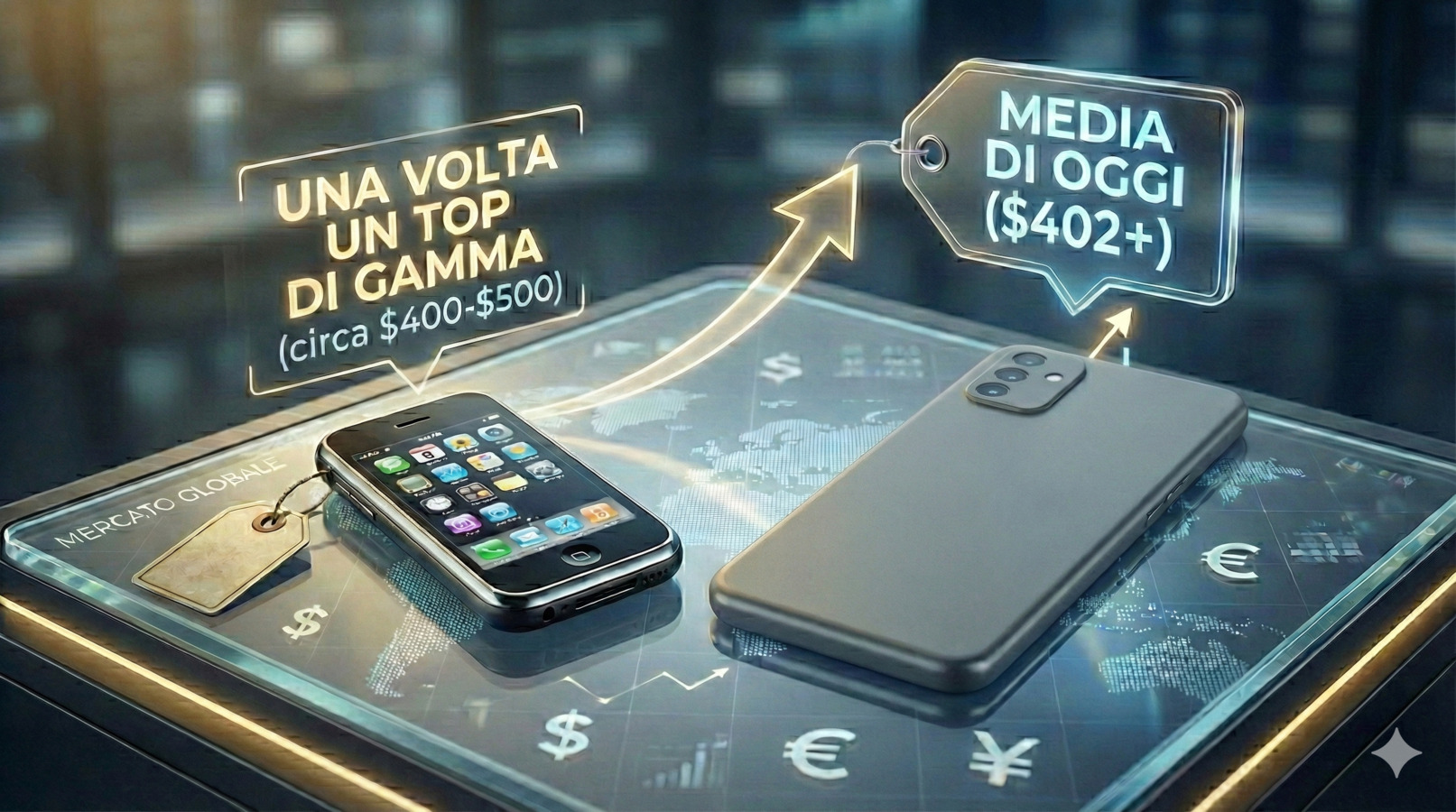
It seems a geological era has passed since Steve Ballmer, the then-CEO of Microsoft, replied with an almost incredulous laugh at the announcement of the first iPhone.
It was 2007, and the idea of offering the public a phone priced at $499 for the 4GB version, or $599 for the 8GB version, appeared as a bold bet, if not downright crazy, especially for a device without a physical keyboard.
That figure, which once represented the ceiling for mass-market mobile consumer electronics, today takes on a completely different meaning.
You don’t need to be a financial analyst to notice how prices have risen, but recent data confirm that what was once the luxury threshold has, in fact, become the norm.
The average smartphone now costs more than 400 dollars

If today’s flagships easily exceed four figures, a trend solidified by the iPhone X, the real news lies in the average cost that global users are paying to purchase a device. According to Counterpoint Research, the last quarter of 2025 marked a historic turning point for the mobile phone market.
For the first time ever, the average selling price (ASP) of a smartphone has broken through the $400 barrier, landing exactly at $402. This is a notable jump compared to the $350 recorded in the previous quarter.
This momentum has driven the industry’s global revenue to a record $135 billion in the last three months of the year, with a 7% year-over-year growth and a 4% increase in shipments.
The different speeds of the tech giants
Analyzing the market’s internal dynamics, it emerges that Apple continues to play a leading role in driving profits. Thanks to the launch of the iPhone 17 series, the Cupertino company captured as much as 57% of global sector revenues in the fourth quarter.
Performance in key markets such as China, North America and Latin America has confirmed the brand’s strength, able to maintain high perceived value of its products despite economic fluctuations.
Divergences appear for Samsung, which while maintaining second place for revenues with 11% of the total, has experienced a mixed phase. The South Korean giant saw shipments rise 17%, an excellent result driven mainly by the Galaxy A series, i.e., the mid-range and lower mid-range.
On the other hand, demand for foldable devices and for the most expensive high-end models declined. This combination of factors caused a drastic drop in Samsung’s average selling price, down 20% year over year.
In essence, the company sold much more, but on average earned less per unit.
Meanwhile, other players like OPPO and Xiaomi have shown peculiar trends. OPPO has stood out as the fastest-growing brand, also recording the largest rise in average selling price (+6%), a sign of an effective upward repositioning.
Xiaomi, despite a decline in shipments and revenues due to difficulties in India and China, nonetheless managed to raise its average price by 3% thanks to the success of some premium models.
The price of artificial intelligence
Looking to the future, experts do not foresee a reversal in trend, indeed. Tarun Pathak, Counterpoint’s Research Director, suggests that prices are set to rise further.
The main cause will not be just inflation, but the technology’s evolution itself. The growing demand for capabilities based on generative artificial intelligence imposes increasingly stringent hardware requirements, particularly regarding DRAM and NAND memories.
The rising costs of these essential components, which has already started to impact margins for manufacturers like Apple, will become a determinant factor in 2026.
According to analyses, this scenario will force manufacturers to raise prices further, potentially leading to a contraction of global shipments.