The era of image generation depicting the icons of global entertainment has been abruptly slowed on Google’s platforms.
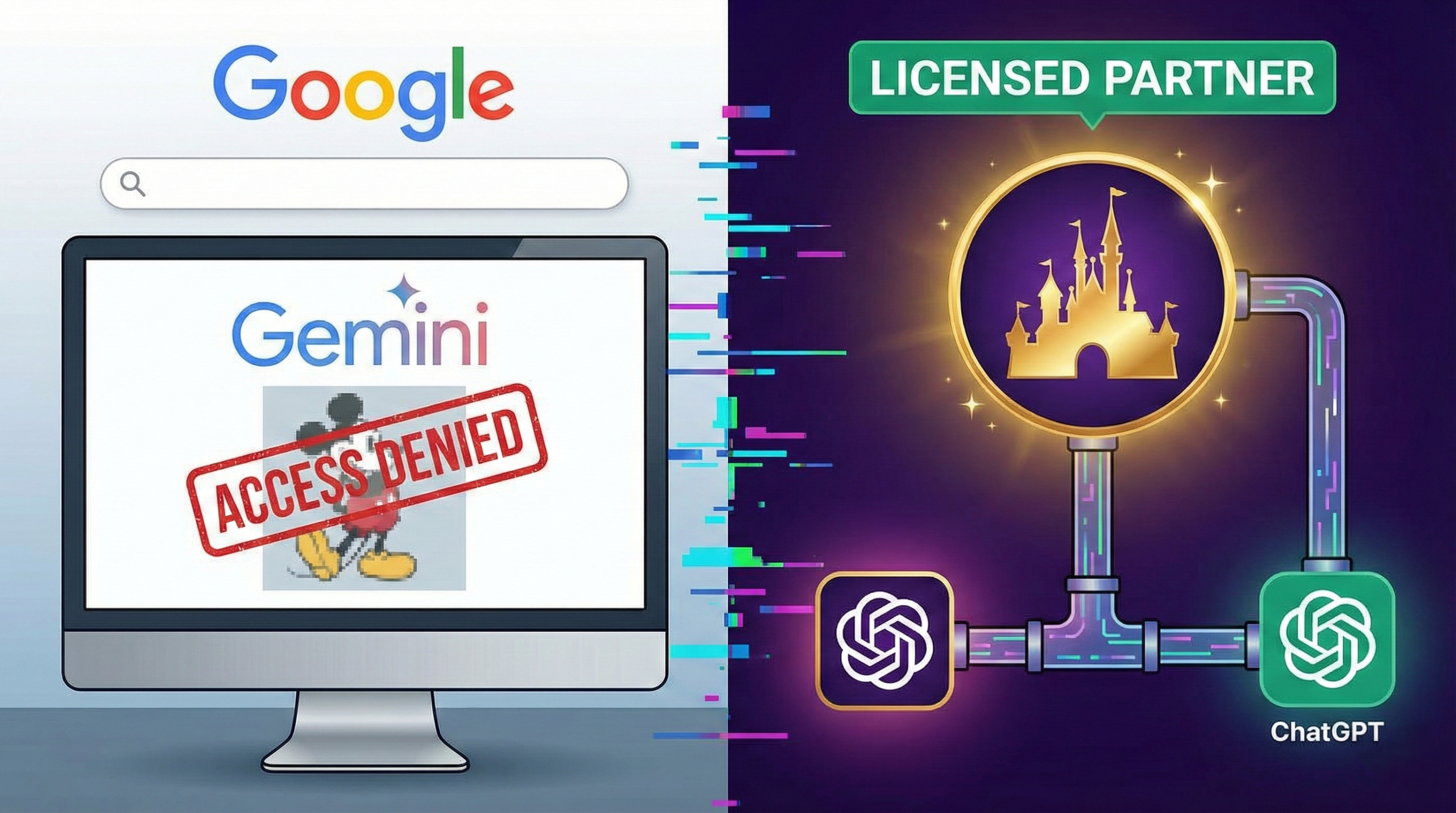
Whoever today attempts to use Gemini or Nano Banana to bring to life new illustrations of Mickey Mouse, Iron Man or Yoda (and more) runs into a categorical refusal.
This new restrictive policy is not the result of a mistake, but the direct consequence of a complex legal and commercial maneuver orchestrated by Disney at the end of 2025.
No Disney on Gemini, exclusive deal with OpenAI and cease-and-desist

The decision by Mountain View to impose these new filters stems from a formal cease-and-desist letter received last December. Disney’s lawyers were unequivocal: Google had to immediately cease copying, public display, distribution and creation of derivative works based on the company’s copyrighted characters.
This aggressive move foreshadowed the announcement of a strategic partnership between the entertainment giant and OpenAI.
The agreement, which guarantees ChatGPT and Sora exclusive rights to AI-generation rights for a three-year period, effectively shut out competitors, forcing Google to revise its security protocols to avoid far-reaching legal disputes.
As a result, access to a catalog of over 250 iconic characters belonging to brands such as Marvel, Pixar and Star Wars is now exclusively in the hands of Sam Altman’s technologies.
What are the system’s limits?
The consequences for the end user are immediate. Entering prompts that explicitly request or even hint at generating well-known faces from the Disney universe now returns a standardized message. The chatbot explains it cannot generate the requested image due to concerns raised by third-party content providers, inviting the user to modify the request.
Tests conducted by Android Authority confirm that the blockade is surgical and specific: while requests related to Disney brands are systematically rejected, it is still possible to generate images related to the intellectual property of other competing studios.
For example, requests to create images of Shrek, whose intellectual property belongs to DreamWorks and NBCUniversal, are processed without any impediment by Nano Banana.
It is interesting to note that the application of these filters was not instantaneous. In the weeks immediately after receiving the cease-and-desist letter in December, the system still had flaws that allowed sporadic generations of protected material.
However, as the weeks progressed and the OpenAI agreement was confirmed, the strings of censorship tightened definitively, blocking every attempt.
Google’s position
Despite the current block’s severity, Google maintains a diplomatic line regarding the matter. A company spokesperson highlighted the existence of a long-standing and mutually beneficial relationship with Disney, reaffirming the commitment to continue dialogue between the parties.
The Mountain View company defends its development model, based on the use of public data from the open web to build its artificial intelligences, citing the implementation of innovative copyright controls such as Content ID for YouTube.
However, the reality shows that, at least for the next three years, creativity related to the Disney universe will remain accessible only through official partners, leaving Google’s tools without a significant slice of contemporary pop culture imagery.