


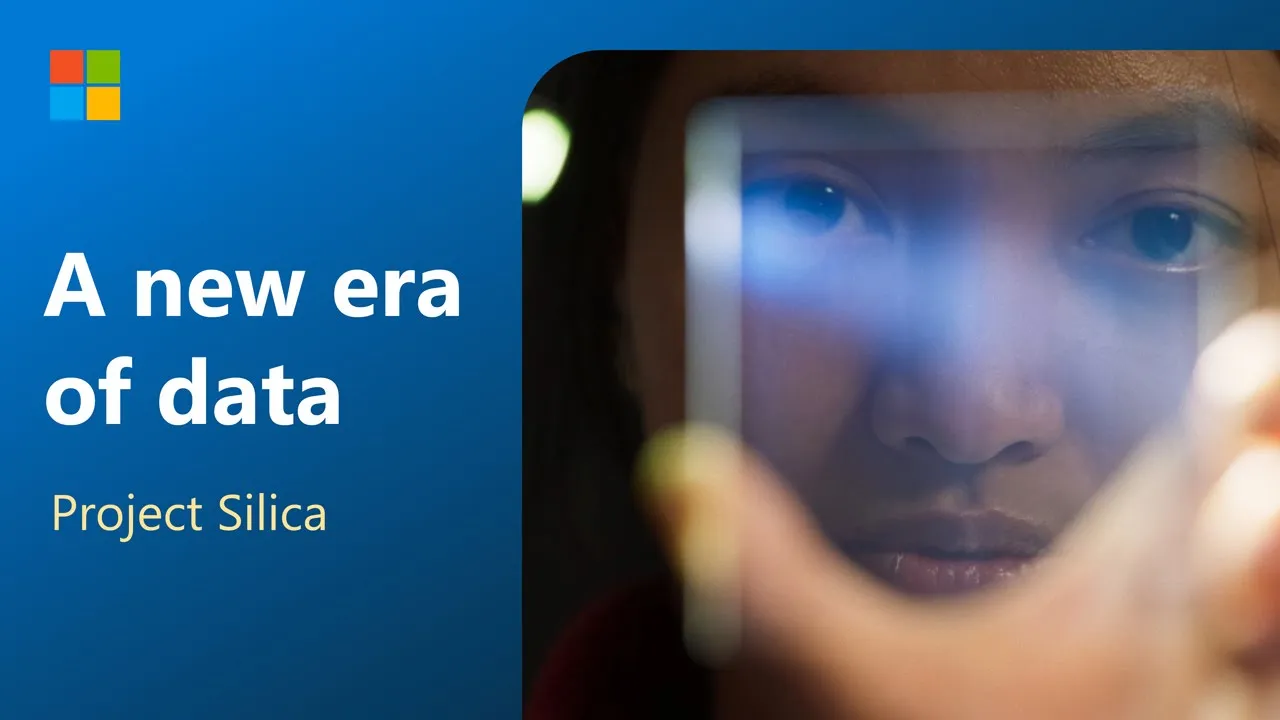
Our knowledge of ancient civilizations is largely based on fragments of clay tablets and parchments eaten away by time. Over many millennia, however, our descendants could reconstruct the history of our era starting from a thin transparent slab.
While modern magnetic media are subject to rapid and inexorable decay, researchers at Microsoft have unveiled the latest developments of Project Silica, a data storage system that uses the properties of light to etch information onto a virtually indestructible medium.
The main aim of the research team is to avert what experts define as a potential “digital dark age“, ensuring that our immense information heritage does not go lost.
The result is an element capable of withstanding ten thousand years without any maintenance.
Microsoft Project Silica, beyond traditional optical technology

The system’s operation vaguely resembles that of ordinary CDs, where a light beam physically alters a surface to encode data. The Redmond-based company’s project, however, takes this principle to an extreme level of complexity and precision.
Using a small square of borosilicate glass only two millimeters thick (an unusually common material, similar to what is used for kitchen bakeware or oven doors) engineers employ special femtosecond lasers. These devices emit incredibly fast light pulses to create tiny deformations inside the material.
The fundamental technical innovation lies in the use of the so-called “phase voxels“, i.e. the three-dimensional equivalent of a pixel, cleverly combined with variations in the light’s wavelength.
Interestingly, during development, the team found that limiting engraving to four optical and physical dimensions, rather than the five posited in the earliest university studies on the topic, significantly improves energy efficiency and increases storage density.
Absolute security for archives and museums
Developed over roughly eight years by a heterogeneous team of mechanical engineers, computer scientists and optical experts, the project was born by listening to the specific needs of large institutions.
Entities such as national archives, museum complexes and the major entertainment companies require media capable of withstanding decades of total neglect on shelves without suffering any damage.
Storing data on these slabs perfectly meets this requirement: once written, the data becomes completely immune to malware, cyber tampering or simple chemical deterioration.
In the most recent practical demonstrations, researchers have managed to stack over three hundred voxel layers, bringing the theoretical capacity of a single glass fragment to 4.8 terabytes. This is enough to hold about two million printed books or five thousand ultra-high-definition videos.
Permanent information at zero cost
Currently, the purely scientific challenges related to encoding on this material have largely been overcome, leaving developers with the task of further perfecting the laser hardware needed for the writing phase.
The future benefits for documentary preservation look vast. Unlike today’s massive servers or magnetic tapes, which require constant energy expenditure for cooling and regular replacement cycles, the Silica technology completely eliminates long-term maintenance costs.
Once engraving is complete, the medium can be physically stored and forgotten, preserving our digital memory intact for the millennia to come.