


Often, when evaluating the power of a new flagship smartphone, the focus is almost exclusively on the processor frequencies and the amount of RAM installed.
However, overall performance and daily responsiveness of a device crucially depend on another essential component: the storage memory.
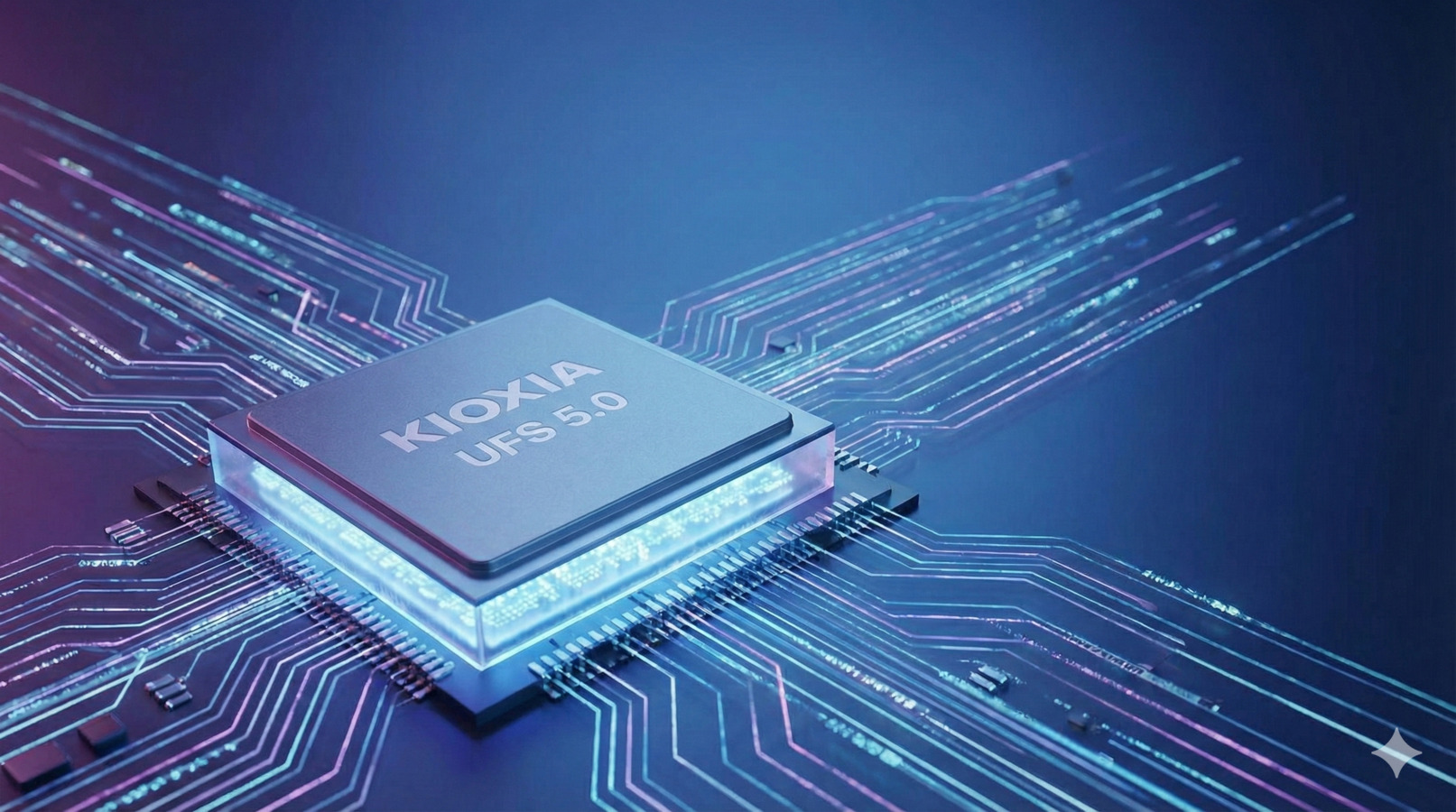
It is precisely in this area that Kioxia is making significant strides. Recently, the company announced the start of shipments of the first evaluation samples for the integrated memories based on the highly anticipated standard UFS 5.0.
Kioxia has the first UFS 5.0 samples ready, extreme speeds and advanced thermal management

While JEDEC works to finalize the final details of the new global protocol, the numbers revealed so far are truly impressive.
If the previous and appreciated UFS 4.0 technology guaranteed optimal transfers up to 4.2 GB/s, the 5.0 version is set to pulverize this limit, pushing to the remarkable threshold of 10.8 GB/s.
To make such a performance leap practically possible, the solution developed by Kioxia uses, among other things, a physical layer MIPI M-PHY 6.0.
Information will move at an unprecedented speed across smartphones, while maintaining excellent thermal stability and avoiding annoying system freezes under heavy loads.
Additionally, the use of the UniPro 3.0 specification plays a decisive role in efficiency, ensuring that the enormous data flow does not drain the battery life.
Practical applications, costs and availability
The implications of this technology go far beyond simple file transfers or loading applications. The processing of local AI on the device on the phone requires continuous access to enormous amounts of information.
UFS 5.0 memories, currently tested in particularly large capacities of 512 GB and 1 TB, will provide the bandwidth necessary to handle these complex real-time algorithmic operations.
There’s, of course, a cost for such engineering excellence. Given the current dynamics of the semiconductor market and high production costs, it is reasonable to expect that adopting these modules will impact the final price of ultra-high-end smartphones.
Since the technical evaluation phase of the samples has just begun, consumers will have to wait a little longer. The first true flagship devices equipped with this extraordinary speed won’t hit shelves until the end of 2026 or the early months of 2027.