


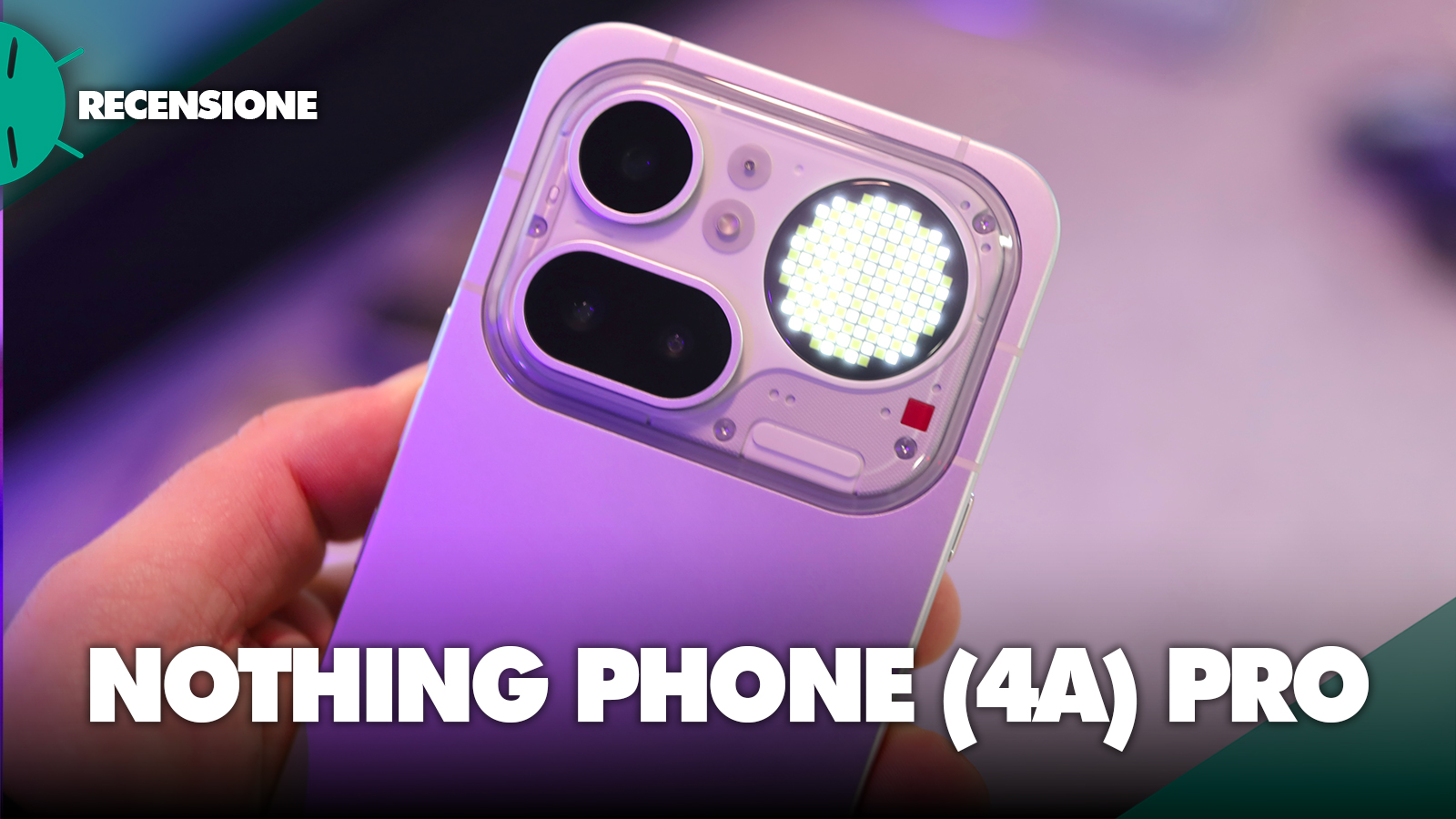
Reviewing the Nothing Phone (4a) Pro today starts from a very simple premise: in the mid-to-high range, being “different” is no longer enough. In recent years Nothing has built much of its image around an immediately recognizable design, a fresher approach compared to traditional brands, and software capable of standing out for its cleanliness and personality. However, at this point the market forgives nothing: if you want to ask a significant price for a mid-range, you must offer something that goes beyond the initial wow factor.
And this is precisely where, in my view, the Nothing Phone (4a) Pro makes the most interesting leap. Because it is a smartphone that does not rely solely on its visual identity, but tries to become a more complete, more mature product and above all more credible in everyday use. There is a new metal design, there is a stronger technical sheet, and there is a camera that, at least on paper, really aims to stand out thanks to the periscope. All these elements contribute to positioning it in a much more ambitious way compared to the “a” models of the past.
Nothing Phone (4a) Pro review: design, camera and price
Video review Nothing Phone (4a) Pro
Design and materials
The first thing that strikes about the Nothing Phone (4a) Pro is that, while still instantly recognizable as a Nothing device, it changes quite a bit in the way it communicates. The brand has trained the public to expect phones with a strong visual footprint tied to transparency and rear LEDs, but here the impression is more of a mature shift.


The unibody metal body is the most evident novelty, and it’s also the one that most changes the perception of the product. Flat surfaces, a thickness of just 7.95 mm, and the overall build quality make this device feel much closer to a high-end tier than you’d expect given the price. It’s not just aesthetics; it’s about perception: the phone communicates solidity, care, and a premium feel that was less evident in the previous “a” models.

Also interesting is the work done under the chassis, with a vapor chamber cooling system of 5300 mm² that helps keep temperatures under control, especially during longer sessions. Additionally, there is an IP65 rating against water and dust, which still represents a good level of protection for daily use.
Then there’s Glyph Matrix, which evolves in a significant way. The 137 mini-LEDs are brighter, reaching up to 3000 nits and covering a wider area, allowing more complex and, above all, more useful animations. It’s not just a design signature, but a tool that, if used well, can really improve the management of notifications, timers, and quick information without turning on the screen.

Ergonomically, it remains a large smartphone, not particularly light, and not designed for one-handed use, but it gives that sense of a “serious object” that many users look for. And that’s precisely the point: the Nothing Phone (4a) Pro doesn’t want to go unnoticed, it wants to be noticed with greater maturity.
Display
The display is one of the strongest points of the Nothing Phone (4a) Pro. The 6.83-inch AMOLED panel with a resolution of 1260 x 2800 pixels, around 440 ppi, and a 144 Hz refresh rate is one of those that, in real use, truly makes a difference.

Scrolls and animations feel extremely fluid, and what stands out even more is the consistency of the experience. Everything is always responsive, precise, and pleasant to use. Even after several hours of use, there are no obvious slowdowns, contributing to an overall sense of quality.
Brightness is very high and can reach up to 5000 nits in HDR content. In practice, that means excellent outdoor visibility and a very convincing performance in video and multimedia playback. Colors are well balanced, blacks are deep, and Gorilla Glass 7i completes a display that sits comfortably among the best in its class.
Cameras
When it comes to cameras, Nothing has worked much more to differentiate this model from its non-Pro counterpart. The Nothing Phone (4a) Pro features a triple camera setup consisting of a 50-megapixel Sony LYT700C main sensor with f/1.9 aperture and optical stabilization, an 8-megapixel ultra-wide, and a 50-megapixel periscopic telephoto lens with 3.5x optical zoom. Completing the package is a 32-megapixel front camera and the ability to record video up to 4K at 30 fps.

The main camera is the one that delivers the most convincing results. The Sony LYT700C sensor performs well in favorable lighting, offering detailed images with natural colors and good dynamic range. The processing is fairly balanced and does not go overboard, avoiding the artificial look often seen on other devices in the same tier.
In everyday use it is a reliable camera that lets you shoot without overthinking the final result. And that is precisely its strength: it doesn’t always wow, but it rarely disappoints.
Gallery samples and further camera details continue in the same spirit, including daytime and low-light comparisons, with a wide set of images illustrating performance across scenarios.
The true distinguishing feature is the 50-megapixel periscopic telephoto lens with 3.5x optical zoom. In this price range it’s still a rare presence and represents a tangible advantage in terms of versatility. It enables more compelling distant shots and notably enhances the portrait experience. Digital zoom goes up to 140x, but in practice the real value lies in the mid-zooms, where the phone can maintain a quality that’s more than decent.
The 8-megapixel ultra-wide is more basic and represents the least convincing aspect of the camera setup, especially in challenging lighting. It does its job but without particular ambition. The 32-megapixel front camera is adequate for selfies and video calls, with quality in line with expectations.
On the video front, the Nothing Phone (4a) Pro tops out at 4K 30 fps. It isn’t a device designed for maximum video output, but in daily use it handles well. Stabilization is effective and overall quality is more than adequate for social content.
Hardware and performance
The Nothing Phone (4a) Pro is powered by the Snapdragon 7 Gen 4 at 4 nm, clocked up to 2.8 GHz. It’s a choice that emphasizes balance over raw power, and you can clearly see this in the user experience. The phone is fluid, always responsive, and handles everyday tasks well, from multitasking and social use to browsing and photography. It isn’t a device aimed at stunning benchmarks, but at reliable day-to-day performance.

However, it’s worth noting that internal storage isn’t among the fastest on the market. UFS 3.1 storage is solid but not top-of-class. Still, this aligns with the product’s positioning: this is not a device that aims to be the fastest overall, but one that offers a stable and well-optimized experience.
The vapor chamber helps keep temperatures in check and provides good stability under load, while regarding audio, the Nothing Phone (4a) Pro includes a stereo system that offers a generally solid experience. Volume is high, channel separation is perceptible, and the quality is more than adequate for multimedia, videos, and gaming. It isn’t among the best in class for deep bass, but it remains above average for the segment. The in-call audio on the earpiece is clear and well defined, with no notable distortions even at high volume.

On the reception front, performance is reliable. The phone connects well to cellular networks and maintains good stability both in calls and data browsing. Even when moving around or in more complex environments, there are no evident issues, a sign of solid modem optimization.
Finally, the in-display fingerprint sensor is very good: responsive, fast, and precise, but it is placed a little too low for my taste. Given the phone’s size, it can be slightly awkward to reach, especially when holding the device with one hand.
Software
The software remains one of the main reasons to choose the Nothing Phone (4a) Pro. The device ships with Android 16 and Nothing OS, which continues to stand out for cleanliness, lightness, and coherence. The interface is smooth, intuitive, and free of unnecessary apps. Everything is designed to offer a simple but carefully polished experience.

In recent updates, Nothing has also worked a lot on Essential Space, which now presents a completely redesigned, more intuitive and fluid interface. The new Event feature has also been introduced, making the Action System more useful for managing daily information, along with an integrated search that lets you find content more quickly.
Moreover, Essential Apps and Playground are now available for the Phone (4a) series as well, further expanding the capabilities offered by the software without weighing down the experience.
Support for updates is decent but not outstanding: 3 years of Android updates and 6 years of security patches, a duration that generally isn’t surprising.
Battery life and charging
The 5070 mAh battery guarantees solid endurance. With moderate-to-heavy use you can easily reach the end of the day without having to pay special attention to consumption. It’s not a device built to smash records, but it is reliable and consistent, which is what matters in daily use.
The 50W fast charging helps reduce wait times and makes the device practical even on the busiest days.
Price and considerations
The Nothing Phone (4a) Pro hits the market at €499 for the 8/128 GB configuration and at €569 for the 12/256 GB model. For launch, however, prices drop reciprocally to €449 and €519 in offers. In light of these figures, the buyer’s doubt remains the same: is the spend worth it? Positioning itself in this tier, aesthetic originality alone is no longer enough. The device must offer substance, conveying the certainty of a well-placed investment in a saturated market full of strong competitors ready to fight with hardware specs and photographic sensors.
I link di acquisto presenti in questo articolo generano una piccola commissione per GizChina.it. Scopri tutti i dettagli qui.
Q&A – Nothing Phone (4a) Pro
Is the Nothing Phone (4a) Pro worth buying in 2026?
Yes, it’s one of the most interesting mid-range devices of 2026 thanks to premium design, clean software, and a very balanced user experience.
How’s the camera on the Nothing Phone (4a) Pro?
The 50 MP Sony main camera is reliable, while the real strength is the 3.5x optical-zoom periscopic telephoto lens, rare in this tier.
Is the Nothing Phone (4a) Pro fast?
In everyday use it’s smooth and responsive thanks to the Snapdragon 7 Gen 4, even though it isn’t the most powerful phone in its class.
How long does the battery last on the Nothing Phone (4a) Pro?
The 5070 mAh battery guarantees a full day of use, with 50W fast charging.
What display does the Nothing Phone (4a) Pro have?
It features a 6.83” 1.5K AMOLED display with a 144 Hz refresh rate, very fluid and up to 5000 nits brightness.
What does the Nothing Phone (4a) Pro cost in Italy?
Prices start at €499 for the 8+128 GB version and €569 for the 12+256 GB version. For launch, however, promotions bring them down to €449 and €519 respectively.
How many updates will the Nothing Phone (4a) Pro receive?
Nothing guarantees 3 years of Android updates and 6 years of security patches, a support window that sits above average for the segment.