


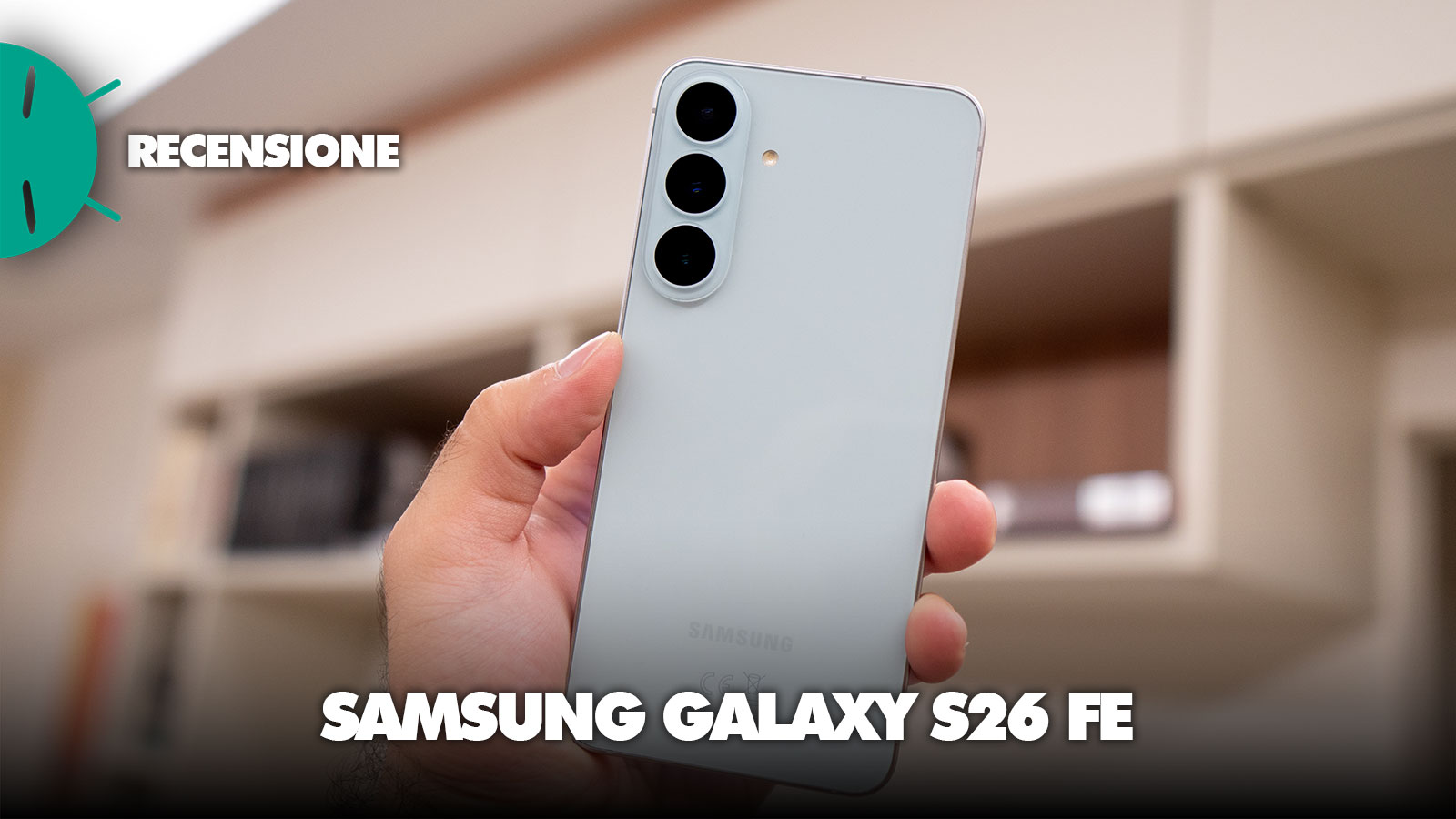
With Galaxy S26 FE Samsung puts itself in a fairly awkward position, because the phone itself works well in almost everything, but you need to do a few more calculations than usual before recommending it. We are not looking at a mid-range trying to look like a top-tier device: materials, performance, cameras, software and features such as wireless charging and DeX place it clearly much closer to the Galaxy S series. At the same time, however, the distance from the previous S25 FE isn’t as wide as a generational change might suggest.
The most interesting novelty is certainly the Exynos 2500, which delivers a concrete performance boost and better thermal management, but otherwise Samsung has opted for a decidedly conservative approach: the display is very similar to last year, the cameras are basically the same and the battery maintains a capacity of 4,900 mAh. There are even a few backward steps, such as the USB-C port limited to USB 2.0 standard and the disappearance of wired video output.
The result, all things considered, is a balanced smartphone, pleasant to use and destined to receive updates for many years, but with a question that constantly echoed in my mind: how much should the Galaxy S26 FE cost to truly make sense?
Review SAMSUNG Galaxy S26 FE
Design and materials
Holding it in the hand, the Galaxy S26 FE does not give the impression of being the “budget” version of something: it is slim, solid, well built and uses Gorilla Glass Victus+ on both the front and back, with an aluminum frame and IP68 certification. At its 193 grams it isn’t ultralight, but it distributes the weight well and the 7.4 mm thickness goes a long way to making it feel less bulky than its dimensions might suggest.

The part Samsung changed mainly lies in the camera area; the three lenses are no longer completely independent but sit within a transparent camera island that subtly breaks the back’s monotony. It isn’t a design revolution and, looking at it from the front, distinguishing it from the previous model becomes decidedly more difficult.
Even the rest follows what we could define as Samsung’s aesthetic vocabulary: flat edges, highly rounded corners, slim and fairly uniform screen bezels, and a front camera embedded in a small central punch hole. Personally I don’t feel it needs anything more flashy; after all it’s one of those phones that may not draw attention when placed on a table, but immediately conveys a sense of high quality when you start using it.
The available color options are Blueberry, Graphite and Pistachio, with the latter at least giving a bit more character to an otherwise very sober design.
Display
Here Samsung truly plays in-house; we know how dominant its displays are in the smartphone sector. The 6.7-inch Dynamic AMOLED 2X is a screen that is incredibly pleasant for daily use: high contrast, perfect blacks, vivid colors without being overly exaggerated and a refresh rate up to 120 Hz that makes everything feel extremely smooth.
The resolution is Full HD+, 2340 x 1080 pixels, more than sufficient on this diagonal, while HDR10+ support is present. Even in bright sun I didn’t have particular readability issues: in tests the panel exceeds 1,200 nits with large portions of the screen lit and can push beyond 1,800 nits on smaller areas. That said, in 2026 Samsung can no longer live solely on its display reputation.

The panel is not LTPO and the refresh rate management remains fairly straightforward: in adaptive mode it mainly shifts between 60 and 120 Hz, not reaching the very low frequencies used by the best modern panels to reduce consumption. The system still intervenes on the frame rate when the image stays static, so there is a bit of energy optimization, but technologically we are a notch below the Galaxy S26 higher-end variants. Most importantly, it changes very little compared to the display used on the S25 FE. It remains an excellent screen, just not one of the reasons to upgrade to the new generation.
Hardware, performance and connectivity
If there is one thing that really differentiates Galaxy S26 FE from its predecessor, it’s certainly the processor: here we have the new Exynos 2500 at 3 nm accompanied by the Xclipse 950 GPU, 8 GB of LPDDR5X RAM and UFS 4.0 storage options in 128, 256 and 512 GB. No microSD, now almost a given in this category. In daily use it’s very hard to truly push it into trouble: apps, multitasking, light editing and gaming are handled without problems and, above all, the leap from the Exynos 2400 on the previous generation is noticeable even without looking at benchmarks.
Performance approaches what we would have clearly called top-of-the-line not long ago and thermals are improved as well. Under prolonged stress throttling remains, but it is more predictable and the phone can maintain high performance longer than the previous model. The 8 GB of RAM is a somewhat more debatable choice. They are sufficient and One UI handles them well, but on a phone of this tier, in 2026, seeing many competitors offer 12 GB inevitably makes Samsung’s RAM offering seem less generous on paper.

The available color options are Blueberry, Graphite and Pistachio, with the latter adding at least a bit of character to an otherwise very sober design.
Display
Qui Samsung gioca decisamente in casa: sappiamo quanto i suoi display dominino il settore degli smartphone. Il Dynamic AMOLED 2X da 6,7 pollici è uno schermo estremamente piacevole nell’uso quotidiano: alto contrasto, neri perfetti, colori vividi senza essere esagerati e una frequenza di aggiornamento fino a 120 Hz che rende tutto estremamente fluido.
La risoluzione è Full HD+, 2340 x 1080 pixel, più che sufficiente su questa diagonale, e supporta HDR10+. Anche sotto la luce diretta non ho particolari problemi di leggibilità: in test il pannello supera i 1.200 nit con aree ampie illuminate e può superare i 1.800 nit su zone più piccole. Detto questo, nel 2026 Samsung non può più contare solo sulla reputazione dei propri display.
The panel is not LTPO and the refresh rate management remains fairly simple: in adaptive mode it mainly swings between 60 and 120 Hz, without reaching the very low frequencies used by the best modern panels to reduce power consumption. The system still intervenes on the frame rate when the image is static, so there is a minimum amount of energy optimization, but technologically we are a notch below the Galaxy S26 high-end. Above all, it changes very little compared to the display used on the S25 FE. It remains an excellent screen, simply it does not represent one of the reasons to move to the new generation.
Hardware, prestazioni e connettività
If there’s one thing that really differentiates the Galaxy S26 FE from its predecessor, well, it’s certainly the processor: here we have the new Exynos 2500 at 3 nm accompanied by the Xclipse 950 GPU, with 8 GB of LPDDR5X RAM and UFS 4.0 storage available in 128, 256 and 512 GB variants. No microSD, now almost taken for granted in this product category. In daily use it’s very hard to actually put it to the test, I’ll be honest: apps, multitasking, light editing and gaming are handled without problems and, above all, the leap compared to the Exynos 2400 mounted on the previous generation is noticeable even without reading benchmarks.
Performance approaches what, until recently, we would have called top-of-the-line, and thermal management has also improved. Under prolonged stress, throttling remains present, but it is more predictable and the phone manages to maintain high performance for longer than the previous model. The 8 GB of RAM are instead a somewhat more debatable choice. They are sufficient and One UI handles them well, but on a smartphone in this tier, in 2026, seeing many competitors offer 12 GB inevitably makes Samsung’s hardware specification less generous on paper.
On the connectivity front we have 5G, eSIM, Wi‑Fi 6E in the supported markets, Bluetooth 5.4, NFC and dual SIM. UWB is missing, but the real oddity is something else. Samsung has replaced the USB 3.2 of the previous S25 FE with a USB 2.0. Not only do wired transfers become much slower, but the DisplayPort video output is also removed, along with it DeX via cable. Wireless DeX continues to work, but it’s hard to understand why a newer and more expensive model should lose a feature that the predecessor possessed. For many, it will be an irrelevant detail, but for those who actually use DeX or frequently transfer large files via USB, it’s decidedly less relevant.
Camera
Opening the Camera app there aren’t any big surprises for those coming from the Galaxy S25 FE; the main camera still uses the Samsung ISOCELL GN3 50 MP sensor, optically stabilized, accompanied by a 12 MP ultra-wide and an 8 MP 3x telephoto lens, also equipped with OIS. In front there’s a 12 MP camera. The main camera remains a safe bet: by day it produces detailed photos, with pleasant colors and a very wide dynamic range. Samsung in recent years has also progressively reduced that very aggressive processing that made its photos instantly recognizable, and the result is generally more natural.

Even the 2x zoom obtained from the main camera is good and, personally, I have found myself preferring it to the real telephoto when the light wasn’t perfect. The 3x optical remains anyway an advantage over many smartphones in the same tier that completely remove the telephoto. The problem is the 8 MP sensor, small and already quite dated. Outdoors it still manages to produce photos more than pleasant and offers a very useful perspective for portraits and distant details, but you just need to move indoors or wait for sunset because the hardware limit starts to show. The 12 MP ultra-wide does a decent job, with colors consistent with the main and a fairly good dynamic range. Pity for the absence of autofocus, which excludes use as macro.

At night I would rely mainly on the main camera, on the other hand the 50 MP sensor delivers a good performance and Samsung handles lighting and colors discreetly, while the telephoto lens quickly loses detail and contrast. The selfie camera is very good, despite not having autofocus. At the usual arm’s-length distance, faces appear detailed and well exposed, even in lighting conditions that aren’t exactly straightforward. So there’s nothing really wrong with this photography department. In fact, the presence of the telephoto lens makes it more versatile than many rivals. It’s simply a system that Samsung has been dragging along virtually unchanged for too long, if you want to nitpick.
Software
One UI continues to be one of the most tangible reasons to choose Samsung, without beating around the bush: the Galaxy S26 FE arrives with Android 17 and One UI 9 and, above all, with the promise of receiving up to seven generations of operating system updates, a detail that weighs much more than a few hundred points more in benchmarks, especially for those who change smartphones every four or five years.
One UI 9 does not radically modify the experience compared to previous versions, but it continues that refinement work that Samsung has been carrying out for several generations. The interface appears slightly more orderly, some sections have been simplified and the quick panel offers more customization options. Galaxy AI now permeates much of the system; Now Brief allows you to create customized cards, Bixby also leverages integration with Perplexity, and new tools dedicated to device management and support have appeared.

I particularly liked My FanCam, a feature that analyzes a video and can automatically recreate the framing by tracking a person or what they are doing. For those who create social content it can be considerably more interesting than many spectacular AI features presented during a presentation but unused after two days. Even the Video Pro mode has become more complete, with a greater number of frame rates available. The strength, however, remains the whole package. Samsung offers an enormous number of features, a very mature ecosystem, well-curated apps, and an update policy that allows you to buy this smartphone knowing that it will hardly become “old” from a software perspective within a few years.
Autonomy
Inside the Galaxy S26 FE there is a 4,900 mAh battery, exactly the same capacity used by last year’s model; Samsung has not followed the silicon-graphite battery trend that allowed other manufacturers to easily exceed 6,000 or even 7,000 mAh without making phones as thick as power banks. Yet, thanks largely to the higher efficiency of the Exynos 2500, endurance improves significantly compared to the Galaxy S25 FE.
Under normal use you reach the end of the day without particular care and, on less intense days, there remains a good amount of battery into the evening. It is not a champion of endurance or the best in its market segment, where many other players have moved faster and today we find devices of similar size with significantly larger batteries.
Wired charging goes up to 45 W, with about 69% recovered in half an hour using a compatible charger, while a full charge takes around an hour. Wireless charging at 15 W, Qi2 compatibility and reverse wireless charging are also present.
Price and considerations
The Galaxy S26 FE left me with a few questions, perhaps because I appreciated it more during use than when I started comparing it with what it costs. Taken on its own it is indeed a very successful phone: the display is excellent, the performance is very good, the build quality is premium, the main camera is reliable, we have a true 3x telephoto, wireless charging, IP68 and software that will likely continue to be updated when many competitors have already disappeared.
The problem comes when you put the price on the table: officially in our market it’s 819 euros on Samsung’s official store, a fairly high price net of promotions, cashback or other initiatives. The online market, however, shows this S26 FE at under 500 euros, perhaps its true price range, especially when compared to direct competitors, which come with better LTPO displays, vastly larger batteries, much faster charging, 12 GB of RAM and more modern camera systems.
Then there’s Samsung itself, with the Galaxy S26 and S26+ which can become dangerously close when the inevitable Samsung promotions start. This does not mean the S26 FE is a product to avoid; on the contrary, it is worth considering with the right offers, and with an online street price under 500 euros I would consider it, no ifs and buts.
I link di acquisto presenti in questo articolo generano una piccola commissione per GizChina.it. Scopri tutti i dettagli qui.
Se non visualizzi correttamente il box qui sotto, prova a disattivare AdBlock.
⭐️ Scopri le migliori offerte online grazie al nostro canale Telegram esclusivo.