

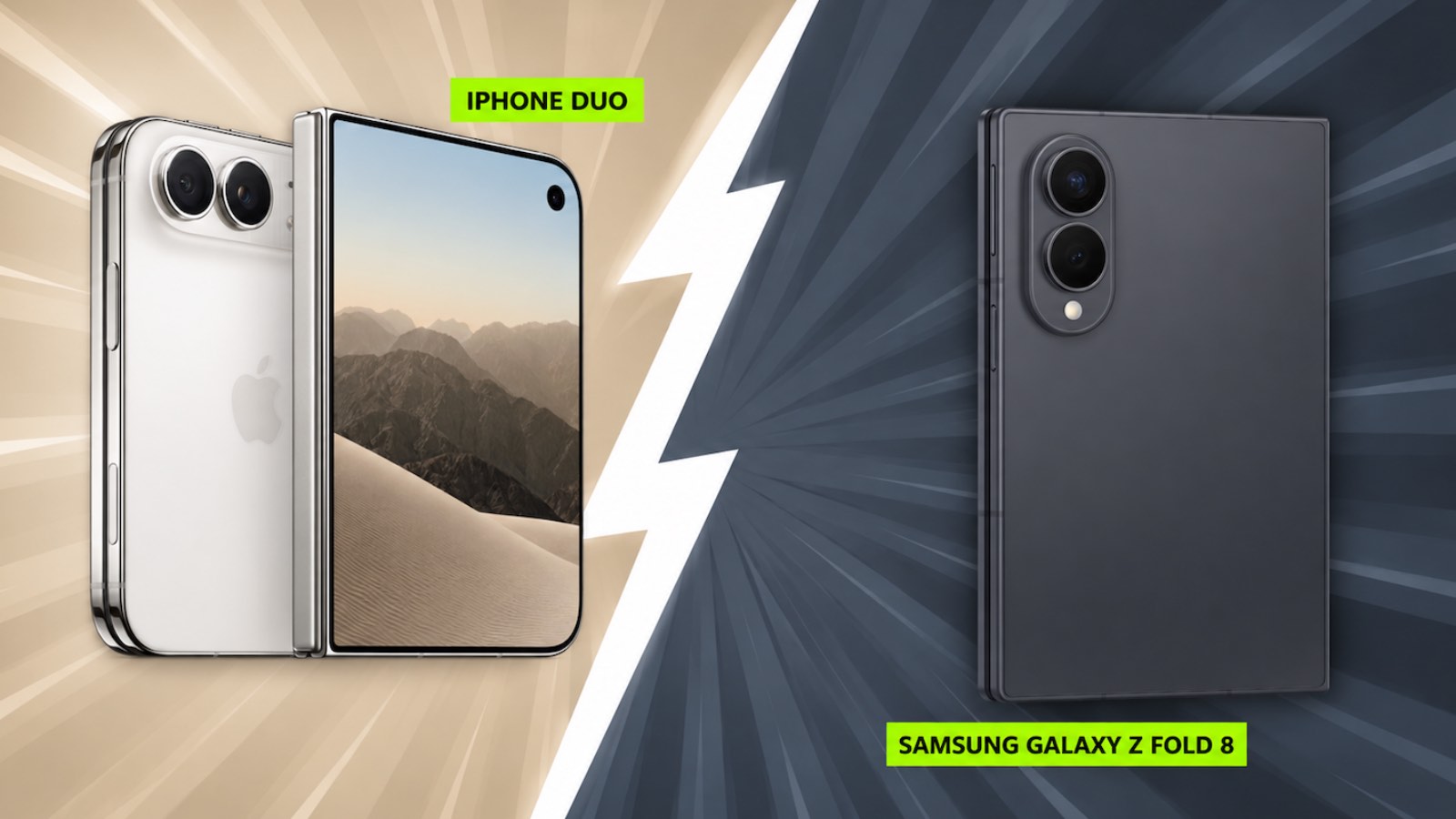
iPhone Duo, the all-new Apple foldable adopts the same “wide” format chosen by Samsung for Galaxy Z Fold 8: external display wider than usual and internal display almost square when open. It is the first time the two manufacturers face off in the foldable smartphone arena, and there is a lot of curiosity around Cupertino’s model, which marks a first for the brand.
iPhone Duo vs Samsung Galaxy Z Fold 8: all the differences between the flagship foldables of the moment

Both devices mount an external display of 5.4″-5.5″ and an internal display of 7.6″, but the proportions tell different approaches: the iPhone Duo keeps the same aspect ratio on both screens, while Galaxy Z Fold 8 switches from an external 10:16 to an internal 4:3, closer to a small tablet when opened.
Looking at the look, Apple’s model is inspired by the iPhone Air and introduces a horizontal camera module; the Samsung rival adopts a proven approach, with a vertical capsule housing the two main cameras.
Design and hinge: titanium for both, but weights differ

iPhone Duo uses a Grade 5 mirror-polished titanium chassis, internally reinforced with ceramic fibers, with Ceramic Shield 2 on the front and Ceramic Shield on the back; 35% of the device’s materials are recycled, including 85% of the titanium in the shell.
When closed it measures 117.8 x 84.1 x 11.3 mm, while open it reaches 117.8 x 164.6 x 5.2 mm, for a weight of 254 grams. Galaxy Z Fold 8, instead, introduces the proprietary Flex Titanium hinge technology, designed to reduce the visibility of the central crease on the inner display, with a weight of 201 grams and closed dimensions of 123.9 x 81.9 x 9.7 mm.
On the durability front, the iPhone Duo boasts IP68 certification, which guarantees protection from water and dust up to 6 meters deep for 30 minutes. The Galaxy Z Fold 8 is IP48 certified, a lower level of protection than Cupertino’s model.
Display: same dimensions, brightness almost identical

On paper, the two internal displays are virtually identical: 7.6″ on both, with a refresh rate up to 120 Hz and peak brightness reaching 3,000 nits. The internal display of the iPhone Duo reaches a resolution of 2,670 x 1,878 pixels (430 ppi) with a nano-texture finish designed to reduce reflections, while the Galaxy Z Fold 8 features a glossy Dynamic AMOLED 2X panel (2,448 x 1,848 pixels, 403 ppi).

The external screen instead shows the first real difference in approach: 5.4″ and resolution 2,034 x 1,398 pixels (460 ppi) on the iPhone Duo, versus 5.5″ on the Galaxy Z Fold 8, with Samsung choosing a narrower and elongated format (aspect ratio 16:10) compared to Apple’s choice to keep the same proportions of the inner screen even outside (14:10).
Chipset e prestazioni
iPhone Duo mounts the new chip A20 Pro, with a 6-core CPU (up to 20% faster than the A19 Pro), 7-core GPU, a dual Neural Engine with 16 cores and a dedicated vapor chamber cooling system. Galaxy Z Fold 8 responds with the Snapdragon 8 Elite Gen 5 for Galaxy, an octa-core chipset (2 Oryon Gen 3 cores at 4.74 GHz plus 6 cores at 3.63 GHz) paired with the Adreno 840.
Both flagship models use LPDDR5X RAM, while on the storage side, the iPhone Duo would use UFS 4.1 storage, whereas Samsung would use UFS 4.0.
On the connectivity front, iPhone Duo pairs Wi-Fi 7 with a 2×2 MIMO configuration, Bluetooth 6, second-generation Ultra Wideband and dual-frequency GPS, handling up to 8 configurable eSIMs with two active at the same time, with no physical SIM slot. Galaxy Z Fold 8 likewise offers Wi-Fi 7 and Bluetooth 6.0, with support for both eSIM and traditional dual-SIM 5G.
Battery and charging: more claimed battery life for iPhone Duo
iPhone Duo claims up to 24 hours of typical usage, up to 31 hours of video playback on the inner display and up to 44 hours on the external display. The 60W USB-C wired fast charging reaches 50% in about 20 minutes (30 minutes with the 35W MagSafe power adapter), while MagSafe/Qi2 wireless charging reaches up to 25W.
Galaxy Z Fold 8, however, features a 4,800 mAh battery, with 45W wired fast charging and 20W wireless charging.
Apple does not disclose the capacity in mAh of the two iPhone Duo batteries, opting instead to communicate the estimated hours of battery life: a different approach from Samsung’s transparency about raw data.
Fotocamere

iPhone Duo adopts a Fusion dual-camera rear system: the main 48 MP sensor on a 26 mm lens with an f/1.6 aperture and OIS also doubles as a telephoto 2x at 52 mm from a 12 MP sensor. We also have a 48 MP ultra-wide camera with a 13 mm focal length, f/2.2 aperture, and a 120° field of view.
The optical zoom therefore covers a range from 2x to 4x, with digital zoom reaching up to 10x, as well as 4K Dolby Vision video up to 120 fps. The Galaxy Z Fold 8, on the other hand, mounts a dual 50 MP sensor each (main with optical image stabilization and f/1.8, ultra-wide at 120° with f/1.9), without a dedicated telephoto lens.

On the selfie front, the iPhone Duo pairs a 12 MP Center Stage camera with an f/2.2 aperture and automatic framing on the external display to a FaceTime camera with an f/1.8 aperture hidden under the inner display, while the Galaxy Z Fold 8 retains two traditional 10 MP selfie cameras, one for each screen.
Software and the pen challenge: Apple Pencil beats the absence of the S Pen
Both devices come with their own AI assistant built into the operating system: iOS 27 redesigned for the foldable form factor on the iPhone Duo, with Apple Intelligence, Split View and StandBy mode on both screens; Android 17 with One UI 9 and Galaxy AI on the Galaxy Z Fold 8.
The most discussed difference, however, concerns a specific accessory. iPhone Duo supports Apple Pencil on both screens, a choice that surprises considering how Apple has historically downplayed the idea of a stylus for smartphones. Samsung, on the contrary, had first introduced stylus support on foldables with the Galaxy Z Fold 3 in 2021, keeping it until the Galaxy Z Fold 6 in 2024, only to abandon it starting with the Galaxy Z Fold 7 in the name of a reduced thickness.
iPhone Duo turns out to be thicker and heavier than Galaxy Z Fold 8, even if only slightly, and the advantage is the ability to integrate support for the Apple Pencil.
All in all, all of this makes it harder for Samsung to justify the absence of the S Pen with the mere requirement of a thinner design. It remains to be seen whether this comparison will push the Korean giant to reintroduce the stylus with the next generation of the series.
Specifications comparison: iPhone Duo vs Samsung Galaxy Z Fold 8
| Feature | iPhone Duo | Samsung Galaxy Z Fold 8 |
|---|---|---|
| Dimensions (closed) | 117.8 x 84.1 x 11.3 mm | 123.9 x 81.9 x 9.7 mm |
| Dimensions (open) | 117.8 x 164.6 x 5.2 mm | 161.4 x 123.9 x 4.5 mm |
| Weight | 254 g | 201 g |
| Colors | Starlight, Midnight | Graphite, Cream, Lavender, Pistachio |
| Certification | IP68 | IP48 |
| External display | 5.4″ Super Retina XDR, 2,034 x 1,398, 120 Hz, 3,000 nits | 5.5″ Dynamic AMOLED 2X, 10:16, 120Hz |
| Internal display | 7.6″ Super Retina XDR, 2,670 x 1,878, nano-textured, 3,000 nits | 7.6″ Dynamic AMOLED 2X, 4:3, 3,000 nits |
| Chipset | Apple A20 Pro | Snapdragon 8 Elite Gen 5 for Galaxy |
| RAM | 12 GB | 12/16 GB LPDDR5X |
| Storage | 256/512 GB, 1/2 TB | 256/512 GB, 1 TB |
| Battery | 4,700 mAh (not confirmed by Apple) | 4,800 mAh |
| Charging | 60W wired, 25W wireless MagSafe/Qi2 | 45W wired, 20W wireless |
| Rear cameras | Dual 48 MP + 48 MP | Dual 50 MP + 50 MP |
| Selfie camera | 12 MP external, FaceTime under the inner display | 10 MP external, 10 MP internal |
| Stylus support | Apple Pencil (USB-C) | Not supported |
| Software | iOS 27 | Android 17, One UI 9 |
| Starting price | From €2,369 (12/256 GB) | From €2,099 (12/256 GB) |
Our reviews
Beyond the specs on paper, we recommend taking a look at our Galaxy Z Fold 8 review, with all tests on performance and cameras!
Conclusion: which wide foldable to choose?
On paper, the iPhone Duo and Galaxy Z Fold 8 aim for the same exact form factor, but come from different philosophies: Apple bets on declared endurance, premium materials and the Apple Pencil support as a distinguishing element, while Samsung keeps a more affordable starting price and a thinner and lighter profile, albeit giving up its own stylus for several generations.
Those seeking stylus support on a wide foldable today have one concrete answer, Apple. Those prioritizing the lower entry price and the Android ecosystem can turn to Galaxy Z Fold 8.
What do you think of Apple’s and Samsung’s new wide foldables? Which one convinces you more? Let us know in the comments!
I link di acquisto presenti in questo articolo generano una piccola commissione per GizChina.it. Scopri tutti i dettagli qui.