


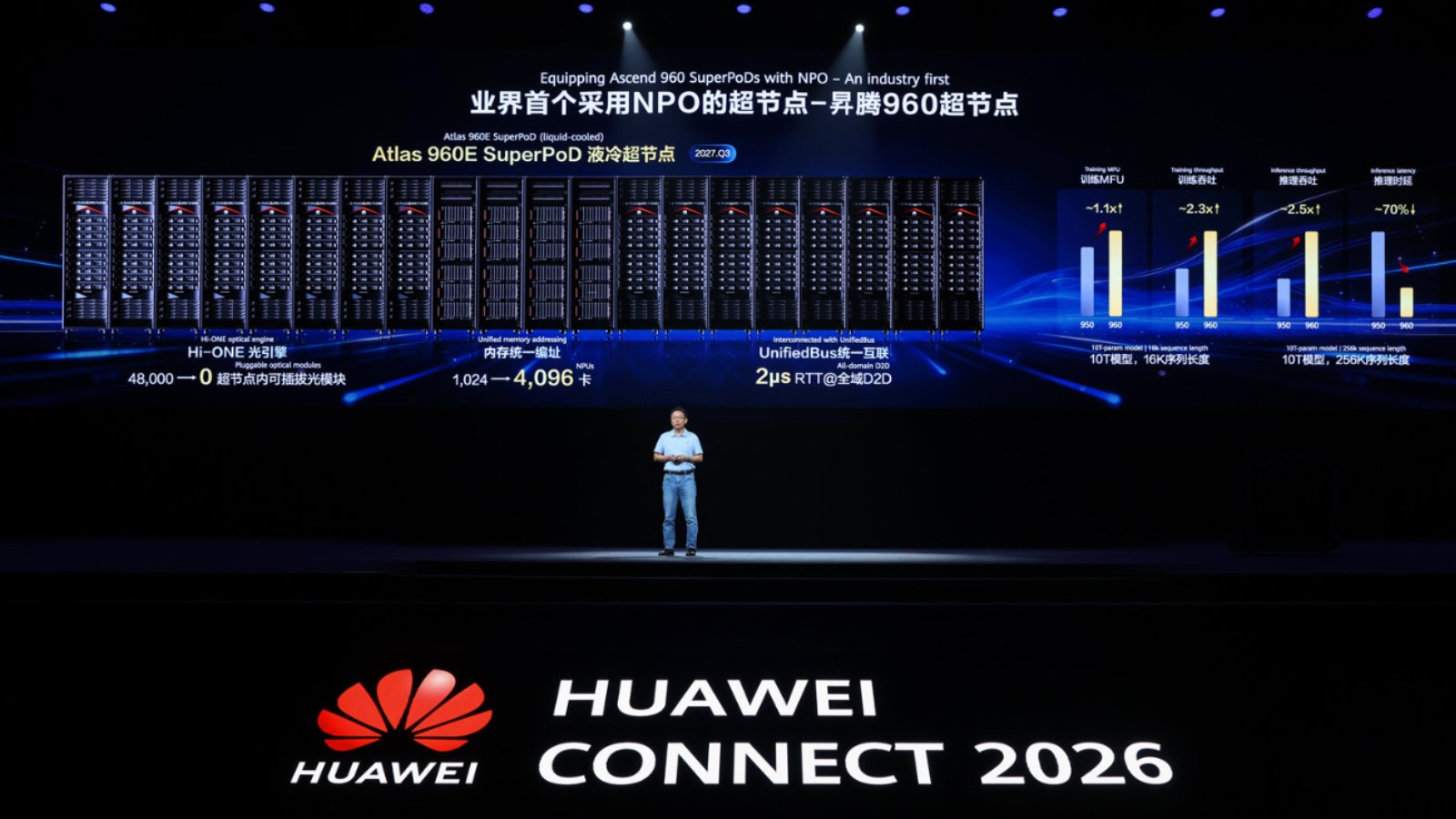
During the HUAWEI CONNECT 2026 event, in Shanghai, Huawei unveiled Atlas 960E, a new AI system that the company defines as the world’s first based on Near-Packaged Optics (NPO) technology, a solution that brings optical links very close to the chips, reducing the distance signals travel and enabling high-speed communications with lower power consumption and latency.
A SuperPoD, in simple terms, is a set of many chips interconnected so tightly that they behave as a single large computer, instead of as many separate devices. Atlas 960E is designed to train and run the largest AI models, those approaching 10,000 billion parameters (the value indicating, roughly, how complex a model is).
Atlas 960E SuperPoD: how it works and how powerful it is

At the heart of the system are two technologies: UnifiedBus, which manages communications among the various components, and Hi-ONE, an optical component Huawei describes as the first of its kind produced at industrial scale, as well as the only one in the sector with its own integrated light source. Together they allow all the chips in the system to share memory and resources as if they were a single large computer.
Each Atlas 960E can contain up to 4,096 Ascend AI chips, with liquid cooling and an orthogonal architecture (cards arranged at 90° to eliminate traditional cables and zero latency).
The system offers a declared compute power of up to 8 EFLOPS in FP8 and 16 EFLOPS in FP4, and memory HBM up to 1 petabyte, a quantity substantially higher than the norm for this type of system.
Thanks to Hi-ONE, moreover, Huawei claims energy savings of over 550 kW compared to traditional optical solutions, as well as a more reliable system: the uptime would be doubled, with a 99.8% availability, i.e., the system would be operational almost all the time.
Not just a system, but an entire infrastructure
In addition to the Atlas 960E, Huawei also presented TaiShan 950, a system designed to manage even more devices (up to 4,096 nodes, with 256 TB of shared memory), aimed especially at AI-agent-based applications, i.e., those systems capable of completing tasks autonomously. Completing the infrastructure is OceanStor M900, dedicated to the fast management of data used by AI models during their operation.
Moreover, multiple Atlas 960E units can be connected to form a total system up to 512,000 NPUs, or even up to 1 million in particular configurations: numbers that serve more to convey the scale Huawei is aiming for rather than describe a typical use.
The road map for the coming years
Ascend 960DT is planned for Q1 2027, three quarters earlier than the original roadmap, while Ascend 960PR will arrive in Q3. Ascend 970 and Ascend 980 are scheduled for 2028 and 2029 respectively. For Atlas 960E some sources indicate Q3 2027, while Huawei currently describes the NPO platform as still in testing.
For all the news about the brand’s ecosystem, you can find our most recent articles in the Huawei section of GizChina.it.