


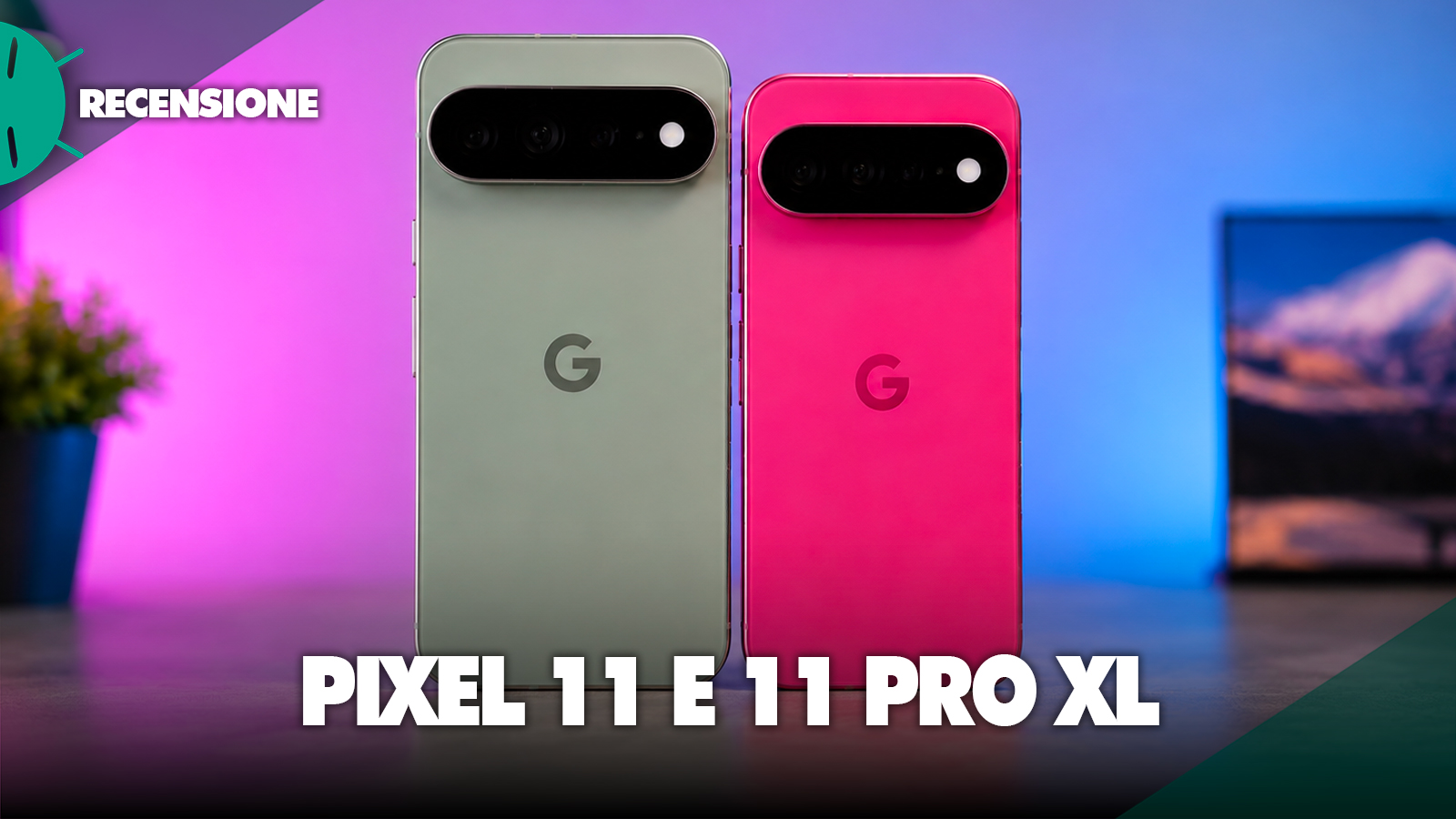
Reviewing a Google Pixel in recent years has become almost paradoxical. Not because they are banal smartphones, far from it, but because Google has now reached such a level of maturity that it is increasingly difficult to introduce a novelty truly capable of changing the user experience from one generation to the next. With Pixel 10 and Pixel 10 Pro XL I had this this feeling: Google seemed to have finally found its formula, made up of recognizable design, clean software, great cameras, extremely long support and an increasingly coherent ecosystem.
And indeed, with Google Pixel 11 e Pixel 11 Pro XL, the concept doesn’t change. In fact, it’s taken even further. There is a new Tensor G6, some important changes to the camera system, 256 GB of base internal storage, faster wireless charging, a less protruding camera bar, and, above all, an ever-increasing number of AI-based features. But there is also another element that cannot be ignored: prices are rising.
And this is precisely the central point of the entire review, because the Pixel 11 and Pixel 11 Pro XL are undoubtedly better than their predecessors, but not in every single aspect. Some components improve, others remain unchanged, and in some cases Google has even taken a step back.
All in all, this isn’t a generation where everything grows: it’s a generation of compromises. And considering how much they cost, it could weigh quite a bit.
Google Pixel 11 and Pixel 11 Pro XL Review: what really changes and which one to choose
Videorecensione Google Pixel 11 e Pixel 11 Pro XL
Design e materiali
Aesthetically, Google hasn’t really changed anything, and in my opinion it’s the right choice. Pixel 11 and Pixel 11 Pro XL continue to be immediately recognizable as Pixels. The camera bar remains the central element of the design, the lines are clean and the visual identity developed in recent years continues to work. The main novelty concerns the rear camera module itself, which has been redesigned and, above all, protrudes much less, especially in the Pixel 11 where, with a case installed, the camera tends to almost disappear into the phone’s overall profile, and it is one of those improvements that on the spec sheet seem insignificant but in daily use are appreciated much more than many features advertised during presentations.


Pixel 11 remains the model I prefer in terms of size. It’s compact just right, but without becoming too small for multimedia content, photos, or browsing. Pixel 11 Pro XL is instead the smartphone for those who want a much bigger screen and aren’t too worried about size and weight. Build quality remains very high on both: materials, assembly and the feel of the touch are what you’d expect from premium products.

On the Pro, there is also HiLight, a small multicolor LED integrated on the back. The idea is interesting, but honestly at the moment it feels to me like one of this generation’s missed opportunities: it can light up when using Gemini or at certain calls, but the customization options are decidedly more limited than I expected. It can’t yet transform into that true evolved notification LED that could have distinguished the new Pixels from the competition. In short, the design improves, but let’s be clear: we’re talking about refinements.
Display
The displays continue to be of excellent quality, but it is also one of the aspects in which the transition from the previous generation is less noticeable. Pixel 11 uses a OLED Actua 6.3-inch panel with a refresh rate up to 120 Hz, while Pixel 11 Pro XL features a Super Actua LTPO 6.8-inch panel, capable of dynamically managing the refresh rate. They are panels that are very pleasant to use, well calibrated, with convincing colors, excellent contrast, and outdoor visibility is excellent. In terms of brightness, Pixel 11 reaches around 3,000 nits peak, thus essentially at the same level as Pixel 10, while Pixel 11 Pro XL rises to 3,600 nits, compared to 3,300 nits of Pixel 10 Pro XL. In practice, the real increase concerns mainly the Pro XL model, while on the Pixel 11 base it changes very little.

And it’s not necessarily a defect, because the Pixel 10 already had excellent panels, but I would have liked a few more steps forward, especially from an aesthetic standpoint. The bezels, in fact, continue to be quite thick for smartphones in this price range, and, especially when looking at the Pixel 11 Pro XL next to some of the best Android flagships of 2026, the difference is noticeable. They are symmetrical and therefore visually orderly, but Google could have leveraged the front surface better and made the design a bit more modern.
On the PWM dimming front, basically nothing has changed compared to the Pixel 10 series. Pixel 11 continues to operate around 240 Hz, exactly like Pixel 10, while Pixel 11 Pro XL also starts from around 240 Hz and can reach around 480 Hz with the mode designed for sensitive eyes, just as it did on Pixel 10 Pro XL. In practice, in this regard Google has maintained the same flicker management as the previous generation, with modest values but still quite far from those achieved by some Android competitors who use much higher PWM frequencies.

The overall quality, however, is not in dispute: brightness, color reproduction, contrast, and smoothness are excellent and the Pro XL maintains the LTPO panel advantage, especially for dynamic refresh-rate management. The point is simply that, looking at them as a whole, these displays represent more of a refinement than a true upgrade: Pixel 11 is practically identical to the Pixel 10, while the Pro XL improves mainly in peak brightness, which goes from 3,300 to 3,600 nits.
In short, they are excellent displays and slightly brighter, but they basically remain the Pixel 10’s: I would have preferred to see thinner bezels and, above all, a serious intervention on PWM dimming.
Hardware e prestazioni
Both use the new Google Tensor G6. As always, though, one must avoid judging this processor solely by benchmarks. Google continues to follow a philosophy very different from Qualcomm and Apple: Tensor is not necessarily designed to be the most powerful SoC in absolute terms, but to work in an extremely integrated way with Android, the camera, and above all with artificial intelligence models.

In everyday use, the improvement is noticeable. Applications open slightly faster, the interface is very smooth, and AI-related capabilities have grown significantly. But the real point, in my opinion, is not pure speed. In 2026 any €1,000 smartphone must be fast. What matters is efficiency, thermal management, and the modem’s behavior, aspects on which previous Tensor generations had not always been impeccable. And this is where the Tensor G6 must prove that it has made the real leap.
One of the features I appreciate the most is the internal storage. Finally it starts at 256 GB, and considering the prices I would also add: it’s about time. Photos and videos are taking up more and more space, Android is increasingly complex and AI features require increasing amounts of space and resources. Continuing to sell smartphones for over 1,000 euros with 128 GB would have been really hard to justify.

There is, however, a compromise. If prices rise, I would expect that every hardware component would improve. And yet that’s not the case. Pixel 11 uses 12 GB of RAM and Google has made the memory allocation more conservative even in some configurations of the Pro family, while the previous generation could reach up to 16 GB. In everyday use, it probably changes very little: 12 GB is more than enough for Android, multitasking and basically any application. But the issue is a matter of principle. If the price goes up, I’m not thrilled to see a number on the specs sheet go down.
An improvement that I’ve appreciated quite a bit also concerns the new modem, which together with the revised Tensor G6 makes these Pixels more efficient, stable in signal reception and convincing in thermal management. They are probably two of the most important hardware upgrades of this generation, and in daily use they work very well. The problem is that they are not enough, on their own, to justify an upgrade: once the new processor and modem are set aside, there is practically no other hardware novelty capable of really changing the experience compared to the Pixel 10. And this, in my opinion, is the main limit of this generation.

There’s also another hardware element that disappears completely: the temperature sensor of the camera. Personally I won’t miss this feature much, and I think many users hardly used it. But here too the same argument made for RAM applies: it remains anyway one less hardware feature on a product that costs more. And it is precisely by summing these small elements that the concept of “upgrade” begins to become less linear.
Fotocamere
Fortunately, in the camera department the story changes quite a bit. Pixel 11 uses a triple camera and the real novelty is the larger main sensor compared to the one used in the Pixel 10, which, it must be said, was a rather low starting point. In any case, in real-world use this mainly means more light captured, better handling of night scenes and a hardware base finally more competitive than other Android flagships.

And then there is, of course, Google’s processing. HDR, skin tones, highlight management and color consistency continue to be among the benchmarks of mobile photography. What I appreciate most about the Pixel devices continues to be the simplicity: you frame, shoot, and in the vast majority of cases you end up with a very good photograph.
Pixel 11 Pro XL raises the bar even higher. Google has worked on both the main sensor and, above all, the 5x telephoto lens, which now uses a larger sensor. There is also Pro Zoom up to 120x, although I must admit that a smartphone reaching 100x or 120x is of relatively little interest to me. What really matters is what happens between 5x and 20x. It is there that a telephoto lens can be really useful, and it’s precisely there that the new Pro XL manages to be more convincing.
For videos, Google continues to work mainly on the combination of hardware and computational processing. Pixel 11 records up to 4K at 60 fps, while Pixel 11 Pro XL maintains the most advanced modes in the lineup, including the possibility to reach 8K via Video Boost, in addition to 4K up to 60 fps, 10-bit HDR, optical and electronic stabilization, cinematic modes and tools dedicated to night recording. The front camera can also record in 4K, a notable aspect especially for those who use the smartphone for vlogs, Reels and social content.
On the video front, however, I haven’t seen practically any generational leap. The quality remains good, the stabilization works well, the dynamic range is wide and the colors are convincing, but essentially the videos are the ones we already had on the Pixel 10. And when we move to the comparison with iPhone the difference continues to be evident: in photography Google can easily hold its own with the best, while in video the iPhone remains clearly superior, especially for shot consistency, changes in focal length, handling of more challenging conditions and overall reliability of the result. If video is one of your absolute priorities, I would personally continue to prefer the iPhone without too many doubts.
Le funzioni IA per le foto e i video
By 2026 you can no longer talk about the Pixel’s camera without talking about artificial intelligence. And with Pixel 11 the boundary between photography and processing becomes even more subtle. There are new tools for improving photos, Night Sight evolved, generative editing, assistance during framing and new features that leverage Gemini models to intervene on both photos and videos.

From a technical standpoint, it’s impressive, but personally I still have a slight reservation. I really like the AI features that enhance a photo that was actually taken, while I’m much less convinced by those that begin to reconstruct entire portions of the image. It’s a debate that will become increasingly important in the coming years, and Google is probably the company that is pushing more than any toward this new idea of photography.
The Pro XL also enhances its video capabilities, with more advanced stabilization, tools designed for those who record a lot of content, and a greater ability of the Tensor G6 to intervene in the processing of footage. It is one of the areas where Google is most persistently trying to narrow the edge that Apple continues to have in video.
And it’s precisely here that you can see how AI has now become an integral part of the photography system: it’s no longer an add-on feature, but one of the pillars of the Pixel’s photographic experience.
Software ed intelligenza artificiale
When it comes to software, it’s hard to criticize Google. Pixel 11 and Pixel 11 Pro XL come with Android 17 and continue to offer seven years of updates and Pixel Drop. The real protagonist, however, is Gemini. By now it’s no longer simply an app: it’s an integral part of the Pixel experience. It can understand the content displayed on the screen, converse with apps and services, analyze images and use contextual information to respond in increasingly useful ways.

And it’s right here that the great paradox of the new Pixels arises. The most impressive innovations are software. And if they are software, why would I necessarily have to buy the Pixel 11? Many of the features that make this generation interesting do not depend on a new sensor or new hardware, but on the evolution of artificial intelligence and Google’s services. And it’s therefore inevitable to wonder how many of these features will end up, at least in part, also on previous generations.

On the one hand, it’s a huge advantage, because it means Google continues to improve its smartphones over time. On the other hand, it makes it increasingly difficult to justify an annual upgrade. And this is probably the biggest problem smartphone manufacturers will have to face in the coming years: when software becomes the true innovation, new hardware risks seeming increasingly less essential.
Batteria e ricarica
On the autonomy front, however, the results I obtained were decidedly positive. In one of my days of use I reached about 18 hours since the last full charge with still 20% of battery remaining, but the truly interesting data is another: I had logged over 5 hours of screen-on time. And in my opinion, it’s a very good result, especially considering the energy efficiency of the previous generations.
Of course it doesn’t mean that the Pixel 11 can automatically guarantee six and a half hours of display. Battery life changes a lot depending on the network, brightness, the camera, and the apps used. But reaching 5 hours of screen-on time with around 20% battery remaining means that, with normal use, the full day should absolutely not be a problem. In my case, moreover, it hadn’t been a particularly light usage: according to the system statistics, Wi-Fi, ambient display, and the mobile network were among the main sources of consumption. And it is precisely for this reason that the data convinced me even more.
I wouldn’t call it record-breaking battery life anyway. In the Android world there are now smartphones with enormous batteries and silicon-carbon technologies capable of delivering more. But compared with some older Pixel generations, where battery life and the modem could be real weak points, The improvement is evident.
What remains much less exciting, however, is wired charging. Google remains extremely cautious, and if you’re used to Chinese flagship phones with 80W, 100W, or more fast charging, you’ll notice the difference. Personally I don’t consider it essential to fully charge a smartphone in fifteen minutes, but for a device in this price range I would have expected something more.
What’s more interesting, however, is Pixelsnap instead. Magnetic wireless charging becomes faster and, above all, the ecosystem of magnetic accessories is now one of the strengths of the range. Power banks, car mounts and chargers become immediately more convenient and, finally, Android also has an integrated solution truly comparable in philosophy to MagSafe.
Prezzo di vendita e conclusioni: quale Pixel scegliere?
The new Pixels will be distributed through the main online channels and in physical stores, including Google Store, Amazon, MediaWorld, Unieuro and Euronics. Pre-orders are already open, while actual availability is expected for August 20 starting at 1:00 PM.
The list prices start at 999 euros for Google Pixel 11, 1,199 euros for Pixel 11 Pro, and 1,399 euros for Pixel 11 Pro XL.
Google has also planned several launch promotions tied to trading in used devices. Purchasing through Amazon, MediaWorld, Unieuro, or Euronics you can obtain a premium trade-in value of 200 euros on Pixel 11, 300 euros on Pixel 11 Pro and 400 euros on Pixel 11 Pro XL. In the case of the Pro XL model, those who decide to trade in an old Pixel can also benefit from an additional 100 euros of extra value. These conditions will remain valid until the September 13.

On the official Google Store, however, the promotion will be active from August 12 to September 1 and offers a €200 trade-in value for the Pixel 11 and €400 for the Pixel 11 Pro and Pixel 11 Pro XL. Additionally, there is also a dedicated discount on purchasing the new Pixel Watch 5 at the same time, making the official channel particularly attractive for those who intend to delve deeper into the Google ecosystem.
And here we are at the real sticking point. Google Pixel 11 and Pixel 11 Pro XL arrive on the market with higher prices than the previous generation and, while the base 256 GB of internal storage makes the increase somewhat more understandable, they still can’t erase it. In particular, the Pixel 11 Pro XL enters a tier in which it directly competes with any other Android flagship and with the iPhone Pro Max. And at that level every defect weighs twice as much.

And I’ll be honest: at full price I have trouble recommending the new smartphones, especially to those who already own a recent Pixel. The story changes, however, by taking advantage of launch promotions and especially the super-valuation of used devices: if you have an old smartphone to trade in and manage to substantially lower the actual outlay, the Pixel 11 and Pixel 11 Pro XL become immediately much more interesting.
Because the problem isn’t just the price in absolute terms. It’s the balance between what you pay and what actually changes compared to the previous generation. Pixel 11 is better: it has Tensor G6, a more advanced main camera, faster wireless charging, more base internal storage, a less protruding camera bar, and new AI features. But the jump from Pixel 10 is small. If you already own Pixel 10 or Pixel 10 Pro XL, I don’t see a compelling reason to change smartphones after twelve months, also because, as we’ve seen, not all specifications necessarily go in the right direction.
A completely different story if you come from Pixel 7, Pixel 8 or earlier generations. In that case the leap becomes much more significant and can be perceived in virtually every area: display, performance, photography, battery life, wireless charging, and above all the software experience.
Anyway, at the end of the test I arrived at a fairly simple conclusion: between the Pixel 11 and the Pixel 11 Pro XL, personally I would buy the Pixel 11. It’s more compact, significantly cheaper and basically retains everything that makes the Pixel experience interesting. It has a great display, Tensor G6, a camera finally improved even from a hardware standpoint, 256 GB of base storage, Gemini, seven years of updates and above all a battery life that in my test convinced me.
Pixel 11 Pro XL is the product to choose if you want the best: a larger display, a superior camera system, a more advanced telephoto lens, greater video versatility, and all the Pro features. But the price is hard to ignore, and it becomes even harder to justify considering that the Pixel 10 Pro XL will inevitably continue to fall.
In short, if you already have a Pixel 9 or newer, I would wait: the new modem and Tensor G6 are great, but there isn’t enough else to justify upgrading to the new generation. If, on the other hand, you’re coming from an older model, the story changes, especially if you can make good use of a trade-in. Because, in the end, these Pixels, in my view, are primarily worth it if you can pay substantially less than the list price. With high trade-in value and promotions, they can become a great purchase; at full price, though, I would have a lot more trouble recommending them.
Se non visualizzi correttamente il box qui sotto, prova a disattivare AdBlock.
I link di acquisto presenti in questo articolo generano una piccola commissione per GizChina.it. Scopri tutti i dettagli qui.