


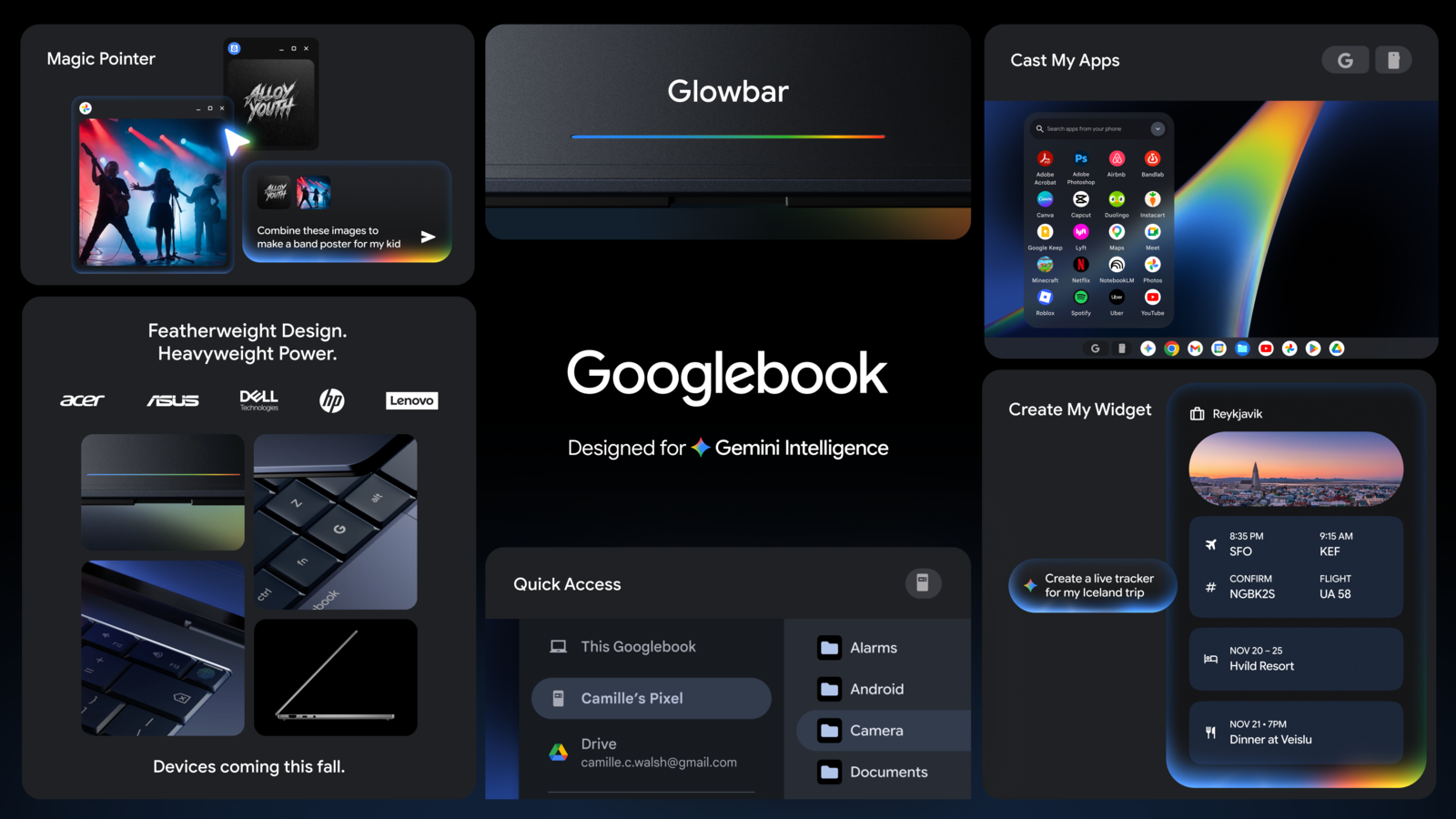
Semiconductor manufacturers are using social channels to confirm their collaboration with Google for the development of the new line of laptops named Googlebook.
In a post on the X platform, Intel has announced its involvement in the project, while Qualcomm issued a similar statement via Instagram.
Both companies used very similar language, describing the future devices as powerful, high-end and specially designed for artificial intelligence.
Googlebook, the major chip manufacturers believe in the project

These confirmations come shortly after the event The Android Show: I/O Edition, during which Google offered a preview of its future platform and confirmed that it is working with several PC manufacturers, including HP, Dell, Acer, Asus and Lenovo.
In an exclusive interview granted to Chrome Unboxed, Google’s vice president John Maletis added further details, revealing that the devices will arrive on the market equipped with processors from Intel, Qualcomm and MediaTek.
During the initial presentation, the focus was not on the hardware, but on the new operating system that will manage these devices. This software unites the hallmark elements of Android and ChromeOS, offering a deep integration of Gemini AI within the overall user experience.
John Maletis explained that Googlebook represents a completely new category of laptops powered by artificial intelligence, where this technology is not treated as a mere add-on.
Initially it was hypothesized that the entire range would be based on Arm architectures, given the strong resemblance to the typical Android smartphone and tablet experience. Intel’s official involvement, however, opens up the possibility that the new operating system will also support x86 hardware, unless the company has an unreleased processor based on the Arm architecture.
Strict Standards, Native Apps and Design
To ensure a consistent, high-level experience, Google is imposing very strict technical specifications regarding memory, storage capacity, keyboard quality, and the overall assembly of the computers.
The official launch of the first wave of these devices, strongly focused on premium hardware components, is scheduled for the upcoming autumn.
On the design front, there will be the return of the LED bar named Glow Bar, an aesthetic element previously seen on devices in the Chromebook Pixel series.
From a software perspective, the laptops will run Android apps natively and without emulation, promising significantly higher performance and tight integration with Android smartphones. Among the features managed by Gemini, there will also be room for the new interface Magic Pointer.