


For the vast majority of users, installing the latest version of an operating system is a routine procedure, a quick step to gain new features and ensure the most recent security patches.
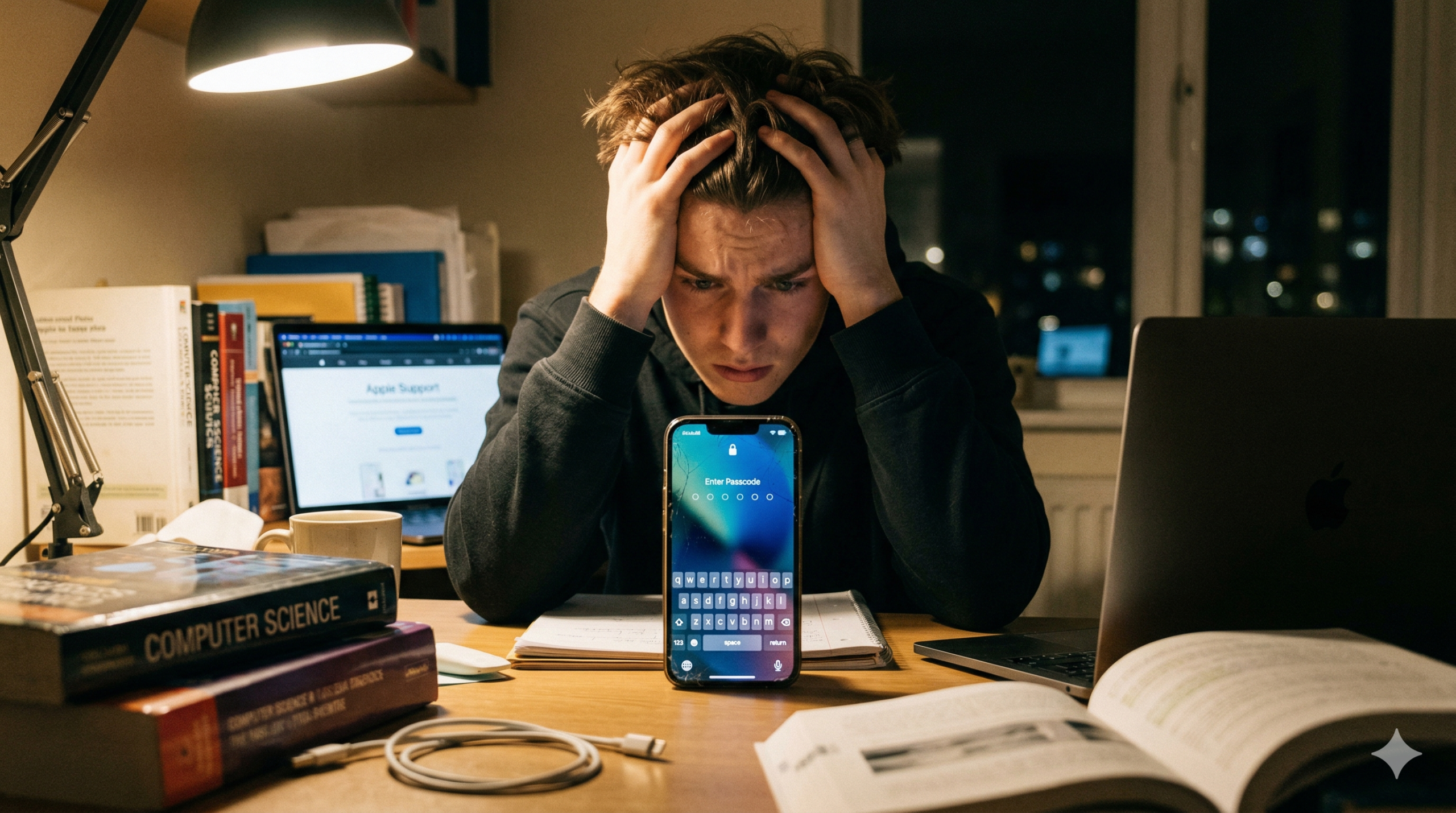
However, for Connor Byrne, a 21-year-old United States college student, the simple jump to a new firmware has turned into a real cybersecurity trap.
The keyboard updates and the iPhone remains locked

Byrne has always preferred to adopt an extremely rigorous approach to protect his data, choosing to use a complex alphanumeric string instead of the classic four- or six-digit unlock code.
Unfortunately, after updating his iPhone 13 from iOS 18 to the latest release iOS 26.4 released on April 5, the young man has completely lost the ability to type his password, finding himself suddenly locked out of his device with no apparent way out.
The cause of this unusual problem lies in a seemingly harmless modification made by the developers to the Czech language keyboard.
The student’s complex password indeed included a special character, known as háček or caron (ˇ). In previous iterations of the system, this symbol was easily accessible directly from the lock screen keypad.
With the update, the password input interface underwent a fatal change: in the position originally occupied by the háček appeared a second acute accent, visually and functionally identical to the one already present on the adjacent key.
Byrne described this modification as completely illogical, since the two symbols share the same encoding. Tests conducted by The Register have confirmed the presence of the pesky bug.
Although the character still exists within the system dictionary once the iPhone is unlocked, the home screen does not allow typing it in any way, triggering the tapping animation and sound but omitting the symbol in the password input.
An Unreachable Digital Treasure
The purely economic damage associated with the device’s inaccessibility is utterly negligible, according to the young man, given that his iPhone 13 has a heavily scratched display and is aging.
The real value lies solely in the photographs and memories contained within it. The young man has never backed up his data to iCloud, making it impossible to recover the images via a computer or another device.
The Apple customer support, consulted to resolve the issue, suggested that the only way to regain control of the smartphone is to perform a full factory reset, a procedure that would inevitably delete all files.
During a surreal Genius Bar appointment, an employee even started the formatting process of the device without first obtaining the explicit consent of the student, fortunately stopped just in time.
Desperate attempts and inflexible security
To recover his files, Byrne explored every possible avenue to force the system. He tried inserting the new acute accent hoping for a simple graphical error, he unsuccessfully tried to force a downgrade to iOS 26.3.1 and even wrote the password on printed paper so that the AutoFill function could interpret it.
Unfortunately, the camera mistook the delicate Czech symbol for a banal degree mark or for quotation marks. Even hardware or biometric alternatives clashed with the company’s strict security policies.
The use of Face ID is not a valid option not only due to the young man’s explicit privacy choice in case of forced checks by authorities, but also because after every reboot the system mandatorily requires manual entry of the PIN before enabling facial recognition.
Moreover, the use of an external keyboard connected via cable is blocked by the device’s strict initial security state, which inhibits communication with any USB accessory until the very first manual unlock.
Awaiting an unlikely corrective intervention from the California technicians, the young man has said he was forced to buy a cheap Android smartphone, holding on to the hope that a future software release might finally unlock his precious memories.