

Okay, let’s be honest: not all of us were born to run a marathon in under two hours and yet, if there’s one thing we Sunday runners (or Wednesday after work) love, it’s technology that makes us feel a little more pro. Huawei has returned to the fitness sector with the new Watch GT Runner 2 and did so in grand style, engaging the famous marathoner Eliud Kipchoge during the official presentation of this smartwatch in Madrid, to refine features that promise to take us from the couch to the finish line with a level of precision never seen before.
The declared goal is ambitious: to challenge the “sacred monsters” like Garmin and Apple on their own turf, that of absolute precision and depth of data. But does it make sense to spend on a wrist coach this advanced if our objective is simply to surpass 10km without getting winded? I put this new tech toy to the test to understand whether it is really the promised revolution or if it is “too much” for those who don’t race in Formula 1. And no, the answer isn’t as obvious as you would expect.
Review HUAWEI Watch GT Runner 2
Design, materials and display
As much as one might think that sensor precision and the reliability of a smartwatch are fundamental in the sports sector, it is also true that the eye wants its part, especially if this watch must stay on the wrist even during the post-workout aperitif. If the first GT Runner hinted a bit too much of “sport plastic”, with the GT Runner 2 Huawei has decisively shifted gears, betting everything on materials that you normally find in products that cost twice as much.
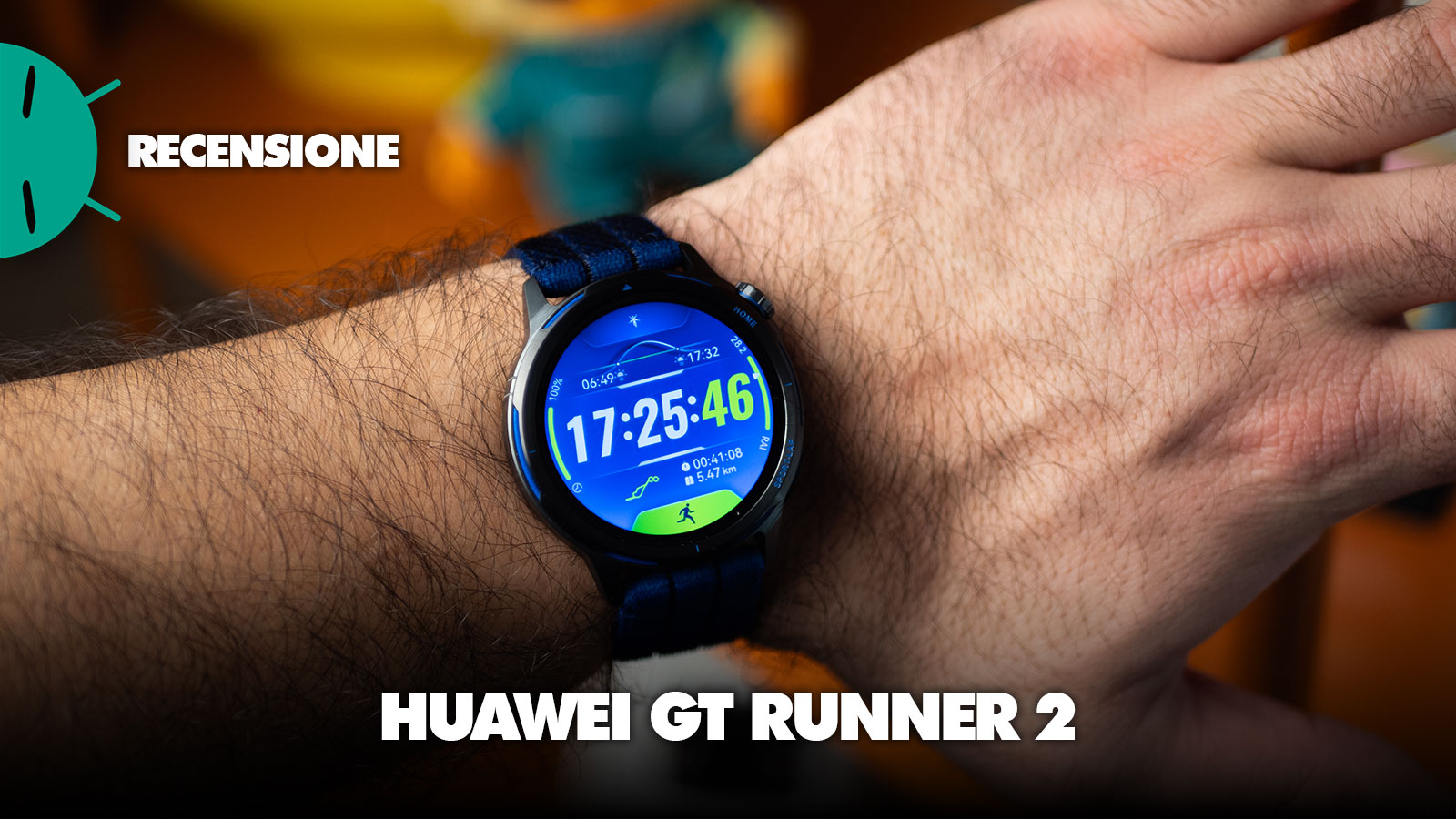
The first thing you notice, right out of the box, is the lightness, but not the cheap kind. The case is entirely carved from titanium, a choice that keeps the scale needle at only 34.5 grams (strap excluded). It is so slim (10.7 mm) that it disappears under the cuff of a sweatshirt, a detail not to be underestimated for those who, like me, hate those sport watches that look like bricks strapped to the wrist (and Garmin knows this well).

A really interesting technical touch is the colored ring surrounding the dial: it’s not just aesthetics, but acts as an “isolation” for the GPS antennas, so that the signal isn’t shielded by the metal of the case. And I must say it’s genius, because effectively the GPS fix is almost instantaneous when starting a workout. In terms of color options, I tried the Blue variant, very distinctive but still more understated than the orange version, which has a wild character. For those who don’t want to take risks, there’s also the black variant, certainly more anonymous but suitable for nearly any occasion.
The strap deserves an honorable mention, because besides the classic silicone, the package includes the new AirDry woven fabric, a solution I had never tried and that proved exceptionally comfortable, with millimetric adjustment and, above all, incredibly quick to rinse and dry after heavy sweating.

On the display, Huawei has delivered its best yet, packing an AMOLED 1.43-inch panel that reaches a peak brightness of 3000 nits. Even in direct sun, running in broad daylight, you’ll always be able to read your numbers perfectly with a level of sharpness that I would call almost embarrassing. To protect the display there is the second generation Kunlun Glass, a glass Huawei says is ultra-resistant to drops and scratches, and indeed it withstood a few minor drops or bumps during my over two weeks of use.


Hardware, performance e connettività
Under the hood of the HUAWEI Watch GT Runner 2 lies a tech core aimed squarely at one objective: never lose your bearings (and pace). If, like me, you’re not a lab-statistics junkie but you love devices that “just work”, then you’re in the right place.
The real strong point this year is the positioning system; as mentioned earlier, Huawei on this GT Runner 2 has introduced a truly unique dual GNSS antenna design. The first antenna is integrated into the housing, the second is hidden directly in the titanium bezel, all separated by an isolating ring to prevent interference. And the result is almost flawless; having done running sessions mostly in the city over these testing weeks, starting from home surrounded by buildings, I can say the GPS fix has consistently settled in about 5-7 seconds at most.
There is also to note that Huawei has integrated an intelligent feature that, thanks to preloaded maps, “anchors” the route even when passing through tunnels or shaded areas. As a casual runner, I appreciate the effort: there is nothing more frustrating than seeing your GPS track look like a child’s drawing simply because you went under a portico.

On the connectivity front, Huawei has equipped this smartwatch with Bluetooth 6.0 for a very stable connection with the smartphone, and not only; calls via the smartphone are impeccable, with very good microphone quality given that you can answer and speak directly from the watch. Also the NFC presence is useful for cardless payments, though there isn’t direct compatibility with Italian banking apps, so you need to rely on Curve, as already seen on other devices from the Chinese brand.
Sensors and sports monitoring
Coincidence or not, when Huawei sent me this smartwatch for testing, I had just started running again after many years of hanging up the shoes, so what better opportunity to restart, even at modest paces. The beating heart of it all is the TruSense module, which honestly surprised me: for someone like me who has no desire to wear those uncomfortable chest straps, knowing that the wrist sensor reaches a nearly surgical accuracy (we’re talking about 94% compared to medical systems) is a godsend. While we run, the watch doesn’t just tell us how fast the heart is beating, but calculates the Running Power in Watts, a data point very useful for professionals, and provides an ability index (the RAI) which is a bit like a videogame score: the better you run, the higher the number, and it’s incredibly satisfying to see it grow.

L’effidibilità delle misurazioni è davvero eccezionale; l’ho confrontata con il mio Apple Watch Serie 9, un prodotto che, per fama, è sempre stato molto preciso e affidabile nelle misurazioni, e devo dire che sia sul fronte cardiaco sia sul fronte GPS con i percorsi registrati, i risultati sono sempre stati in linea tra i due dispositivi, senza discrepanze di alcun tipo. Huawei ha spinto tantissimo sulla modalità Marathon e sull’intelligenza artificiale, creando piani di allenamento che non sono “fissi” ma dinamici.
In pratica, se una notte dormi male o sei troppo stressato dal lavoro, l’orologio lo capisce dai sensori di recupero e ti suggerisce di rallentare o riposare, evitando di arrivare ai primi chilometri di corsa con le batterie scariche. E, per quanto possa sembrare fantascienza, dopo averlo indossato per qualche giorno come unico smartwatch al polso, effettivamente le indicazioni che fornisce si rivelano vere e piuttosto affidabili, segno di una affidabilità a 360 gradi.

Tuttavia, in scenari di montagna o su sterrato in percorsi poco definiti, a volte il GPS tende a “semplificare” un po’ troppo la realtà, posizionandoci virtualmente in mezzo alla carreggiata o tagliando le curve, influenzando leggermente il calcolo reale dei chilometri percorsi. Anche l’altimetro a volte si prende qualche libertà creativa, segnando altitudini negative. Questo per dire che, se siete utenti super esperti o professionisti della corsa, ma praticamente tra i runner solo il 20% rientra in questa categoria, questo potrebbe non essere il prodotto giusto per voi. Per il restante 80%, incluso me, è un prodotto di altissimo livello.
Software
Software molto buono, seppur restino i soliti problemi di sempre, ma andiamo per ordine. Navigare tra i menu è un’esperienza che definirei “burrosa”: HarmonyOS si conferma una garanzia di fluidità, con animazioni che non perdono un colpo e una risposta ai tocchi che farebbe invidia a molti smartphone di fascia alta. La logica è semplicissima, basata su swipe che ti portano rapidamente dai widget dell’attività quotidiana al meteo, fino ai controlli musicali.
Autonomia
Huawei ha compiuto un piccolo miracolo di ingegneria inserendo una batteria al Silicio-Carbonio da 540 mAh, una tecnologia che permette di avere molta più energia in uno spazio ridotto. Il risultato? Se lo usi come un normale smartwatch, l’autonomia dichiarata sfiora i 14 giorni, mentre quella più realistica si avvicina a circa 8-9, comunque notevole. Anche con un uso più intenso, fatto di notifiche costanti e qualche corsa settimanale, si arriva tranquillamente a coprire una settimana intera, il che lo mette su un altro livello rispetto ai classici Apple o Samsung che vanno ricaricati quasi ogni notte, rendendo quasi inutile la funzione di monitoraggio del sonno.

Per chi invece guarda alle prestazioni “sul campo”, le 32 ore di autonomia con GPS attivo sono un dato impressionante. Significa poter correre tre o quattro maratone di fila senza mai spegnerlo, o più realisticamente, che si possono affrontare una settimana di allenamenti quotidiani senza mai preoccuparsi dell’icona della batteria. La vera chicca, però, è circa 10 minuti di ricarica, sufficienti a garantirvi autonomia per almeno due giorni di utilizzo. Per una ricarica completa da 0 a 100 bastano invece circa 45 minuti.
Prezzo e considerazioni
Ma, tirando le somme: il Watch GT Runner 2 vale l’investimento? Se siete runner “umani” come me, la risposta è sì senza mezzi termini. A un prezzo di listino di 399 euro, che diventano 349 euro tondi grazie allo sconto di 50 euro previsto per il lancio, vi portate a casa un gioiellino in titanio che non ha nulla da invidiare ai mostri sacri del settore per qualità costruttiva e stile. È lo sportwatch perfetto per chi cerca un equilibrio tra un assistente tecnico avanzato e un accessorio da indossare 24/7 senza sembrare appena usciti da una sessione di allenamento intensivo.
Certo, bisogna accettare qualche compromesso: il GPS non è sempre chirurgico nei percorsi più tortuosi e l’installazione iniziale dell’app richiede qualche passaggio extra se non hai uno smartphone Huawei. Tuttavia, l’autonomia infinita, lo schermo che brilla anche sotto la luce più forte e la comodità del nuovo cinturino AirDry lo rendono una scelta estremamente intelligente. Non sarà forse lo strumento definitivo per chi vive di pane e maratone olimpiche, ma per noi che corriamo per scaricare lo stress e vogliamo un coach affidabile (e bello da vedere) al polso, è difficile trovare di meglio a questo prezzo.
I link di acquisto presenti in questo articolo generano una piccola commissione per GizChina.it. Scopri tutti i dettagli qui.
Se non visualizzi correttamente il box qui sotto, prova a disattivare AdBlock.
⭐️ Scopri le migliori offerte online grazie al nostro canale Telegram esclusivo.