


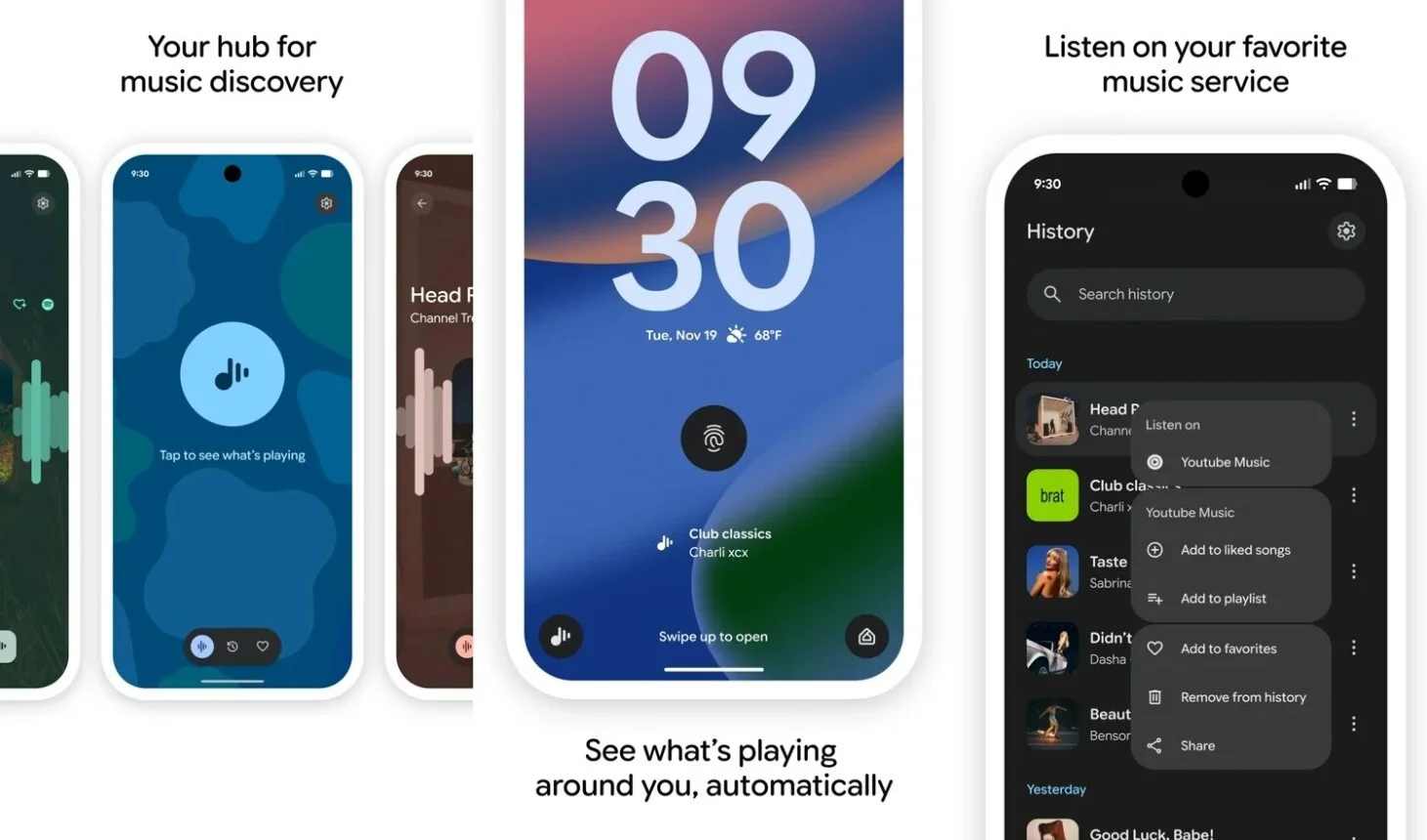
With the recent release of the March Feature Drop, Google has introduced a series of interesting novelties for owners of compatible Pixel smartphones.
Among the most significant changes is the evolution of Now Playing: the well-known music recognition feature has abandoned its role as a silent system service to become, in every respect, a standalone application.
The move to a dedicated app, in fact, has abruptly interrupted communications with several third-party utilities used for the synchronization and export of the tracks you’ve listened to.
Now Playing is now an app, but not all updates are welcome

The primary role of Now Playing has always been as essential as it is appreciated, namely identifying the music playing in the surrounding environment and keeping a record of it within a convenient history on the phone.
Although the native interface offers a tidy space to browse recognized songs, many enthusiasts prefer transferring this data to larger and more structured music platforms, such as Last.fm. To perform this operation automatically, the community has historically relied on external tools such as Pano Scrobbler or MacroDroid.
The operation of such utilities relied on a precise technical workaround: the constant monitoring of system notifications generated by the recognition function. By reading the metadata directly from the on-screen notification, the software compiled their lists ready for export.
However, with the recent transformation into a standalone application, the system has apparently deactivated the generation of these specific notifications, effectively removing the communicative bridge needed for scrobblers to extract and process the musical information.
Between intentional choices and clues in the code
In the face of this sudden limitation, reactions online did not wait. As highlighted by Reddit user birbeck1, it was initially hypothesized that the block originated from a restriction deliberately imposed by the California company.
A more technical investigation has, however, revealed a much more encouraging scenario. By examining the source code of the new application, the developer Kieron Quinn uncovered a currently inactive flag, explicitly named “NowPlaying__enable_notification_and_settings_redirect“.
The presence of this snippet in the system files indicates that the removal of notifications may be only a temporary side effect.
This discovery offers a valid hope for the future: the developers at Mountain View could simply re-enable the parameter with a software release, restoring the functionality of external synchronization tools without effort.
What to do while waiting for an official resolution
At the moment, the only concrete option for those relying on Pano Scrobbler and similar services is to be patient.
There are isolated reports suggesting that a lesser-known application called Simplescrobbler could still communicate with Last.fm despite the recent changes to the system environment. However, being a not widely tested solution, its use inevitably requires several trials.
Ultimately, the freedom to leverage clever alternative paths to extend the capabilities of one’s devices has always been one of the main attractions of the Android ecosystem.
Considering the historical importance that music recognition holds for the Pixel lineup’s identity and users’ strong attachment to these automations, it seems very likely that the company will intervene soon to remedy this annoying interruption.