


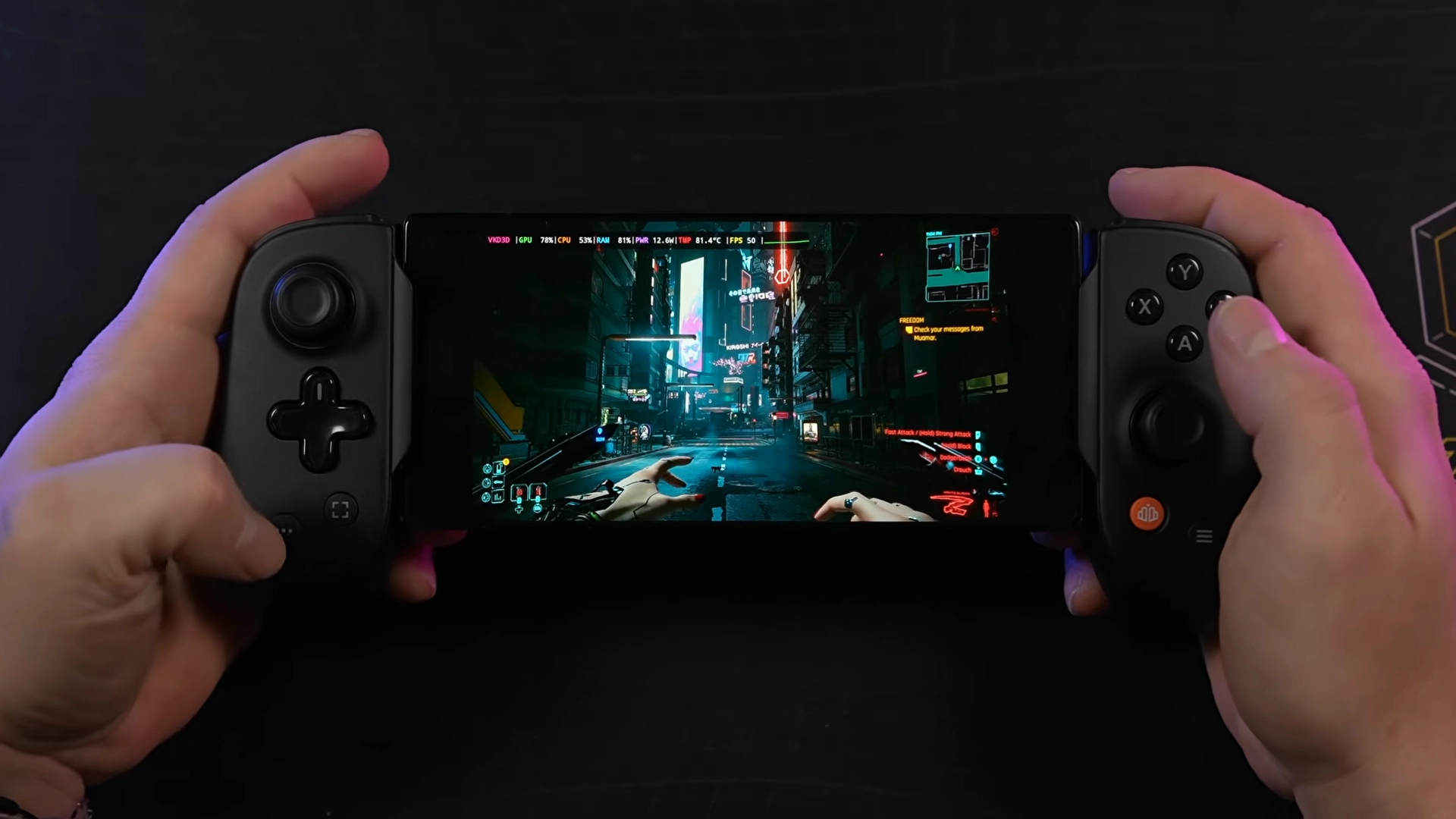
When Cyberpunk 2077 arrived on the market at the end of 2020, its complexity literally crippled the previous-generation consoles, struggling to maintain acceptable performance even on dedicated hardware.
It almost seems paradoxical that, only six years later, that graphical giant used as a benchmark for modern GPUs can be run on a device that fits comfortably in your pocket. We’re not talking about cloud gaming solutions or remote streaming from a desktop PC, but pure local processing.
A recent experiment conducted by the YouTube channel ETA Prime has shown how the joint evolution of mobile hardware and emulation software is breaking down technical barriers deemed insurmountable until recently.
No streaming, Cyberpunk 2077 runs locally on a smartphone

The subject of this test is the RedMagic 11 Pro, a device that integrates the Snapdragon 8 Elite Gen 5 processor. The choice of this specific device is not random: to handle a workload of this scale, compute power alone is not enough unless accompanied by adequate thermal management.
The smartphone in question features an active cooling system, equipped with a fan and a vapor chamber, essential for taming the temperatures generated by the SoC.
The underlying technical operation behind this result is fascinating. The game does not run natively on Android, but uses a complex translation chain through tools such as GameHub.
This software acts as a real-time interpreter, converting x86 instructions and Windows system calls into a language understandable by the phone’s ARM architecture. It is a hybrid approach that closely resembles how Proton works on Steam Deck, where DirectX graphics libraries are translated into Vulkan via compatibility layers such as Wine and DXVK.
The Android ecosystem is following the same path traced by Valve on Linux, aiming to run unmodified PC titles with ever-smaller performance losses.
Performance and graphical compromises
To achieve a playable experience, ETA Prime had to be smart with the graphics settings. By setting the resolution to 720p with low details and enabling AMD’s FSR 2.1 in Balanced mode, CD Projekt RED’s title maintained a stable framerate, oscillating between 25 and 30 frames per second. This is a remarkable result, considering we’re talking about a complex emulation on a phone.
The real technical breakthrough, however, arrived with enabling Frame Generation in the FSR. This technology allowed pushing performance well beyond the critical threshold, bringing the game into the 40 fps range and peaking at 50 in less dense areas.
Naturally, adding synthetic frames came with a small price in terms of image cleanliness, with the appearance of ghosting and some intermittent stutter, but the overall smoothness benefited greatly.
Even using the Steam Deck-oriented graphics preset, which improves texture quality and lighting, the emulation held up: although the base framerate dipped slightly, using Frame Generation brought the smoothness back to levels more than enjoyable.
The thermal challenge remains
Despite the enthusiasm for the software result, physics still imposes its insurmountable limits. The experiment showed that heat remains the main critical factor. Even with the fan at maximum speed, the processor reached peaks of 100 °C under prolonged stress, a value that tests the longevity of the components.
Resource monitoring showed a system pushed to the limit: RAM usage approached 90% (utilizing almost all of the 16 GB available), while the CPU was consistently between 60% and 80% usage.
This scenario highlights how, although the code is technically executable, energy efficiency and thermal management remain open challenges for the future.
Nevertheless, seeing a AAA title this complex run locally on a smartphone is tangible proof that the convergence between mobile and desktop platforms is accelerating, promising a future where our phones could become the only consoles we’ll need.