

The OPPO Reno series has always had a very clear objective: to stand out in a market that is often homogenized, and I must say that OPPO has always succeeded in its goal. It’s no coincidence that, this year as well, with the arrival of the new OPPO Reno 15, the brand renews this promise by delivering what, on paper, should be the ‘entry-level’ model of the family, but in practice shares a lot of the DNA of the bigger brothers in Pro version.
We are looking at a device that bets everything on the user experience and on the visual impact, offering the same design language and the same software as the more expensive variants. There is, however, a catch: the price positioning is ambitious, and this Reno 15 effectively sits as the most expensive base model launched so far by the Chinese brand. This strategic choice puts it in direct competition with highly competitive alternatives, but the numbers on the spec sheet do not tell the whole story, which I will now share with you.
OPPO Reno 15 Review
Design and Materials
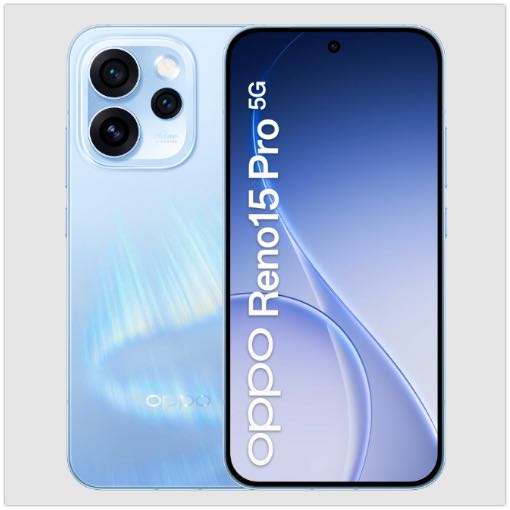
If there is one aspect where OPPO rarely misses the mark, and I’ve been saying this for years since the Reno series was limited to the Asian market, it is the aesthetics, and the Reno 15 is proof of that. The device isn’t just pleasing to look at, but introduces the HoloFusion technology, a back glass treatment that uses thousands of micro-structures to manipulate light and create a depth effect that’s almost three-dimensional.

The company has differentiated the various colorways with unique textures: there is the Aurora White version offering a more ethereal aesthetic, with a ribbon-like effect that seems to float over the chassis; or for those who prefer absolute understatement, there is also a Twilight Black version devoid of complex patterns and, in fact, rather minimalist in its details.
The evolution compared to the past is also visible in the camera module. Abandoning the pill-shaped design, the Reno 15 sports the new Dynamic Stellar Ring, a square platform that integrates perfectly into the back and, thanks to a special finish, emits a soft glow when hit by light—a detail already seen in reality on some past models, which OPPO continues to reproduce, and always with style. The lenses have been reduced in size and everything is finished with clean engravings that give the phone a decidedly modern look.

It’s not only about appearances, though—this Reno 15 also has substantial substance, especially on ergonomics, which play a fundamental role. Thanks to the flat edges, a thickness of only 7.7 mm, and a weight of 197 grams, the phone feels great in the hand and doesn’t fatigue the wrist even after long sessions. On the durability front, OPPO has done an excellent job as well, since the Reno 15 offers a full set of certifications spanning from IP66 to IP69 for water and dust protection.
Additionally, to push the premium feel, a necessary choice given the price positioning, is the chassis, made of aerospace-grade aluminum, as well as the internal shock-absorption system designed to absorb impacts and drops, which I honestly did not have the chance to test.
Hardware and Performance
Again this year OPPO puts its trust in the familiar Qualcomm solution, as under the Reno 15’s shell beats a Snapdragon 7 Gen 4. This choice places the device in a clearly defined mid-range: a handset designed to deliver smoothness and reliability for daily use, but without ambitions of monster power. Make no mistake: for the typical user—social, messaging, web browsing and light multitasking—the experience is overall positive, with apps opening quickly, smooth feed scrolling, and no stutters that would ruin daily use.

The discussion changes when you shift focus to demanding gaming, where the chip’s natural limits emerge, which leads to the classic questions: is it worth spending 599 euros on a new mid-range, or perhaps the same amount (or even less) on a former top-tier model, perhaps one or two years old? Also because, while this Qualcomm solution is reliable, we’re not dealing with a processor born for high-end gaming: titles like Call of Duty Mobile or PUBG run smoothly at 90fps only by lowering details; if you seek higher visual fidelity with graphically demanding titles, the frame rate stabilizes around 30–35fps, a playable but far from competitive.
Regarding memory configurations, OPPO brings to Italy a single 8GB RAM + 512GB storage variant, perhaps a bit limited for some; the good news is that if you’re accustomed to buying from China, you could also opt for a 16GB RAM variant with up to 1TB of internal storage, still not expandable via microSD.
On the connectivity front, the phone supports two physical SIMs, in addition to the now-standard eSIMs. Excellent reception, good call quality, and great Wi‑Fi speed that supports up to Wi‑Fi 6, and no higher.
Software
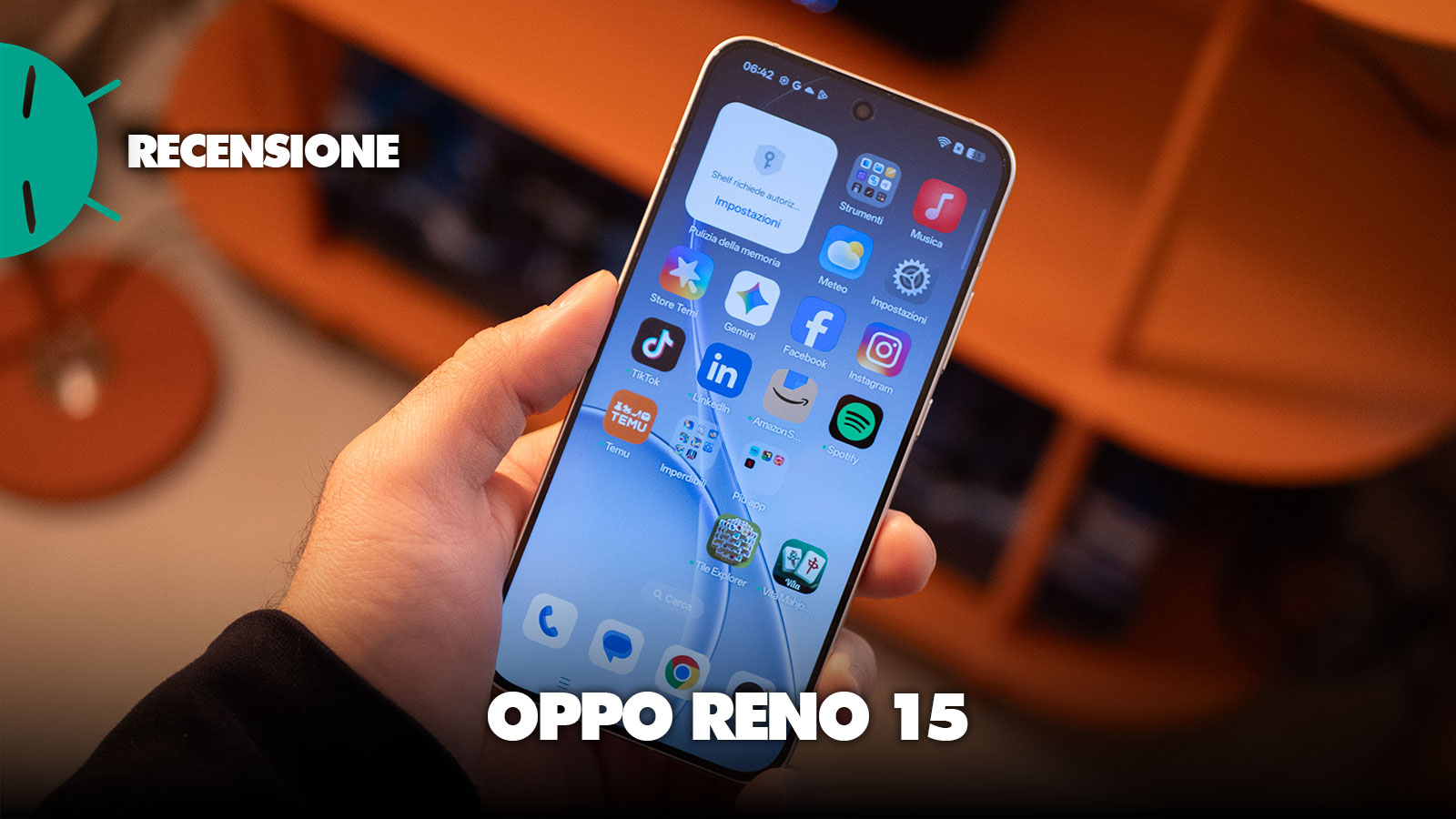
Powering everything is ColorOS 16 based on Android 16, an interface that has reached a notable level of maturity and continues to improve year after year. I’ve never hidden that this UI is among my favorites, especially visually, and it’s no accident that navigating the menus here is a truly pleasant experience: OPPO has worked a lot on code cleanliness and on animations, which are always smooth and snappy, delivering that sense of immediacy that the savvy user seeks. Customization options are as abundant as ever, allowing users to practically tailor the device to their liking.
Battery Life
There is one area where the Reno 15 truly flips the script: autonomy. OPPO has managed to fit a substantial 6,500 mAh battery, increasing capacity without adding bulk to the design or making the phone overly thick. Real-world results are excellent: whether you’re navigating with GPS, using it as a hotspot, or gaming, the device holds up well, taking you to the evening with a healthy remaining charge.
When more power is needed, the 80W SuperVOOC can take you from 0 to 100% in just under an hour, although the charger itself isn’t included in the box, as is traditional.
Price and Considerations
The crucial factor when talking about OPPO is inevitably price. OPPO Reno 15 lands in Italy with a price tag of 599 euros, a substantial figure that places it in a highly competitive tier and could disappoint those who evaluate a smartphone purely by processor GHz. It’s clear that OPPO is selling not just specifications, but a complete package built on design, premium materials, and reliability.
Of course, the aggressive launch offer designed to amortize the initial investment is compelling: by subscribing to the newsletter you can immediately get a 30 euro discount, and at purchase you can also receive a bundled accessory of your choice among the TWS OPPO Enco Buds3 Pro (available in Glaze White or Graphite Grey) or, for those on the move, a practical 10,000 mAh magnetic Power Bank.
In conclusion, the Reno 15 is the ideal choice for a more “smart” and style-conscious audience who wants a device that looks good, can take excellent portraits, and is backed by a battery that seems never-ending. If your priority is benchmarks and raw power, you might want to look elsewhere.
I link di acquisto presenti in questo articolo generano una piccola commissione per GizChina.it. Scopri tutti i dettagli qui.
Se non visualizzi correttamente il box qui sotto, prova a disattivare AdBlock.