


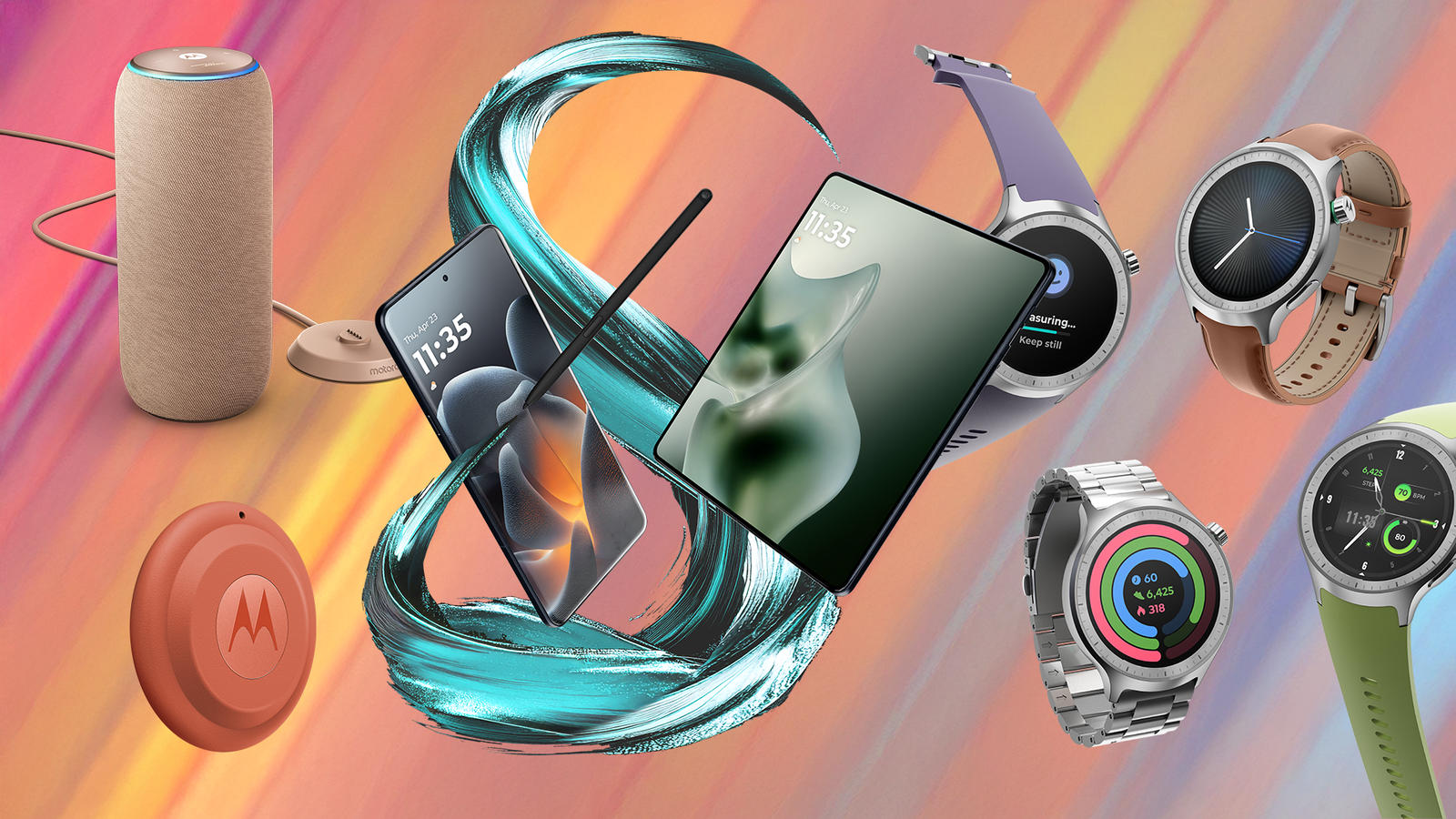
The CES (Consumer Electronics Show) 2026 in Las Vegas was the stage chosen by Motorola to redefine its strategy in the high-end segment of the mobile market.
The company, part of the Lenovo group, presented a portfolio of products spanning from new form factors to novel smartphone lines, accompanied by an ecosystem of interconnected accessories and new AI platforms.
The event marked the debut of the brand’s first book-style foldable device, the Motorola razr fold, and the introduction of the Signature series, designed to compete directly in the premium tier.
All Motorola announcements at CES 2026

Is the Motorola razr fold the foldable you were waiting for?
The most significant novelty in terms of form factor is undoubtedly the Motorola razr fold. If until now the name “razr” was synonymous with clamshell devices, with this new model the company enters the large-format foldables segment, designed for productivity and multimedia entertainment.
The device presents a slim profile that houses two distinct displays: a 6.56-inch external screen, which provides the experience of a traditional smartphone when the device is closed, and an 8.09-inch internal foldable panel.
The main display uses LTPO technology with 2K resolution, offering a broad workspace that Motorola has optimized through adaptive interfaces and flexible layouts.
These software solutions are designed to take advantage of the screen size, facilitating multitasking and the use of the Moto Pen Ultra stylus, an accessory supported by the device for writing and drawing.


The AI integration plays a functional role in the user experience: the device includes on-device features such as Catch me up and Next Move, designed to organize information and improve daily efficiency for the user.
From a photography standpoint, the razr fold incorporates a triple rear camera system of 50 MP each. The main module is based on a Sony LYTIA sensor, paired with an ultra-wide lens that also serves as a macro, and a periscopic telephoto with 3x optical zoom.
This configuration allows coverage of multiple focal lengths, maintaining high resolution across all shots. For the front cameras, the device features two: an external 32 MP one usable when the phone is closed, and an internal 20 MP one for video calls with the screen open. The video section supports Dolby Vision recording and includes advanced stabilization systems.
The color variants announced at launch are two, both drawn from the Pantone catalog: Blackened Blue and Lily White.
Is Motorola Signature enough to compete in the premium tier?
Alongside the foldable, Motorola launched a new family of products named Motorola Signature. The first smartphone in the series was described by the company as the most complete and sophisticated device ever made by the brand, positioning itself in a market tier that demands premium materials and top-tier specifications.
The design stands out for a thickness of just 6.99 mm, making it the thinnest quad-curved display device in its category. The chassis combines an aerospace-grade aluminum frame with back finishes inspired by twill or linen fabric, available in Pantone Martini Olive and Pantone Carbon.
The technical spec of the Motorola Signature is powered by the Snapdragon 8 Gen 5 mobile platform (not Elite unfortunately) at 3nm, enabling high computational performance and supporting generative AI features directly on the device. To manage temperatures in such a slim chassis, Motorola has implemented a liquid-metal cooling system with a copper lattice.
The display is an Extreme AMOLED unit of 6.8 inches with Super HD resolution (which provides 14% more pixels than standard Full HD) and a refresh rate up to 165 Hz. The peak brightness is rated at 6200 nits, validated by Pantone SkinTone for color fidelity.


The Signature camera system has received particular attention, earning the DXOMARK Gold Label recognition.
According to the winged brand, it is the first ultrathin smartphone to integrate four 50 MP cameras. The main sensor is a Sony LYTIA 828, capable of recording video up to 8K resolution and in Dolby Vision 4K. Complementing it is a periscope telephoto with 3x optical zoom based on a Sony LYTIA 600 sensor, a 122-degree ultra-wide lens (also usable for macro) and a 50 MP front camera with a Sony LYTIA 500 sensor.
Despite the slim profile, the battery is a silicon-carbon 5200 mAh cell, promising up to 52 hours of use. The charging system supports 90W TurboPower wired charging, capable of powering a day in about 7 minutes, and 50W wireless charging.
Durability is certified by IP68 and IP69 standards against water and dust, along with MIL-STD-810H military standard compliance and Corning Gorilla Glass Victus 2 protection. Software-wise, the device ships with Android 16 and the promise of seven years of updates for both the operating system and security patches.
Motorola razr 60 FIFA World Cup 26 Edition is in limited edition and you won’t be able to have it
Ahead of the upcoming football World Cup, Motorola unveiled a special edition of its clamshell foldable: the Motorola razr 60 FIFA World Cup 26 Edition.
This model celebrates the company’s partnership as the official smartphone supplier for the tournament and stands out with a dedicated aesthetic. The rear panel features a green color with geometric shapes and a soft texture, inspired by the official branding of the competition and the energy of the game.
Technically, this special edition maintains the core features of the razr 60 series, including the intelligent external display and Moto AI features.

The build includes a titanium-reinforced hinge and offers water and dust resistance rated IP48. The integrated battery is 4500 mAh.
On the software side, the device includes exclusive customizations such as themed wallpapers, official tournament ringtones, and the ability to apply a FIFA watermark to photos taken.
Note that the commercialization of this variant will be geographically limited: the device will be available exclusively in the United States and Canada markets starting February.
The Moto Things ecosystem and the new frontiers of AI
In addition to smartphones, Motorola has significantly expanded its range of connected accessories under the moto things umbrella, introducing four new devices designed to integrate with the brand’s phones.
The audio segment sees the introduction of the moto sound flow, a portable speaker that integrates Sound by Bose technology and support for dynamic spatial audio. A distinctive feature of this speaker is the integration of Ultra-Wideband (UWB) technology, enabling advanced listening continuity features.
For example, the Dynamic Stereo function adjusts the left and right audio channels based on the user’s physical position relative to two paired speakers, while RoomShift automatically transfers sound to the nearest speaker when the user moves from one room to another with their phone. The device delivers 30W of power, IP67 certification and a 6000 mAh battery.


In the wearable sector, Motorola has forged a strategic partnership with Polar to develop the new moto watch.
This smartwatch, featuring a 47 mm round dial and aluminum case, integrates Polar’s health and fitness tracking algorithms, offering detailed analyses on training, recovery and sleep quality. The device promises up to 13 days of autonomy and includes a dual-frequency GPS for greater accuracy in outdoor activities, plus water resistance up to 1 ATM.


For creative productivity, the moto pen ultra was introduced. This stylus is designed to work in synergy with the new Signature smartphones and the razr fold. It supports pressure levels and tilt detection for a natural stroke and includes a button for quick access to a software toolbar.
Among the smart features are Sketch to Image, which transforms sketches into elaborate images via AI, and Quick Clip for quick content selection.


Completes the lineup of accessories with the moto tag 2, a Bluetooth and UWB tracker powered by the Google Find Hub network.
This small device promises over 500 days of autonomy and includes a multifunction button that can be used to ring the missing phone or as a remote shutter for the camera.


Finally, on the software platform front, Lenovo and Motorola announced Motorola Qira, a unified AI solution.
This platform aims to consolidate the various AI tools from the two brands under a single interface, capable of maintaining the context of user operations across multiple devices. As a demonstration of the technology’s future potential, Project Maxwell, a wearable device concept developed by 312 Labs, was shown.
Project Maxwell is conceived as a perceptive personal assistant that, worn and usable hands-free, analyzes the surrounding environment through audio and visual sensors to provide real-time contextual information, anticipating the user’s needs without requiring direct input on a screen.